Court convicts Obado, Oyamo and Obiero of Sharon Otieno’s murder

Former Migori Governor Okoth Obado and the late Sharon Otieno
A High Court verdict closes a seven-year chapter in one of Kenya’s most closely watched criminal trials — and ends the political career of a man who once commanded one of the country’s most powerful county governments
By MKT Reporter
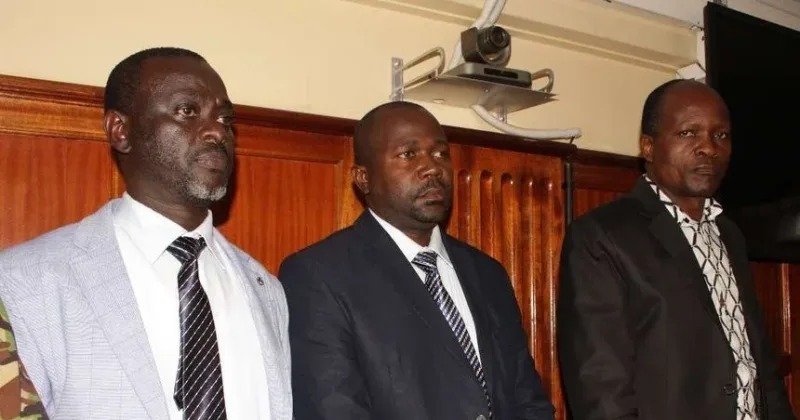
The High Court convicted former Migori Governor Okoth Obado, his former personal assistant Michael Oyamo and former Migori County Clerk Caspal Obiero on Thursday of the 2018 murder of Sharon Otieno, a university student who was seven months pregnant when she was abducted and killed, bringing to a close one of the most gripping and consequential criminal trials in Kenya’s post-devolution history.
Justice Cecilia Githua, delivering judgment at the Milimani Criminal Division in Nairobi, ruled that the prosecution had proved its case beyond reasonable doubt and that all three accused had acted with common intention to murder Otieno. “It is therefore my finding that the prosecution has proved this case against the first accused, the second and the third accused persons beyond reasonable doubt,” Githua ruled. “I consequently find each accused person guilty of the offence of murder contrary to Section 203 of the Penal Code as charged in Count One. Each accused is accordingly convicted under Section 322 of the Criminal Procedure Code.”
The judge ordered the trio remanded in custody immediately. The matter will return to court on 18 August 2026 for a pre-sentence report, with the hearing to be conducted virtually. Murder carries a maximum penalty of death in Kenya, though such sentences are rarely imposed. Their bonds, which had allowed them to move freely for years during the trial, were cancelled on the spot.
Obado had arrived at the Milimani Law Courts that morning in his Lexus, greeted supporters outside and walked calmly into the courtroom. By the end of the day, court orderlies were escorting him to a prison van. Nearly eight years after regaining his freedom pending trial, a murder conviction transformed his legal status in a matter of minutes. It was a journey that compressed the entire arc of his public life into a single afternoon.
To understand the weight of Thursday’s verdict, it is necessary to trace how far Obado had come — and how steeply he had fallen. A self-made grassroots politician, Obado rose from representing sugarcane farmers in South Nyanza to becoming Migori’s inaugural governor. He began his working life as a sugarcane farmer before training as a teacher, graduating from Kenyatta University with a Bachelor of Arts in Education and later earning a Master’s degree in Strategic Management from the same institution. He served as principal of Chung’e Secondary School before entering elective politics, and later became chairman of the Kenya Sugar Board. Those were the years in which he constructed the grassroots authority that would eventually carry him to the pinnacle of county governance.
In the 2013 general election, Obado contested for the governorship on a People’s Democratic Party ticket, defeating ODM candidate Prof. Oyugi Akong’o — a remarkable achievement in a region where ODM’s dominance had long been treated as an immovable political fact. His election victory was challenged in court, prompting a recount, but the outcome was upheld and he was confirmed as Migori’s first governor under the devolved system. Ahead of the 2017 general election, he again fought fierce internal battles within ODM before securing the party’s gubernatorial ticket, going on to defeat his longtime rival Ochilo Ayacko and earning a second five-year term.
In his heyday, Obado’s supporters referred to him as Obado Sirkal — equating him to the power of the national government itself — and were eager to defend him at all costs. So dominant was his influence that he openly challenged ODM leader Raila Odinga’s regional supremacy without attracting the full wrath of Raila’s supporters, a rare act of defiance in Nyanza politics. In the rough and murky politics of South Nyanza, Obado traversed the political landscape like a colossus — a commanding political force wrapped in a remarkably polite and soft-spoken demeanour, a study in contrasts whose supporters’ faith in his leadership rarely wavered.
Yet even before Sharon Otieno’s name entered the public consciousness, there were fractures beneath the surface. His first term was marked by allegations of corruption and financial mismanagement, including claims of irregular procurement of ambulances amounting to KSh230 million and expensive furnishing of his official residence approximated at around KSh20 million. His supporters frequently clashed with those of his longtime political rival Ayacko. One of the most notable incidents occurred during the 2017 election campaign when violence erupted at an ODM rally in Migori. Kisumu Governor Anyang’ Nyong’o was forced to take cover beneath a podium, while former Mombasa Governor Hassan Joho’s bodyguard was shot and injured. Obado was a man of formidable political energy — but that energy, observers noted in retrospect, was not always disciplined.
Then came September 2018, and everything changed.
On the morning of 5 September 2018, Kenya woke to the brutal killing of a 26-year-old university student, her body found dumped in a thicket in Owade village in Homa Bay County. Sharon Belyne Otieno, a Rongo University student, was 28 weeks pregnant when she was killed alongside her unborn child. A post-mortem revealed she had possibly been sexually assaulted and stabbed eight times in the neck, abdomen and back.
The court found that Sharon’s pregnancy was the engine of everything that followed. Justice Githua ruled that Obado had pressured Otieno to terminate the pregnancy, allegedly giving her KSh30,000 to procure an abortion. Sharon declined after consulting her mother and resolved to keep the child. “The totality of the evidence adduced in this case shows that this particular pregnancy formed the basis of subsequent events, which culminated in the unlawful death of the deceased,” the judge said.
The court found that Obado supplied the motive, instigation and funds to finance the killing, while Obiero provided logistical support and concealment to avoid detection. Oyamo, the court found, convened a meeting to deliver Otieno to her killers. Prosecutors told the court that the evidence demonstrated planning, facilitation, execution and a cover-up, arguing that Sharon’s pregnancy posed “a real and imminent threat” to Obado’s public standing. Justice Githua held that Obado’s physical absence from the scene of the murder did not diminish his criminal responsibility, because the accused had acted in concert with others not before the court.
The judgment rested on circumstantial evidence drawn from 42 prosecution witnesses and 81 exhibits. Justice Githua found that the prosecution had established an unbroken chain linking the accused to the offence. “I am satisfied that the circumstances presented in this case, taken cumulatively, form a chain so complete that there is no escape from the conclusion that the accused persons, jointly with others not before the court, committed the offence charged,” she ruled.
The court rejected Obado’s claim that he had accepted the pregnancy, finding instead that the evidence demonstrated sustained pressure on Otieno to terminate it. The court noted that on Obado’s own admission, he learned about Sharon’s pregnancy in March 2018 — the same month he claims to have terminated, or decided to terminate, his relationship with her. The judge found that sequence deeply telling.
In his defence, Obado had been unequivocal. “I did not kill Sharon Otieno. I did not conspire with my two co-accused persons or anyone to kill the late Sharon Otieno. I did not procure anybody to kill the late Sharon Otieno,” he told the court. He admitted to the romantic relationship and acknowledged paternity of the unborn child, but said he had ended the affair, had no intention of marrying Otieno and had continued providing her with financial support. The court found that financial support, even if genuine, did not undo the weight of evidence that he had sought to suppress the pregnancy before it could damage his political standing.
The murder charge was not the only legal battle consuming Obado’s post-gubernatorial years. In 2021, Obado, his four children and others were charged over an alleged conspiracy to defraud Migori County of about KSh505 million through economic crimes, money laundering and conflict of interest. The case centred on allegations of systematic looting of county resources through fraudulent procurement arrangements, with prosecutors accusing Obado of abuse of office, conspiracy to commit economic crimes, money laundering and illegal acquisition of public assets. Specific allegations centred on the misappropriation of approximately KSh73 million in county funds through fictitious contracts. In September 2025, the Office of the Director of Public Prosecutions announced recovery of KSh235.6 million in assets from Obado and 17 co-accused following a plea bargain. The High Court allowed the DPP to withdraw the corruption charges after adopting the plea bargain agreement as a judgment of the court in May 2026. That settlement, which had appeared to offer Obado a measure of legal relief, now sits in the shadow of a murder conviction.
His political repositioning in those years told its own story. From 2021, Obado’s relationship with ODM leadership deteriorated once again. He gradually gravitated toward the People’s Democratic Party while publicly aligning himself with William Ruto’s United Democratic Alliance, despite maintaining that the two parties had no formal arrangement. He emerged as one of Ruto’s key allies in Nyanza, actively supporting UDA’s expansion in the region ahead of the 2022 general election. Despite that loyalty, Obado did not secure a government appointment after Ruto became President. Within ODM circles, he had become an unwanted figure. A senior ODM official told reporters they did not recognise him, adding that Obado was the architect of his own downfall.
The isolation was social as much as political. Once revered as Obado Sirkal, a grassroots giant who dared to defy even Odinga, the former governor faced a reckoning marked by court battles, asset seizures and social exile. His home in Uriri, which had once been a meeting point for supporters, was described as deserted. “He no longer holds power, and many have abandoned him. These days, when he leaves public events, nobody bothers to accompany or follow him,” a neighbour was reported as saying.
Sharon’s family, who had travelled repeatedly from western Kenya across nearly eight years of hearings — funding their own transport and accommodation to Nairobi each time the case came up — received the verdict quietly from their side of the courtroom. “Our girl is gone, but we finally got justice,” a family member said outside the court. Sharon’s father told reporters they now awaited sentencing, uncertain whether the court would impose a short or lengthy term. “That worries us,” he said, adding that the family would determine next steps once sentencing was complete.
Obado’s arrest and prosecution made him the first serving governor in Kenya to face charges related to a capital offence. His conviction on Thursday extends that grim distinction: he is now the first former governor to be found guilty of murder by a Kenyan court. The verdict, and the accountability it represents — however delayed — carries implications for how Kenya’s judiciary and public institutions handle the intersection of political power and serious criminal conduct.
The case also restored, at least partially, something that had been in danger of being lost. For years, Sharon Otieno’s name had been attached primarily to a political scandal, her identity filtered through the controversies of a powerful man. Thursday’s verdict returned the story to its centre: a 26-year-old student and her unborn child, whose lives were taken to protect a secret, and whose family spent nearly a decade demanding that the law take notice.
The sentencing hearing is expected on 18 August 2026, following the submission of a pre-sentence report. Whatever term the court ultimately imposes, the conviction itself is irreversible at this stage — a finding of fact, entered into the record, that one of South Nyanza’s most powerful politicians ordered the death of a young woman who refused to disappear quietly. For the man who once arrived at court in a Lexus to cheers from his supporters, the road ahead leads somewhere very different.
Similar Posts by The Mt Kenya Times:
- Mt Kenya Times ePAPER September 19-20, 2026
- Kenya joins US and UK to put citizens on the terrorism frontline
- Kenya’s parliament races to tame the AI frontier
- Kalonzo calls Ruto to order over Uhuru attacks
- Gachagua takes his 2027 campaign to America
About the Author