Kenya’s KSh995.7 billion borrowing plan risks squeezing credit for small bus
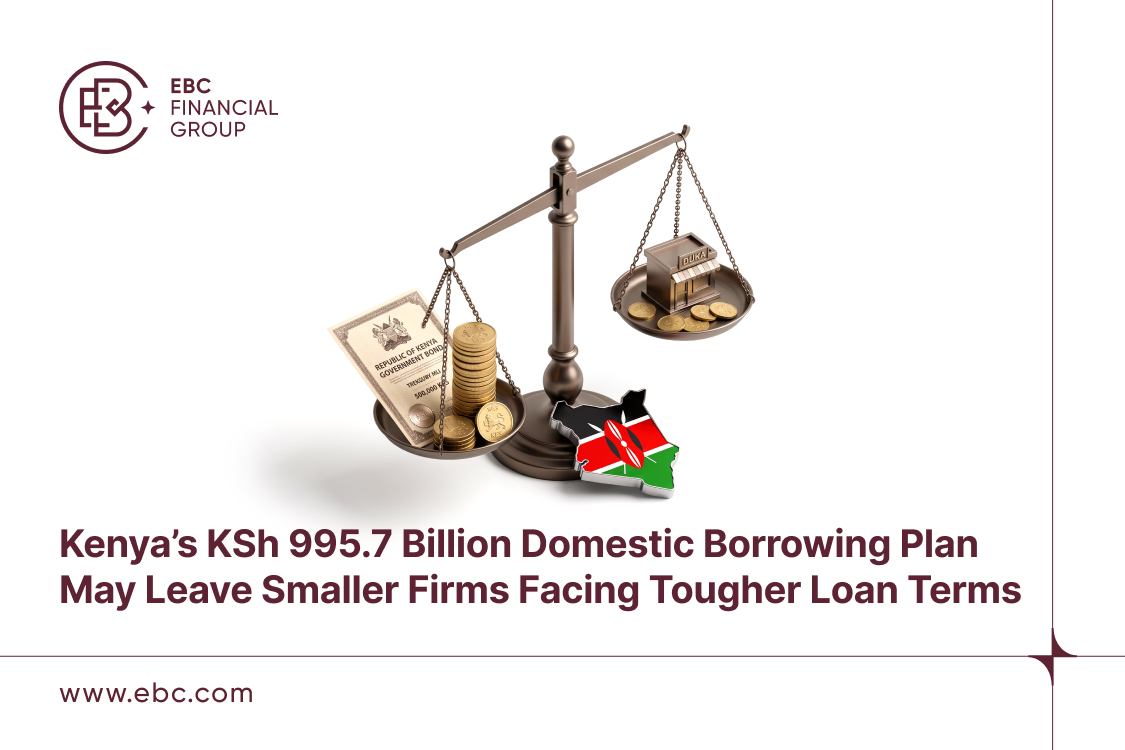
As the government turns to domestic markets to plug a trillion-shilling deficit, analysts warn banks may tilt toward safer government paper and away from riskier small-business lending
By MKT Reporter
Kenya’s plan to raise KSh995.7 billion from domestic investors in the 2026/27 fiscal year could make it harder for smaller businesses to access affordable credit, according to an analysis by EBC Financial Group, even as headline lending figures show an economy recovering from a bruising credit drought.
The National Treasury’s budget summary for the current fiscal year puts Kenya’s deficit at KSh1.112 trillion — equivalent to 5.3 percent of gross domestic product. With net external financing covering only KSh116.2 billion of that gap, the burden of funding the remainder falls squarely on local investors, primarily through Treasury bills and bonds.
The concern, as EBC Financial Group frames it, is not that domestic borrowing is inherently damaging, but that it introduces a set of incentives that may not favour the businesses that need credit most. Government securities offer banks a predictable, low-maintenance return without the due diligence burden — credit checks, cash flow assessments, collateral valuations — that a business loan demands. When government paper is abundant, banks may simply choose the easier option.

David Precious, senior market analyst at EBC Financial Group, put it plainly. “Treasury bills and bonds can offer banks a more predictable return without the same level of company checks required for a business loan,” he said. “Smaller businesses could face stricter terms even while total private-sector credit grows.”
The numbers underlying that concern are striking. Commercial banks already held approximately KSh2.2 trillion in government securities in March 2026 — roughly 27 percent of total banking-sector assets, according to the World Bank’s July 2026 Kenya Economic Update. More than a quarter of the sector’s balance sheet was therefore already parked in government debt before the new borrowing programme began. The World Bank warned directly that heavier domestic borrowing risks crowding out private-sector credit and dragging on investment and economic demand.
For micro, small and medium enterprises, the practical consequences could be immediate. The Central Bank of Kenya’s 2024 survey on MSME access to bank credit found that term loans and overdrafts account for more than 85 percent of small-business lending, and that collateral remains the single largest barrier to formal credit. Micro-enterprise loans already carry shorter repayment periods because lenders consider these borrowers riskier. A manufacturer weighing a machinery purchase may walk away if the loan on offer is too small or must be repaid faster than the investment can generate returns. A distributor may cut stock orders if its overdraft facility is trimmed.
The headline credit data presents a more optimistic picture, but analysts caution against reading it too broadly. The Central Bank’s Monetary Policy Committee reported annual private-sector credit growth of 8.1 percent in March, a sharp reversal from the negative growth recorded in early 2025, while average lending rates had declined to 14.7 percent. The bank’s December 2025 monetary policy statement projected credit growth reaching 10.6 percent by December 2026.
Growth in aggregate lending, however, does not reveal where that credit is flowing. Lower average rates offer little to a business that cannot meet collateral requirements or secure sufficient funding in the first place.
Banks face an additional headwind. Gross non-performing loans stood at 15.6 percent of total lending in March, down from 17.4 percent a year earlier but still high enough for the World Bank to describe the condition of bank loan books as a key vulnerability. A sector carrying that level of bad debt has strong institutional reasons to be cautious — to demand more collateral, apply tighter lending criteria, and favour borrowers with demonstrable repayment capacity.
 Looming capital requirements add another layer of pressure. Under the Banking Act, minimum core capital requirements are set to rise from KSh1 billion in 2024 to KSh10 billion by the end of 2029. The Treasury’s current budget statement proposes extending that deadline to December 2032 and removing annual milestones — a concession that gives smaller lenders more room to manoeuvre, but does not alter the destination. Banks building toward a KSh10 billion capital floor may be reluctant to extend loans that carry meaningful default risk.
EBC Financial Group’s analysis is careful not to predict catastrophe. Government borrowing and business lending can, in principle, grow simultaneously. The critical question is whether that growth is distributed evenly or concentrated among large companies and well-collateralised borrowers who would have accessed credit regardless.
The answer, analysts suggest, will not be found in the headline figures. If private-sector credit expands while MSME lending stagnates, the crowding-out concern will have moved from theoretical risk to measurable reality — and Kenya’s 7.4 million small enterprises will be the ones left counting the cost.
Similar Posts by The Mt Kenya Times:
- Mt Kenya Times ePAPER September 19-20, 2026
- Kenya joins US and UK to put citizens on the terrorism frontline
- Kenya’s parliament races to tame the AI frontier
- Kalonzo calls Ruto to order over Uhuru attacks
- Gachagua takes his 2027 campaign to America
About the Author