Digital Gag Law On Ice: Court Halts Controversial Cyber Harassment Clause
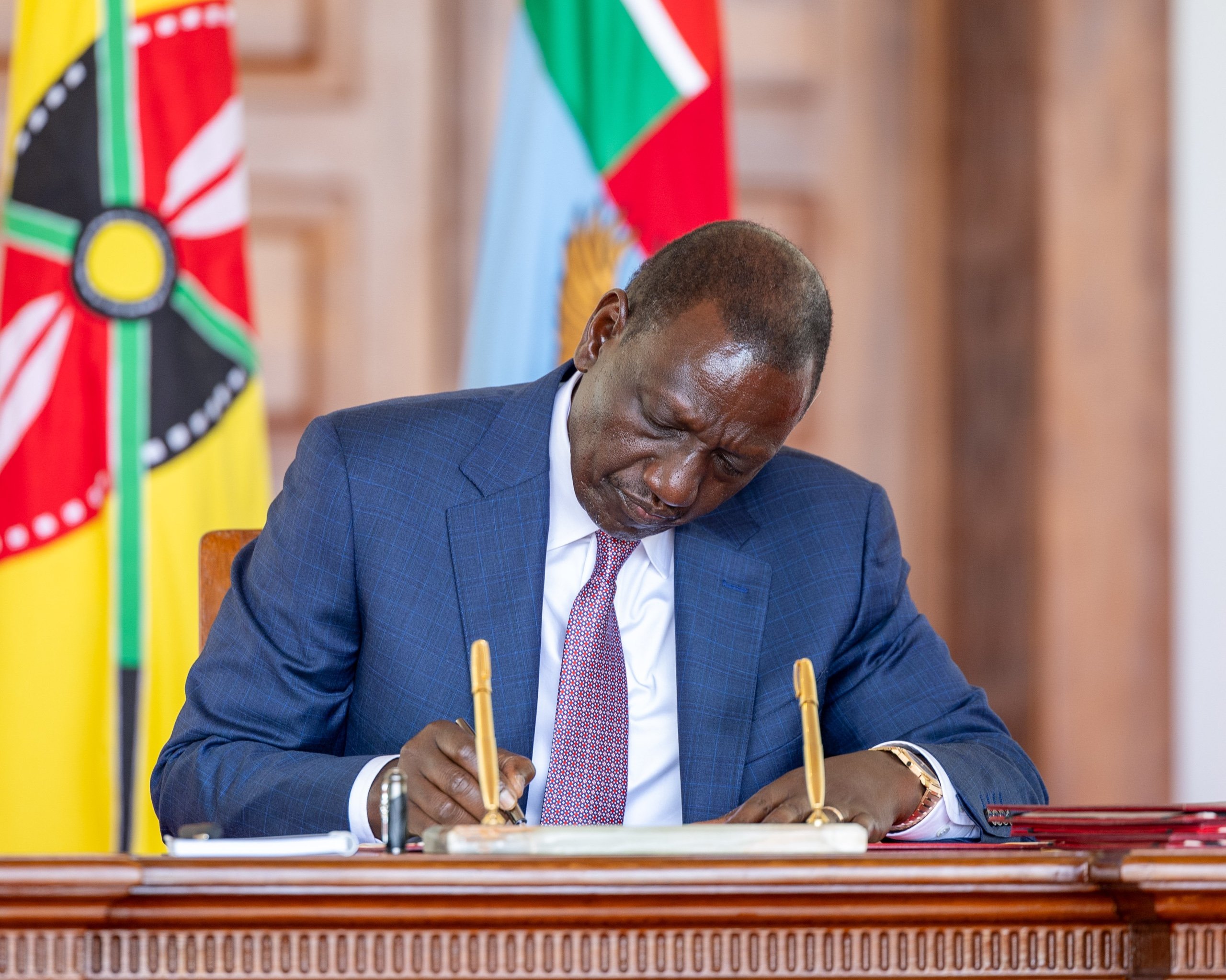
President William Ruto signing Bill into law
By MKT Reporter
In a landmark ruling that has sent ripples through Kenya’s legal and digital landscapes, the High Court has issued a conservatory order suspending the enforcement of a contentious section of the newly enacted Computer Misuse and Cybercrimes (Amendment) Act, 2025. The suspended provision, Section 27, criminalizes cyber harassment, but critics argue it poses a grave threat to freedom of expression and digital rights.
The ruling, delivered yesterday, by Justice Lawrence Mugambi at the Milimani Law Courts, comes in response to a constitutional petition filed by the Kenya Human Rights Commission (KHRC) and former presidential aspirant and human rights advocate Reuben Kigame. The petition challenges the constitutionality of the amended law, particularly Section 27 (1)(b), (1)(c), and (2), which they claim are overly broad, vague, and susceptible to abuse by state actors.
Justice Mugambi’s ruling temporarily halts the enforcement, implementation, and operation of these clauses pending the full hearing and determination of the petition. The court emphasized the need to preserve constitutional rights while the matter is under judicial consideration. “Pending the hearing and determination of this application, a conservatory order is hereby issued suspending the enforcement, implementation, and operation of Section 27 (1)(b), (c), and (2) of the Computer Misuse and Cybercrimes (Amendment) Act, 2025,” Justice Mugambi stated in his ruling.
The petition was spearheaded by Reuben Kigame, a gospel musician, activist, and former presidential candidate, alongside the KHRC. In their submission, they argued that the amended law infringes on fundamental freedoms enshrined in the Constitution, including the right to freedom of expression, access to information, and media freedom. Kigame, who has long championed civil liberties, expressed concern that the law could be weaponized to silence dissent and criminalize legitimate criticism of public officials. “This law is a digital muzzle. It criminalizes speech under the guise of protecting against harassment, but in reality, it threatens the very fabric of our democracy,” Kigame said in a statement following the court’s decision.
The Computer Misuse and Cybercrimes (Amendment) Act, 2025, was signed into law by President William Ruto on October 15, 2025. The government has defended the amendments as necessary tools to combat the rising tide of cyberbullying, online fraud, and digital misinformation. Proponents argue that the law is designed to protect citizens—especially women and children—from online abuse and to ensure responsible use of digital platforms. However, critics say the law’s language is too vague and could be interpreted to criminalize satire, parody, or even investigative journalism.
Legal scholars and digital rights advocates have welcomed the court’s decision as a timely intervention. According to constitutional lawyer Mercy Wanjiku, the ruling underscores the judiciary’s role as a guardian of civil liberties. “The court has rightly recognized that laws affecting fundamental freedoms must meet the highest standards of clarity and necessity. Vague laws are dangerous because they give too much discretion to law enforcement,” Wanjiku explained. Others have pointed out that the law’s broad definitions could have a chilling effect on online discourse, particularly in an era where social media has become a vital platform for political engagement and activism.
Kenya has long been viewed as a regional leader in digital innovation, with a vibrant tech ecosystem and a highly engaged online population. However, the country has also witnessed increasing attempts to regulate online spaces, often under the pretext of national security or public morality. This is not the first time the Computer Misuse and Cybercrimes Act has come under legal scrutiny. In 2020, parts of the original Act were challenged in court, with civil society groups arguing that it infringed on constitutional rights. The current amendment, critics say, is a continuation of that trend.
The court has set a strict timeline for the progression of the case, with hearings expected to commence in the coming weeks. In the meantime, the suspended sections of the law will remain unenforceable. If the court ultimately rules in favor of the petitioners, it could set a powerful precedent for digital rights in Kenya and beyond. Conversely, if the law is upheld, it may embolden other governments in the region to adopt similarly restrictive measures.
The ruling has sparked a flurry of reactions on social media, with hashtags like #DigitalFreedom and #CyberLaw trending across Kenyan Twitter. Many users praised the judiciary for standing up for civil liberties, while others expressed concern about the potential for online abuse in the absence of legal safeguards. “We must find a balance between protecting people from online harm and preserving our right to speak freely,” tweeted one user. “This is a win for democracy. We cannot allow the state to dictate what is ‘true’ or ‘false’ online,” wrote another.
As Kenya grapples with the complexities of regulating digital spaces, the suspended cyber harassment clause serves as a cautionary tale. While the need to address online abuse is undeniable, the tools used must be precise, proportionate, and respectful of constitutional rights. The High Court’s decision is a reminder that in a democracy, even the most well-intentioned laws must be subject to scrutiny. As the legal battle unfolds, all eyes will be on the judiciary to determine whether Kenya’s digital future will be one of freedom—or fear.
Similar Posts by The Mt Kenya Times:
- Mt Kenya Times ePAPER October 20, 2026
- Ruto rallies Kalenjin elders in Rift Valley unity push
- Sonko bid to nullify impeachment judgments fast-tracked in court
- Arrest the sponsors, not just the foot soldiers, Kalonzo tells police
- Police and politics shut down Kitale’s busiest market
About the Author