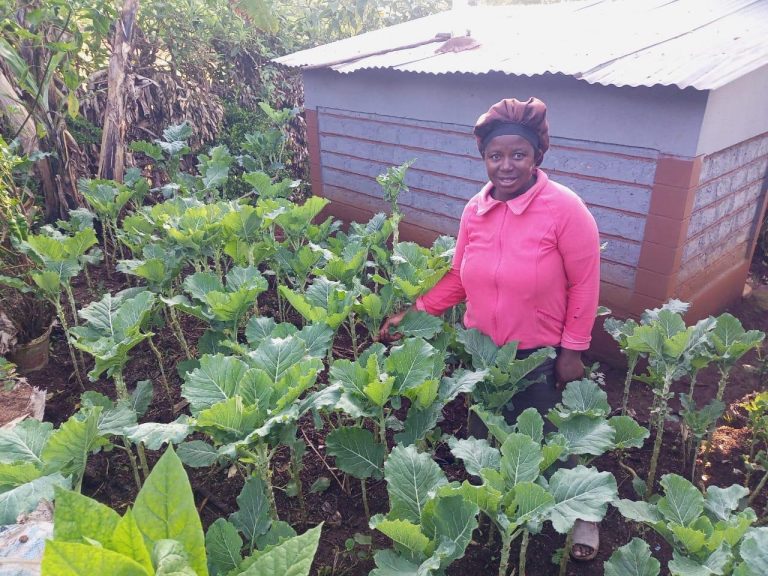
Farmers Turn To Black Soldier Fly Farming For Economic Relief And Environmental Sustainability Amid Climate Change Challenges
 The Mt Kenya Times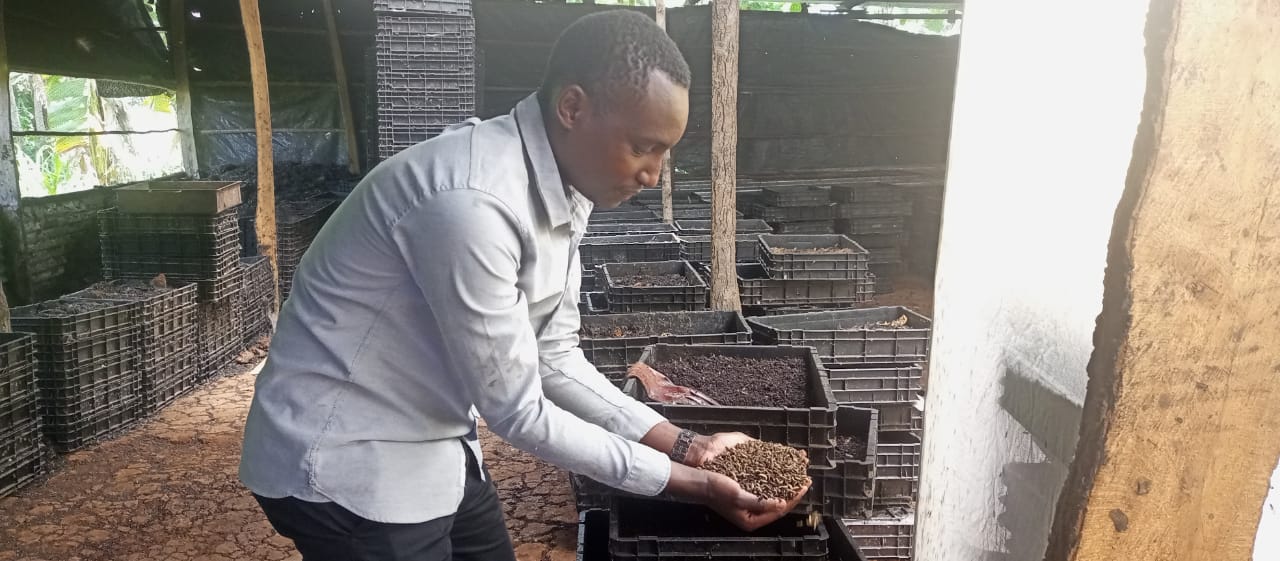
Felix Ombati attending to black soldier fly says that the farming is cheap to start, most of the products they use are wastes. Photo credit |Elizabeth Angira
By Elizabeth Angira
Worth Noting:
- According to Mr Ombati he started the project on 2021, the cost only he uncured was the purchase of cage which costed him Ksh 8000.
- “I did not start with huge amount of money, I used the basins and buckets I had at that time,” he says.
- According to The International Centre of Insect Physiology and Ecology (icipe), has led the way in incorporating insects as alternative, more affordable, nutritious and sustainable protein options in animal feed.
- In particular, the Centre has demonstrated that black soldier fly larvae or the proteins derived from them, can be used safely as components in feeds for poultry, pigs and fish. In poultry, such feeds have been proven to improve growth performance, the quality and quantity of meat and eggs, and overall profitability for farmers.
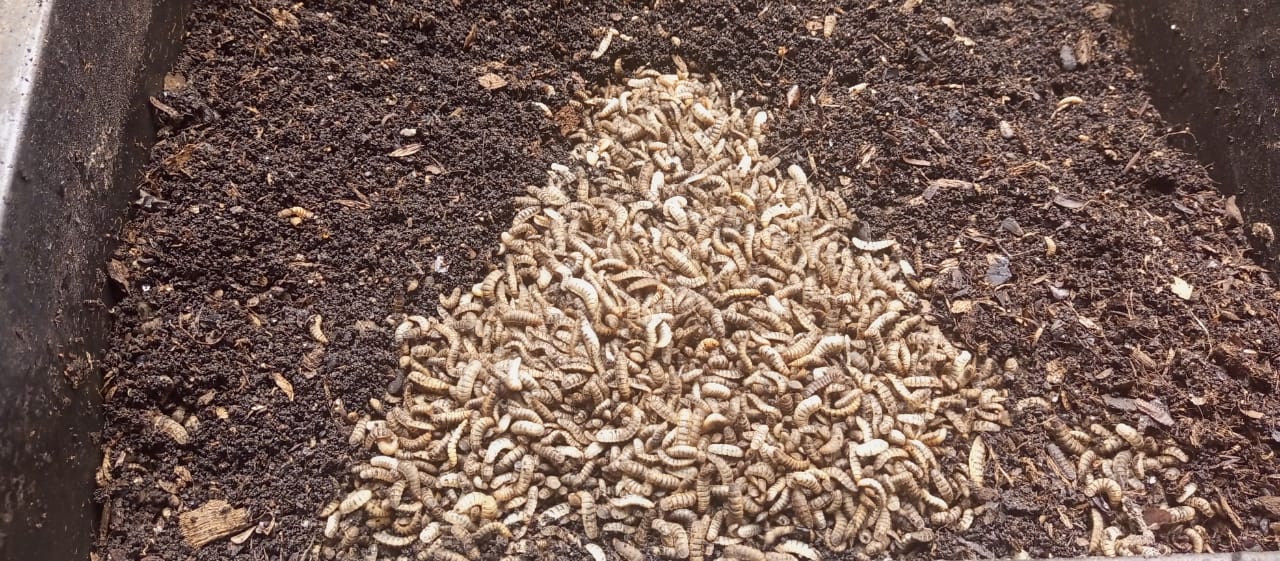
Due to high cost of living, farmers in Gusii region have started to embrace black soldiers fly farming to cushion the high expenses incurred to purchase animal feeds.
Black soldier fly larvae feed on literal waste products, and are very efficient at turning them into their own biomass. 1.5kg of decomposing organic matter creates 1kg of black soldier fly larvae, which in turn create 100g of beef, if used as feed for cattle.
The dry weight of Black Soldier Fly Larvae (BSFL) contain up to 50% crude protein (CP), up to 35% lipids and have an amino acid profile that is similar to that of fishmeal.
Indigenous chicken farmers can cut the cost of production by rising their own nutritious black soldier larvae to supplement the chickens’ feed and enable the birds to achieve maturity and market stage faster.
Lack of access to affordable protein sources for farmed pigs, chickens and fish in Kenya can deter women and youth farmers from starting a small livestock venture, with both groups less likely to have access to the required capital. Yet, their involvement in agriculture is widely recognized as critical to Kenya’s economic development.
Traditionally, Kenyan farmers use fishmeal and soybean as protein sources for their animals, but both can be problematic for smallholder communities.
Kenya does not produce high quantities of soybean, and limited local supply translates to expensive import taxes, which often push the commodity out of the reach of small-scale operations. Likewise, fishmeal is becoming a less reliable protein source due to greater market competition, overfishing and traders often adulterating supplies with sand to increase profit margins.
Two production models show insects could provide a reliable, sustainable, safe, and cost-effective source of protein for small-scale livestock and fish farming enterprises.
Mr Felix Ombati a youth black soldier fly farmer shares his story on how he has ventured into this farming.
Mr Ombati graduate of Bachelor of Science and Agri business he ventured into black soldier fly farming after he read an article about it and realized that the farming was not common in Gusii region.
He says that he did a research and found that the black soldiers are good source of proteins to poultry, livestock and pigs.
Mr Ombati says that he underwent training at The International Centre of Insect Physiology and Ecology (ICIPE) where he was trained on how to grow them from larvae, pupa to adult stage.
“I got starter kit from them, that’s is how I ended up coming up with this beautiful project,” he says.
According to Mr Ombati he started the project on 2021, the cost only he uncured was the purchase of cage which costed him Ksh 8000.
“I did not start with huge amount of money, I used the basins and buckets I had at that time,” he says.
According to The International Centre of Insect Physiology and Ecology (icipe), has led the way in incorporating insects as alternative, more affordable, nutritious and sustainable protein options in animal feed.
In particular, the Centre has demonstrated that black soldier fly larvae or the proteins derived from them, can be used safely as components in feeds for poultry, pigs and fish. In poultry, such feeds have been proven to improve growth performance, the quality and quantity of meat and eggs, and overall profitability for farmers.
Why black soldiers fly
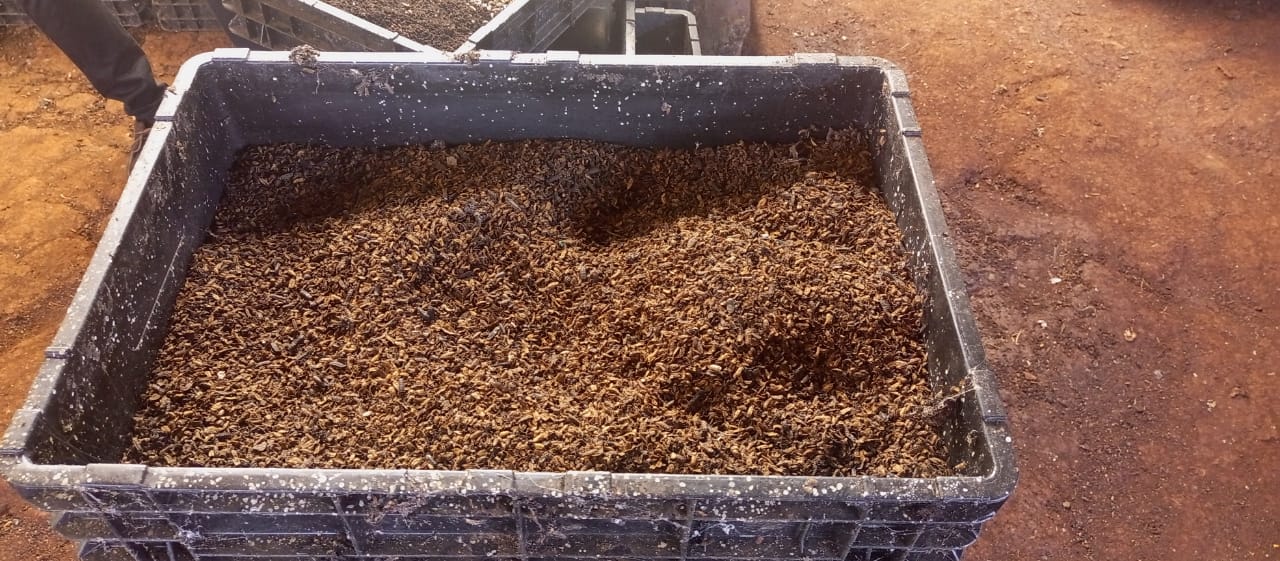
Mr Ombati says that black soldiers farming is cheap to start, most of the products they use are wastes e.g fruits mango peels, watermelons which they collect them during market days on Monday and Thursdays at Daraja mbili market.
He further says that they took shortest time possible, it takes 8-12 days you can be able to harvest them.
He says that black soldier’s fly is fully organic
Mr Ombati says that on a good day they can produce 20kg of fried fry larvae at Ksh 130 per kg.
Fras manure is good for farming
Ms Janet Otwori another farmer says that she cannot regret to have invented in BSF farming, she has trained other women who are happy with that farming.
Ms Otwori says that when they are dried they can be used to make flour and cooking oil.
She says that BSF has high proteins which can be fed on chicken to gain more weight and produce high quality egg production.
Pigs fed with black soldier flies grow faster and produce more and better quality meat.
Cells of pupa they can prevent root nematodes.
Black soldier flies provide the opportunity for smallholder farmers to shift towards a more reliable, profitable and ultimately more sustainable source of protein for their animals.
They currently produce an average of 500 kg of black soldier flies larvae every week, fed directly to his chickens and pigs.
The high-protein black soldier fly increases the chicken’s growth rate and the amount of good, lean meat they produce.
Feeding
Robert Onsare interest in poultry farming began in 2014 when he was still in formal employment. He started by raising Kienyeji chickens for meat and eggs, then scaled up to egg production only.
“I first bought 20 chicks from neighbors and within three months, many had died. I did not give up, and I bought another 100 kienyeji chicks and continued scaling up to 300 and by 2015 when I quit, I had 500 birds,” he says.
After a few years, he realized that the demand for eggs was more than that of meat, so he shifted from kienyeji chicken to high breed broilers.
However, he has had a passion for farming since childhood. And this passion kept him the reason as to why he decided to resign a job in one of the company.
He says that someone advices him to feed his poultry with BSF if he wanted to get more income.
“I can testify the chicks matured faster unlike in the past when he used to feed them commercial feeds, “he says.
To keep them healthy, Onsare feeds the birds with BSF, kitchen waste, sunflowers, cereals, fish meal, green grass and maize germ.
Also keeping her chicken in a large fully fenced compound where they can scavenge and get insects.
Remember, keeping indigenous chicken thrives in a rural areas where people prefer them over exotic ones. Ensuring a strict vaccination schedule prevents loss of poultry.
Onsare likes crossbreed chickens because they are resistant to diseases and mature faster than the local Kienyeji chicken.
He says poultry farmers should vaccinate the chicken after every 10 weeks to keep away diseases like Newcastle which is a big threat to poultry farmers.
He says that farmers should ensure that the chicken cages are cleaned regularly and provide enough water for them to grow healthy.
He keeps her chickens in a large fully fenced compound where they can scavenge and get insects.
Source of income
Mr Ombati says that his main source of income comes from black soldier fly
On his farm he rears 500 chicken and supplies eggs to markets.
“Per week I earn Ksh 10,000 from the eggs, one goes at Ksh 25,” he says.
Mr Ombati has plans to expand his poultry to rear 2000 chicken, he explains, there is high demand of eggs, the eggs are so nutritious and the size is so big.
‘We started black soldier flies production in late 2020 with starter stock of black soldier flies populations of larvae from ICIPE,’ he says ‘
Currently, we are at 5 tones daily production and eyeing to supply the larvae to large scale feed enterprises in Gusii region.
His enterprise employs 10 people, 5 of them women, who are all below the age of 30.
Mr Ombati wants to expand his farming and start rearing pigs and fish.
I started scouting for waste from our neighbors I set out to find more industrial waste at big companies as well as within the single markets who now collects food scraps and leftovers ranging from mango peels, watermelons.
When fed organic waste, black soldier flies produce nitrogen-rich frass (insect manure) that can be used as a high-performing fertilizer.
Insects are playing a key role in providing quality nutrients and boosting farmers’ production and income.
Challenges
High cost of labor who takes care of the black soldiers, to clean the cage and also to grind the wastes.
Mr Ombati says that getting the wastes is also a challenge, he has to source them on market days.
“Since we do not have any company that is processing fruits, so that we can get the wastes, it becomes a challenge to source only from the market.
Nicholas Ondicho, 48 years old, Certified Public Accountant, is among the successful livestock rearing farmer in Kisii County
Due to high cost of living, Mr. Ondicho has been forced to rationalize the animal feeds, the cows takes per day.
“We have now reduced the ratio the animal feed, since it is costly, “he says.
He notes that they used to purchase Unga limited meals at Ksh 1850 now its 3500.
According to him, the quantity of the milk has been reduced due to the animals they do not take the percentage of meals they used to take before the increase of the cost of animal feeds.
He says that raw animal feeds has been increased to 68% price and says that he has changed minds to feed his animals with BSF.
Dr Abel Mokoro, an Agro economist and lecturer at Kisii University, says that they are proteins in nature and therefore when fed to poultry directly provide protein of high quality that is of the essential amino acids, also used indirect by manufacturing animal feed industrial to replace fish meal which scarce.
Mr Samwel Bosire, the Abagusii Council of Elders Secretary General, says that the world has evolved, they have welcomed the new BSF farming to cushion high cost of living.
“We cannot ignore digital farming, we are in the digital era, we cannot oppose to it, but we should not forget our traditional farming, “he says.
Mr Nathan Soire, the Kisii County Director for Agriculture, says BSF farming is worth adoption by especially poultry farmers, it reduces the cost of feeding poultry drastically. It’s a cheap and highly nutritious source of protein.
Mr Soire says, it slow rate of social acceptance of the technology and also extension workers aren’t adequately facilitated by devolved governments to demonstrate on this technology.
He says that the county has scaled up agriculture extension services to promote uptake of BSF farming to address high cost of producing eggs and chicken meat, thus increasing food production, farm income and creating.
Bio Waste Management
Leonard Ofula , Kisii County National Environment Management Authority , says aims to improve urban sanitation, address bio waste management, and mitigate climate change.
He adds that black soldier flies to help in organic waste management and environmental conservation.
“The insects feed on collected organic garbage from marketplaces and homesteads, to form manure and animal feeds,” he says.
Mr Ofula cites that municipalities governing waste disposal struggle to deal with the urban cities’ current waste levels in a sustainable way, as a result, bio wastes accumulate in open and unregulated sites, creating unsanitary environmental conditions that pose public health risks and contribute to greenhouse gas (GHG) emissions, thus BSF will clean the environment.
He says that due to climatic change BSF farming is well fit to help farmers to curb high cost of animal feeds.
Similar Posts by The Mt Kenya Times:
- Mt Kenya Times ePAPER October 17-18, 2026
- Ruto bets billions on Kerio Valley — with one eye on 2027
- Ruto’s health ministry kills Murang’a’s digital hospitals
- Kenya bets on Mount Kenya to drive a billion-shilling tourism revival
- Do you have a wealth vision? Or are you just working until you die?
About the Author