French protests spread nationwide as tear gas and Halloween costumes fill the streets
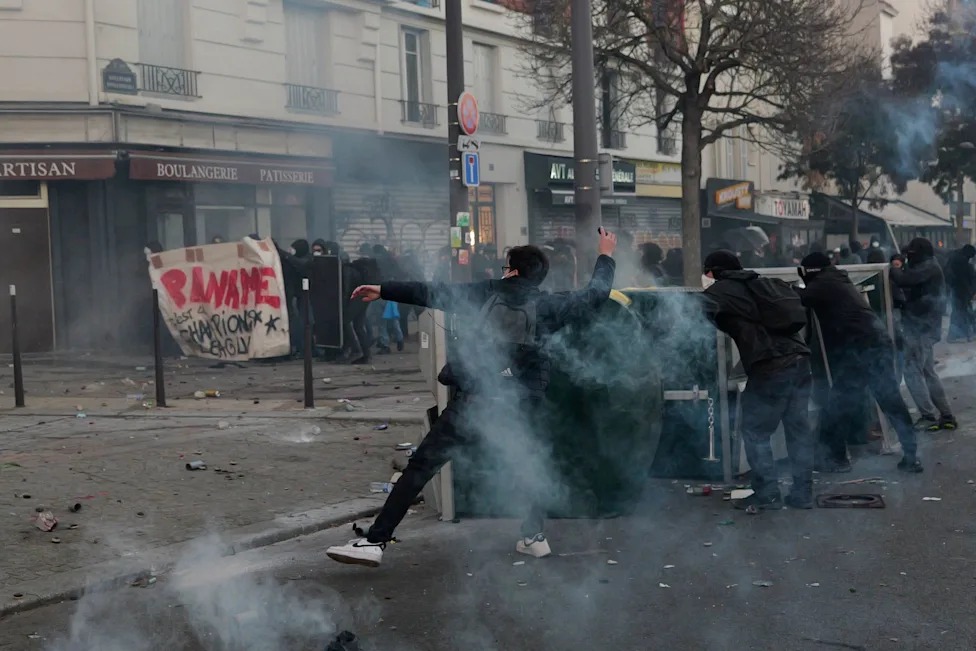
Tear gas used in Paris and Lyon as French protests turn violent
Soaring living costs and police violence are driving hundreds of thousands of French citizens onto the streets each Saturday, testing the government of President Emmanuel Macron six months before a presidential election
By: John James
French anti-government protests gripped cities across France again on Saturday as hundreds of thousands of demonstrators took to the streets in what has become a weekly test of the Macron government’s authority, with clashes erupting in several cities even as the vast majority of marchers kept the mood largely peaceful — some of them, remarkably, dressed as Spider-Man and Frankenstein for Halloween.
French police fired tear gas and clashed with groups of protesters in multiple locations as the demonstrations swept the country for the third consecutive Saturday. France’s interior ministry reported approximately 320,000 people rallying nationwide, with Paris alone accounting for around 70,000, according to police figures. By Saturday night, authorities had recorded more than 560 arrests across the country — adding to the thousands detained in the wake of riots and looting that had marred the two preceding weekends.
The scenes varied sharply from city to city, capturing both the breadth and the complexity of a movement that has refused to dissipate despite a heavy security response. In Marseille, France’s southern port city, demonstrators clashed directly with police. In Lyon, the country’s third-largest city, protesters threw projectiles at officers, prompting the use of tear gas. In Toulouse, water cannon were deployed against an unauthorised protest drawing several thousand people, many of them young, some in costume. In Paris, meanwhile, thousands wound their way through the city’s eastern districts beneath a circling police helicopter, carrying placards that captured the movement’s mixture of frustration and dark humour: “No need for tear gas to make our future look bleak” and “Dressed up as an angry citizen for Halloween.”
Hard-left presidential candidate Jean-Luc Mélenchon joined the Paris march, having accused the Macron government of taking what he described as an increasingly authoritarian turn. His presence underlined the degree to which the protest movement has become entangled with the country’s approaching presidential election, now less than six months away, with far-right leader Marine Le Pen currently leading opinion polls.
Not all participants were angry in the conventional sense. In the northern city of Lille, 47-year-old Aurelie Herrmann chose to dance. “I dance because on television they only show damage and destruction, whereas you can perfectly well demonstrate in good spirits,” she said. In Nantes, 31-year-old Camille Guerin was more direct about the politics: “We say no to the cost of living, no to the far right, yes to high school students’ demands, yes to giving citizens a voice.”
The contrast between these voices and the scenes of broken glass and burning buildings from previous weeks points to one of the most important features of this protest cycle: a movement with a broad social base that the French authorities have struggled to manage without alienating the very public whose support they need. Interior Minister Laurent Nunez had warned on Friday that police had prepared for violence on a scale comparable to the unrest two weeks earlier, when shops were looted and public buildings set ablaze. His office said authorities had detected social media calls urging protesters to use Halloween gatherings as cover for sparking what was described online as a “revolution.”
The warning was sufficient to send a chill through the business community. Some shopkeepers boarded up their premises again, anticipating the worst. Wael Boubaker, a café employee in eastern Paris, was covering a storefront with plywood panels as the day began. “Everyone is staying home,” he said. “No one is going to come and buy anything.” Alain Di Crescenzo, president of France’s chamber of commerce, put it more pointedly when he told broadcaster France Inter: “Shopkeepers can’t wait for Saturday to be over.”
The protest movement that has now consumed three consecutive Saturdays did not begin with confrontation. It grew from a coalition of trade unions, student activists and ordinary citizens united by grievances over the soaring cost of living, persistent inequality and what students described as deteriorating conditions in schools and universities. Those economic concerns remain at the movement’s core. France’s economy, the second largest in the eurozone, is teetering on the edge of recession, and the government is simultaneously under pressure from European partners to reduce its debt levels. That combination leaves the Macron administration with almost no fiscal room to offer the kind of spending concessions that might take the heat out of the demonstrations.
But the movement has since grown beyond its original economic focus. A heavy-handed security response — including a ban on certain marches and serious injuries to some protesters — has brought civil liberties and the right to protest into the centre of the debate. Student demonstrators this week specifically complained that police had refused to authorise a march through central Paris, and they have vowed to stage fresh blockades of schools and universities in the week ahead. What began as anger at grocery bills has broadened into something more politically charged: a confrontation over the kind of country France is becoming.
That confrontation is unfolding in a political environment already crackling with tension. The presidential election is close enough for every protest, every arrest, every canister of tear gas to carry electoral significance. Le Pen’s continued lead in the polls gives the government little comfort. Every Saturday that ends in disorder risks reinforcing a narrative of governmental dysfunction; every Saturday that passes peacefully risks emboldening protesters to escalate.
France is not alone. Similar youth-led demonstrations have erupted across Europe in recent weeks, with thousands of young Germans taking to the streets nationwide on the same Saturday. The sense of a continent-wide restlessness among younger generations, driven by economic insecurity and a feeling that established political institutions are failing them, lends the French protests a significance that extends well beyond the republic’s own borders.
For now, France’s Saturdays belong to the streets. Whether the coming week’s threatened school blockades and the approaching election calendar eventually channel this energy into the ballot box — or deepen the crisis on the pavements — is the question that the Macron government, and France itself, cannot yet answer.
Similar Posts by The Mt Kenya Times:
- Diaspora Times Global Oct 31 – Nov 6, 2026
- US approves $2.1 billion Patriot missile sale to Ukraine, but Zelenskyy warns delivery could take years
- Netanyahu loses his majority: Israel’s election throws the Middle East into fresh uncertainty
- Mandela’s most magnanimous act: Inviting the man who sent him to prison to lunch
- Ghost students, real money: How Kenyan nationals became entangled in America’s $130 million student aid fraud investigation
About the Author