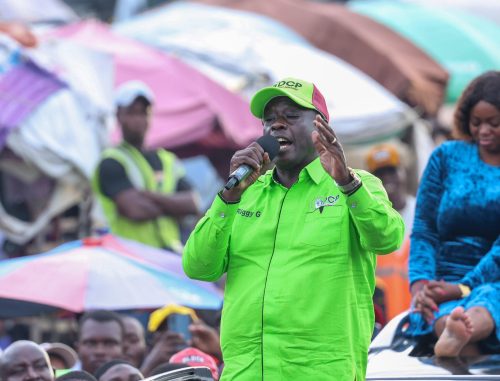
Gachagua Fires Off Explosive Letter Accusing Police Of Enabling Political Violence


By MKT Correspondent
A fresh political storm is brewing after Democracy for the Citizens Party (DCP) leader Rigathi Gachagua yesterday wrote an explosive letter to Inspector General of Police Douglas Kanja, accusing the National Police Service of enabling political violence, shielding criminal gangs and working under the direction of politicians close to President William Ruto.
In the letter, dated yesterday, Gachagua tells the IG that he is fully aware President Ruto had earlier in the day directed him to arrest and prosecute groups accused of orchestrating political chaos across the country. But Gachagua argued that the directive is meaningless unless the police leadership addresses what he describes as deep internal complicity in the escalation of political violence.
He accuses the IG of presiding over a police command that has “surrendered itself” to powerful political figures aligned to the President, politicians who, according to him, have turned the police into a tool for advancing their political interests.
Gachagua claims that police officers in civilian clothing routinely move with gangs in police vehicles, offering them tactical cover, intelligence and backup during political disruptions.
He says he has documented these concerns “severally” and brought them to the IG’s attention, but alleges that no action has been taken. The DCP leader questions the President’s sincerity in his call for the arrest of violent groups, declaring that if Mr. Ruto were genuine “which we highly doubt,” he stresses, then the IG must immediately cut off all police cooperation with the alleged gangs.
He challenges IG Kanja to publicly declare that such groups will no longer enjoy police protection. According to Gachagua, once Kenyans are convinced that the police will not shield violent actors, communities will mobilise to protect themselves and hand over offenders to police stations with confidence that due process will be followed. He argues that the single biggest weakness in confronting political violence and what he calls “goonism culture” is the failure of the IG to act independently.
The letter lists a series of incidents dating back to late 2024, where Gachagua alleges he and other leaders were attacked by criminal gangs working under the cover or supervision of police officers.
He cites an attack during a funeral service in Limuru on November 28, 2024; a December 2024 incident in Shamata, Nyandarua County, where he claims a police inspector accompanied gangs who lobbed tear-gas at him and his supporters; violence at a prayer rally in Nyeri on January 18, 2025; chaos at ACK St. Peter’s Cathedral in Nyeri on March 23, 2025; and an attack in Naivasha on March 29, 2025.

Further, he references a violent confrontation at PCEA Kasarani East Parish in Mwiki on April 6, 2025, and a July 27, 2025 attack in Kinyona, Murang’a, where Senator John Methu and other leaders were also reportedly caught up in violence.
He then cites the most recent events from November 2025, including alleged harassment by militia, uniformed officers and plainclothes operatives in Narok Town on November 24; disturbances attributed to police and gangs in Narok Township and Mbeere North during elections on November 27; and an incident last Sunday at a PCEA church in Kariobangi North, where he accuses officers of attacking women and children in the middle of worship.
Gachagua claims that the investigation file for the PCEA Mwiki attack was completed but allegedly blocked due to interference from the President, stating that a local MCA close to Mr. Ruto was implicated. He adds that the gang involved in the Kariobangi North church incident had earlier been overpowered by congregants but returned under police escort.
He accuses the area OCS, a Mr. Syad Hassan, of firing tear gas at Sunday school children and worshippers to create confusion and allow the gangs an opportunity to strike.
In one of the strongest allegations in the letter, Gachagua asserts that during IG Kanja’s tenure and that of Interior CS Kipchumba Murkomen, political gangs became a “fully fledged unit under the National Police Service,” allegedly operating in coordination with officers. He further questions whether the police mission to Haiti was a “benchmarking mission” on how to use gangs to influence political and social outcomes, an assertion likely to spark intense public debate.
Gachagua concludes by demanding that if President Ruto is serious about ending political violence, “which no one can trust,” he says the IG must publicly disband what he calls the “101 killer squad,” an alleged shadowy group he accuses of abducting and killing youth involved in Gen Z-led protests.
Similar Posts by The Mt Kenya Times:
- Tax relief for Kenyans: Will more money in our pockets make life easier?
- Poisoned bottle: Are we drinking ourselves into early graves?
- How Kenya and South Africa constitutionalized concentration while preaching the gospel of the disadvantaged
- Discipline begins at home
- Onana escapes serious injury in three-car crash
About the Author