How digital alerts are helping women farmers adapt to climate change
 The Mt Kenya Times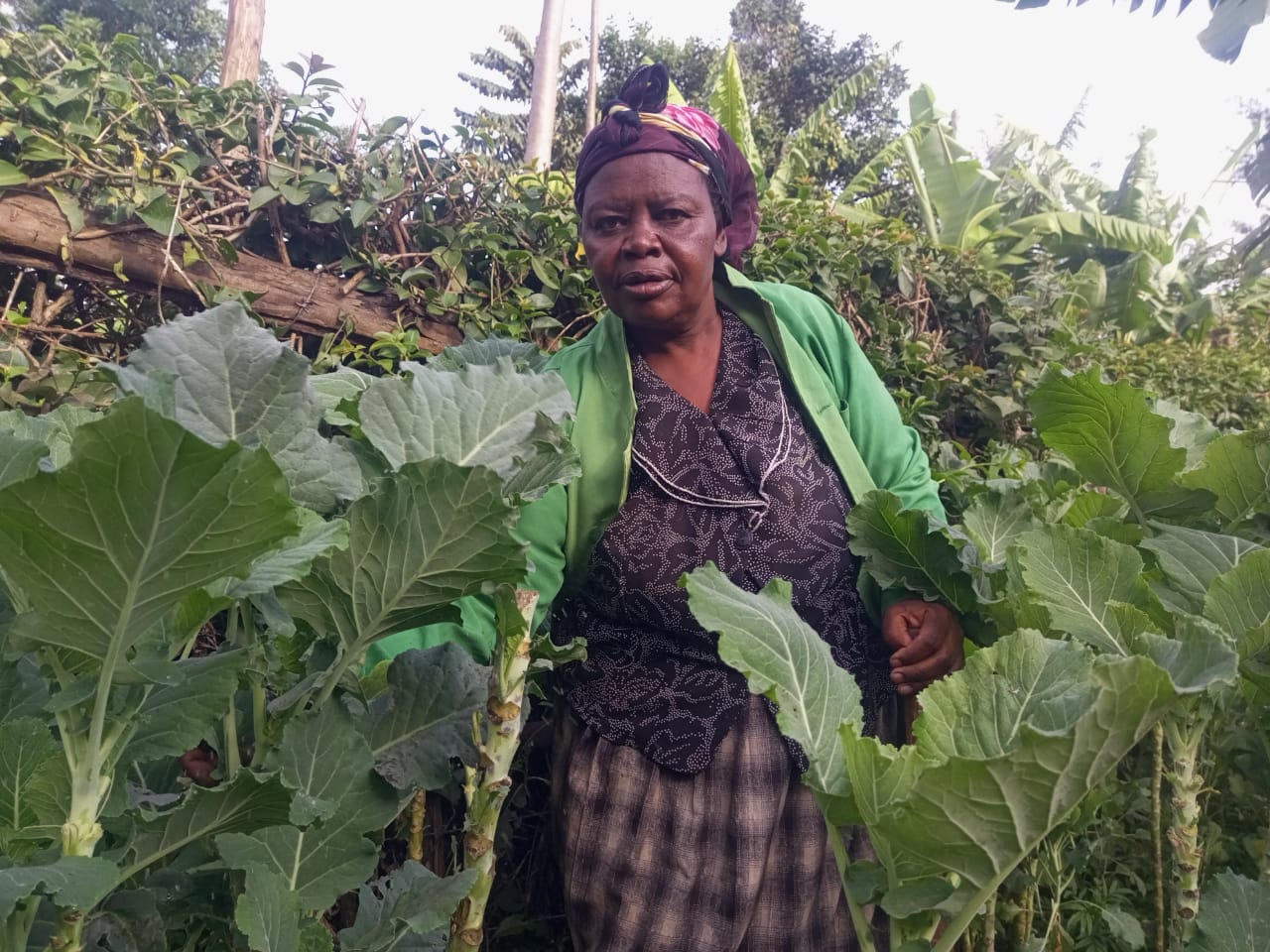
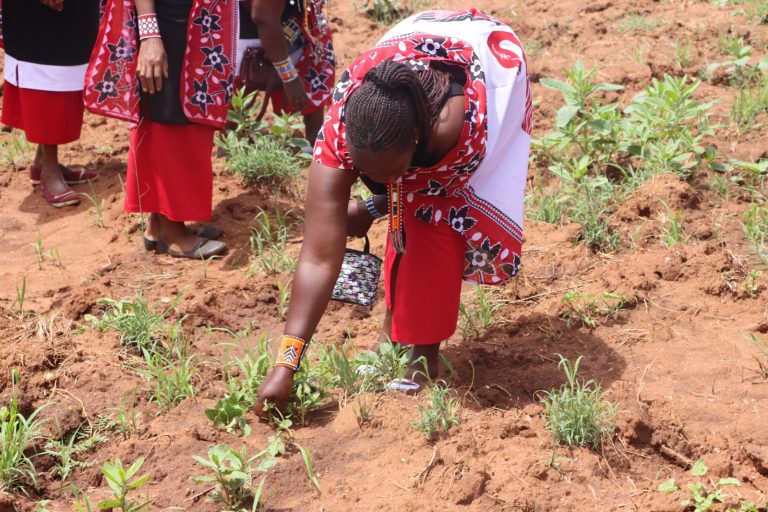
Grace Moraa tends sukuma wiki in her small garden. Once reliant on traditional knowledge to know when to plant or harvest, she is now happy that digital alerts have helped her adapt to climate change photo /Elizabeth Angira
By Elizabeth Angira
Fifty-two-year-old Grace Moraa walks slowly through her small farm, inspecting rows of tender maize plants pushing through the dark red soil.
The air is cool, but the clouds gathering above the rolling hills make her uneasy.
For decades, Moraa relied on instinct and traditional knowledge passed down from her mother to decide when to plant or harvest. The seasons once followed a predictable rhythm, with rains arriving in February, April, October, and sometimes December.
However, in recent years, that pattern has shifted.
“Sometimes the rains come late, sometimes they disappear completely,” Moraa says, bending to feel the moisture in the soil between her fingers. “You plant, hoping for rain, then the crops dry. Other times, floods destroy everything.”
Across Kisii and Nyamira counties, smallholder farmers—many of them women—face the same uncertainty. Climate change has made weather patterns harder to predict, threatening food security and household incomes.
Shifting weather patterns
According to the Kenya Meteorological Department, rainfall in parts of western Kenya has become erratic over the past two decades, with longer dry spells and more intense storms.
Henry Sese, County Director of Meteorology for Kisii and Nyamira Counties, says rains that once arrived predictably in February, April, and October now come late, fall in short, intense bursts, or sometimes fail altogether.
“Farmers are now facing greater uncertainty,” he says.
According to Sese, rising global temperatures, deforestation, and increasing greenhouse gas emissions are some of the major drivers of climate change affecting the region.
Smallholder farmers like Moraa, who depend on rainfall, are highly vulnerable to the shifting weather patterns, but many struggle to access timely climate information, modern farming technologies, and extension services.
“Farmers used to know exactly when to prepare their land,” says Daniel Nyambane, an agricultural extension officer working with smallholder farmers in Kisii County.
“Today, those timelines have changed. Without reliable weather information, farmers are taking bigger risks.”
The consequences are visible in shrinking harvests and rising food prices.
Now, a new ally is emerging. Farmers are turning to digital advisory platforms that combine satellite imagery, weather forecasts, and agricultural research to guide everyday decisions. Some of these tools also incorporate artificial intelligence (AI), using machine learning models to analyse large volumes of climate and soil data and generate localised recommendations.
Unlike traditional forecasts, which provide general updates across wide areas, these systems can offer more tailored guidance—such as when to plant, apply fertiliser, or prepare for extreme weather. However, not all platforms rely on AI.
“Digital weather advisory apps are very important because they translate complex weather data into simple alerts that help farmers prepare for droughts or heavy rains,” says Sese.
The text message that changed everything
 Last year, Moraa received an unusual message on her phone.
The alert warned farmers in her area that heavy rainfall was expected within two days and advised them to delay fertiliser application to prevent nutrients from being washed away.
At first, Moraa was sceptical. For years, she had relied on the sky and the behaviour of birds to read the weather.
Still, she decided to wait.
Two days later, a heavy downpour swept across Nyamira. Fertiliser applied on nearby farms was washed away.
“I realised the message was right,” she says with a quiet laugh. “If I had applied fertiliser that day, it would have been wasted.”
The alert came from FarmRise, a digital agriculture platform developed by Bayer. The platform analyses satellite imagery, weather forecasts, soil data, and farming practices to generate personalised recommendations on planting times, fertiliser application, pest control, and irrigation.
For farmers like Moraa, the advice arrives in simple language through SMS alerts or mobile apps.
“It feels like someone is watching the weather for you,” she says.
Digital adoption
Thirty-eight-year-old Janet Nyanchama from Kisii County says climate information sent to her phone has transformed how she manages her vegetable farm.
Nyanchama grows tomatoes, sukuma wiki, and onions on a small plot behind her home. The produce supports her children’s education and household needs.
However, unpredictable weather often destroyed her crops.
“Sometimes the sun becomes too hot and the tomatoes dry,” she says. “Other times, too much rain brings diseases.”
Last season, she began receiving weekly climate advisories through a digital farming platform.
The messages helped her adjust planting dates and choose crop varieties suited to changing weather conditions.
“My harvest improved,” she says proudly. “Now I feel more confident because I know what to expect.”
From complex data to simple advice
 Experts say reliable climate information is one of the most powerful tools farmers can use to adapt to climate change.
“Digital tools help translate complex scientific data into practical advice farmers can use,” explains climate researcher Kelvin Getanda.
“Instead of receiving a general forecast for a whole county, farmers receive information specific to their location and crops,” he adds.
For farmers with limited access to extension services, these platforms bridge a long-standing information gap.
On another farm in Nyamira County, Rose Kemunto scrolls through her smartphone while sitting outside her kitchen.
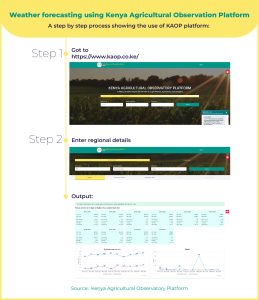
A green icon labelled KAOP – the Kenya Agricultural Observation Platform – flashes open on the screen.
Developed by the Kenya Agricultural and Livestock Research Organisation (KALRO), the platform combines satellite imagery, climate data, and agricultural research to provide farmers with localised weather forecasts and farming advice.
Kemunto discovered the app during a training session organised by agricultural officers.
“At first I thought it was something only big farmers could use,” she recalls. “But when they showed us how it works, I realised even someone like me could understand it.”
With a few taps, she can check rainfall predictions, temperature trends, and advisories on when to plant or apply fertiliser.
Last season, the app warned that the rains would be delayed.
“So I waited before planting my maize,” she says. “My neighbour planted earlier and had to replant because the seeds dried in the soil.”
For many women farmers, receiving this information directly on their phones is empowering.
“Many women manage farms but rarely attend agricultural training. When information comes to their phones, it allows them to make decisions independently,” says Nathan Soire, Kisii County Director of Agriculture.”
Even farmers without smartphones can still access information through extension officers, farmer groups, and SMS.
“This helps them access farming information quickly without travelling long distances to look for extension services,” says Bayer East Africa Customer Agronomist Barnabas Barare, who works with farmers across Kisii, Nyamira, Kericho, and Transmara.
Bridging the gap
However, despite the promise of AI-enabled and digital agricultural tools, challenges remain. Experts say that while localised guidance can help farmers make more informed decisions, its effectiveness depends on the quality of the data behind it. Limited weather stations and gaps in historical data could affect the accuracy of predictions.
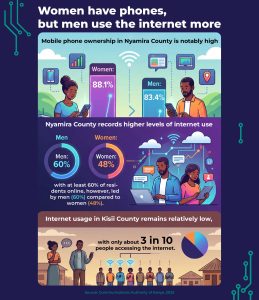
Many women farmers also face barriers such as limited access to smartphones, unreliable internet connectivity, and low digital literacy levels. Financial constraints also make it difficult for some households to afford smartphones or mobile data.
However, outreach programmes are bridging the gap. Extension officers and farmer groups are organising training sessions to support adoption.
Back on her farm, Moraa blends traditional knowledge with digital tools. She watches the movement of birds, the flowering of trees, and the smell of soil before rain and also checks the alerts on her phone.
“The phone gives information,” she says. “But the land also speaks.”
Moraa kneels between rows of beans and gently pulls weeds from the soil. The clouds that worried her earlier have begun to clear, revealing a soft blue sky. Her phone buzzes with another alert: light rainfall expected later in the week.
She smiles.
“I never imagined farming could involve technology like this,” she says. “But now I see it is helping us survive these changing seasons.”
This article was produced as part of the Gender+AI Reporting Fellowship, with support from the Africa Women’s Journalism Project (AWJP) in partnership with DW Akademie. The journalist used AI tools as research aids to review and summarise relevant policy and research documents and extract key statistics. All interviews, analysis, editorial decisions and final wording were done by the reporter, in line with Mt Kenya Times’ editorial standards.
Similar Posts by The Mt Kenya Times:
- Mt Kenya Times ePAPER July 28, 2026
- The DP gamble that could cost Ruto everything
- Just war theory and Kenya’s political journey: When the state meets the street
- Supreme Court tax ruling tests Kenya’s constitutional order
- The rotten diaper of tumbocracy in Kenya
About the Author

 Brenda Holo