
Iran vows to strike back: Hormuz, oil fields and global markets in the crosshairs
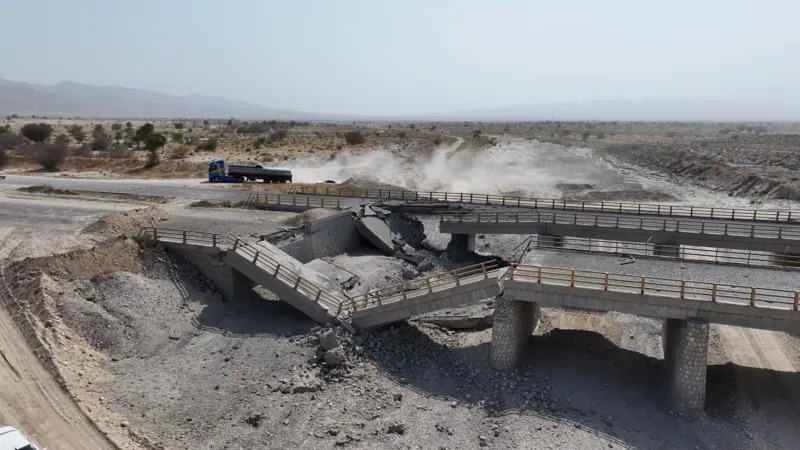
Images shared on Friday showed a damaged bridge in Iran's southern Hormozgan province
As Washington and Tel Aviv reportedly ready a fresh wave of attacks on Iranian energy infrastructure, Tehran says it has a comprehensive response plan that could shake the world economy to its foundations.
By Diaspora Times Team
Tehran is bracing for what its officials are calling an act of “madness.” With reports emerging from Washington that the United States and Israel are preparing a new and potentially devastating wave of strikes against Iranian energy infrastructure, Iran moved swiftly on Saturday to signal that it will not absorb the blow in silence.
Iran’s semi-official Tasnim News Agency, citing a senior Iranian security official, reported that Tehran has prepared a comprehensive plan to respond to any attack targeting its energy facilities. The plan, according to the official, is not defensive in character — it is offensive in scope and deliberate in its targets. The official described any potential US strikes on Iranian infrastructure as “an act of madness,” adding: “We have prepared a broad response plan that includes strikes against the Zionist regime’s critical infrastructure and US energy infrastructure in the West Asia region.”
The statement landed as multiple major American news organisations reported that a significant military operation against Iran was being actively prepared in Washington.
CBS News, citing multiple sources, reported that the United States and Israel are planning what could be one of the harshest bombing campaigns to date, targeting power plants and oil refineries, with strikes potentially beginning over the weekend. Multiple US sources told CBS that Israel had been notified of the potential strikes and had been coordinating with the American military, though they noted that President Donald Trump had not yet given final approval.
The Wall Street Journal offered a starker assessment. The paper cited US officials as saying that Trump had ordered the military to launch a fresh attack on Iran that could begin as soon as the weekend and last several days.
The divergence between the two accounts — one suggesting Trump had yet to sign off, the other that he already had — reflects the intense and fast-moving nature of the crisis. A Pentagon spokesperson issued a statement confirming that the Department is “ready to execute the President’s directives at a moment’s notice” if given the order.
The Hormuz threat
While security officials outlined the military dimensions of Tehran’s response, Iran’s most senior national security figure warned of consequences that would stretch far beyond the battlefield.
Secretary of Iran’s Supreme National Security Council, Mohammad Baqer Zolqadr, warned in a message carried by Iranian media that the US continuation of its naval blockade and warmongering against Iran will only “further tighten the lock on the Strait of Hormuz” and lead to the closure of other straits. He added that the global economy and energy market, as well as American voters, would be the ones to pay the price.
The warning carries enormous weight. Shipping traffic through the Strait of Hormuz — a critical maritime chokepoint for world energy trade — has been largely disrupted since 28 February 2026, when the United States and Israel launched an air war against Iran. In retaliation, Iran launched missile and drone attacks on Israel, US military bases in the region and US-allied Gulf states. The Iranian Revolutionary Guard Corps issued warnings forbidding passage through the strait, boarded and attacked merchant ships, and laid sea mines in the waterway.
Any further tightening of Iranian control over the strait would send shockwaves through energy markets globally — threatening supplies to Europe, Asia and beyond.
London put on notice
As military tensions mounted, Iran’s diplomatic machinery was simultaneously in motion. Iranian Foreign Minister Seyed Abbas Araghchi directly contacted London.
Araghchi made his warning to Britain during a phone call with British Foreign Secretary Ed Miliband late Friday, stressing that any cooperation with “aggressors” — including under the pretext of existing defence agreements — would be “unacceptable.”
Araghchi warned that any cooperation with aggressors — including allowing British territory or facilities to be used for attacks on Iran — would constitute an act of aggression under international law and could trigger Iran’s right to self-defence.
Araghchi said Iran had entered a diplomatic process with the United States in good faith and signed a memorandum of understanding with Washington in June aimed at ending the conflict, but that Washington had failed to honour its commitments. He also highlighted Iran’s efforts to establish operational mechanisms with Oman to manage shipping traffic in the Strait of Hormuz, warning that third-party interference would only further complicate matters. Miliband, for his part, said Britain was not involved in the war against Iran and maintained that diplomacy was the only way to resolve the dispute.
A war already months in the making
The crisis did not emerge overnight. The 2026 Iran war began on 28 February when joint missile attacks were coordinated by the United States and Israel, hitting multiple locations in Iran. President Trump stated that the attacks were part of an effort to instigate regime change and to terminate Iran’s nuclear programme.
Since then, the conflict has followed a brutal rhythm of escalation and partial restraint. Trump warned Tehran explicitly: “From this point forward, any time the Islamic Republic of Iran shoots at a ship in the Strait of Hormuz, whether it be by missile, rocket, drone or any other device or weapon, the US will bomb and destroy one bridge or power plant, including those located next to, or in, the capital city of Tehran.”
Secretary of State Marco Rubio framed the Hormuz standoff in broader terms. “What is at stake here is not simply the issue of what’s happening in the Strait of Hormuz,” Rubio said. “It’s a very fundamental principle about freedom of navigation. If that is threatened, the global economy is threatened.”
Iran has not conceded that point — and has consistently framed any strike on its infrastructure as a red line that will be met with an equivalent or greater response.
Foreign Minister Araghchi has previously stated: “Any aggression against Iran, including our infrastructure, will compel a powerful and decisive response.”
Markets watch, the world waits
US officials involved in planning discussions reportedly considered timing any strikes to conclude before financial markets opened on Monday, given concerns about the potential impact on the US and global economy. That calculation alone speaks to the scale of what is being contemplated — not merely a military operation, but an event with the potential to reshape energy prices, trade routes and geopolitical alignments for months to come.
Whether or not the strikes materialise this weekend, the confrontation between Washington and Tehran has entered a new and dangerous phase. Iran has signalled, with unusual specificity and at the highest levels of its national security apparatus, that it is prepared to respond — and that the world beyond the battlefield will feel the consequences.
The Strait of Hormuz, through which roughly a fifth of the world’s oil supply passes, remains the ultimate pressure point. If Tehran’s lock on it tightens further, it will not only be soldiers and strategists who pay the price.
Similar Posts by The Mt Kenya Times:
- When young lives become disposable
- The day death refused to be scammed
- Statement win at the Gtech: Brentford outclass Chelsea to claim all three points
- When disability funds become a frontier for accountability: Kenya’s PWDs refuse to be invisible
- Public voices concerns over proposed education laws
About the Author


