Kenya Christian Professionals Forum Calls On Parliament To Follow The Law On Budget-Making Process
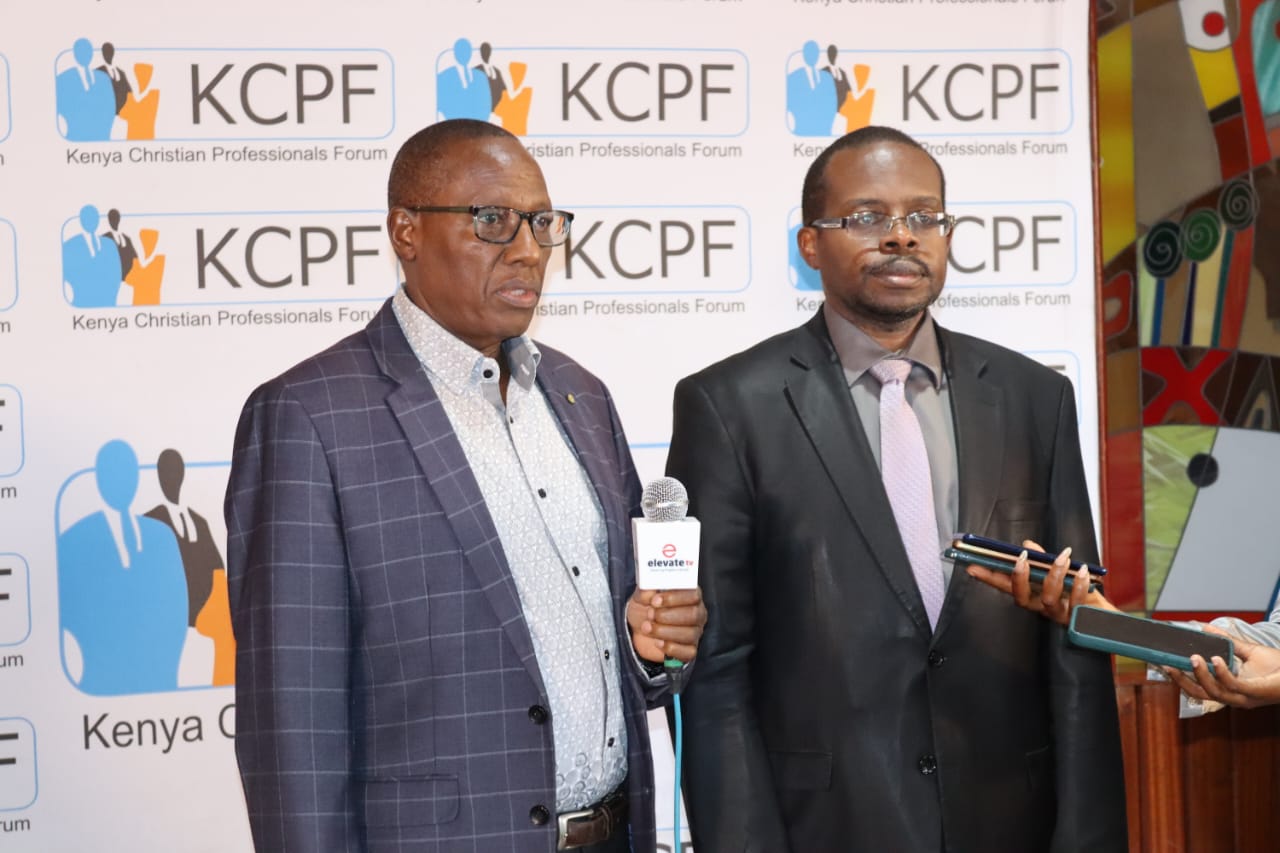
Lawyer Charles Kanjama (right) and Bernard Muchere briefing journalists at All Saints Cathedral, Nairobi yesterday. Photo/Courtesy.

By MKT Reporter
A Christian professionals caucus has raised alarm on the ongoing budget making process saying parliamentarians were not adhering to the laid down procedures.
The Kenya Christian Professionals Forum (KCPF) want the National Assembly and the Treasury to strictly fully comply with the Constitution and Public Finance laws in the ongoing 2025/2026 national budget-making process.
Yesterday, KCPF raised alarm over multiple legal violations, including unlawful borrowing, inflation of revenue estimates, flawed public participation, and a fundamental misapplication of budget instruments.
Some of the issues raised by KCPF include failure of the 2024/2025 National Budget to comply with Article 220(1) of the Constitution of Kenya, which outlines the legal requirements for public financial planning and accountability.
The other is breach of the Public Finance Management (PFM) Act, 2012, by the National Assembly and the National Treasury for failing to publish revenue estimates by 30th April 2025, and instead prioritizing the Finance Bill, 2025 – a reversal of lawful budgetary procedure.
Speaking during a media briefing under the Governance Accountability Program (GAP), KCPF emphasized that the Finance Bill is not the lawful basis for public participation in the national budget process.
Instead, Articles 220 and 221 of the Constitution require that public engagement be based on the revenue and expenditure estimates laid before Parliament, which they noted wascan obligation the Treasury and Parliament have failed to meet.
KCPF chairman Charles Kanjama said: “The National Assembly, in its budget-making process, and particularly in conducting public participation, should focus not just on revenue raising measures equally on the expenditure component. The main focus should not be on the Finance Bill, but on the revenue estimates, loans and grants to root out budgeted corruption where budgets are not supported by corresponding documented expenditure”.
Kanjama who is lawyer disclosed that in the past, the Departmental Committee on Finance has been publishing, for public scrutiny, just the proposed expenditure without disclosing the source of revenue. But following a petition that KCPF wrote to the National Assembly, this time round, the committee adhered to the rule of law on the issue.
Bernard Muchere, a Risk Management Consultant and a Certified Fraud Examiner (CFE) who is a retired Internal Auditor at the National Treasury and a KCPF Consultant noted: “What is currently before the public is the Finance Bill, not the estimates of revenue and expenditure as prescribed by Article 221(5) of the Constitution. This is like putting the cart before the horse. The law is clear – citizen input must be sought at the estimates stage, not the tax amendment stage.”
 KCPF decried the failure of the Cabinet Secretary for the National Treasury to publish the revenue estimates alongside expenditure projections, as required under Article 220(1)(a) and (b) of the Constitution and Section 33 of the Public Finance Management (PFM) Regulations, 2015. The submitted 2025/2026 expenditure plan totals Ksh. 4.57 trillion, while the government’s own data shows an annual average actual revenue of only Ksh. 1.97 trillion in recent years, creating a deficit of approximately Ksh. 2.4 trillion.
Illegal borrowing and constitutional violations
Additionally, KCPF raised concern that the government continues to borrow without adhering to constitutional guidelines. The Constitution mandates that borrowing must be approved by Parliament, and more importantly, must be directed toward development expenditure. Instead, the current fiscal trends show borrowing being used to fund recurrent expenditure, in violation of Article 220(1)(b) and Section 15(2)(c) of the PFM Act.
They warned that this trend risks mortgaging Kenya’s future by prioritizing consumption over development. Furthermore, the national debt ceiling has already been breached, undermining debt sustainability frameworks and exposing the country to economic vulnerabilities.
“Borrowing done outside the confines of the Constitution is not sovereign debt,” KCPF asserted.
“Such debt should not be passed on to future generations as a legitimate national obligation.”
Debt repayment misalignment
KCPF noted that a significant portion of current tax revenues is being redirected to service debt – much of which financed recurrent expenses, rather than development initiatives. The overreliance on tax revenues for debt servicing leaves critical social sectors like health, education and infrastructure underfunded, exacerbating inequality and stalling economic growth.
The Forum called on Parliament to initiate a debt audit to identify and isolate unconstitutional debt and ensure that future debt is aligned with sustainable development priorities as required by law.
Inflated revenue estimates and budgeted corruption
KCPF also flagged the issue of deliberately inflated revenue projections in the budget documents, which create room for wasteful expenditure, budgeted corruption, and supplementary budgets that facilitate unchecked spending.
These unrealistic targets, they said, compromise the credibility of the budget process and violate the principles of transparency and fiscal responsibility enshrined in Article 201 of the Constitution.
“When you inflate revenue, you create space for slush funds that are later captured through corruption-ridden supplementary budgets,” said KCPF, warning that this is a recipe for abuse.
They urged the Office of the Auditor General and the Controller of Budget to strengthen oversight on revenue estimates and prevent misuse of public resources under the guise of supplementary budget adjustments.
The KCPF officials called on the National Assembly to halt further consideration of the Finance Bill until the legally required estimates of revenue and expenditure are published and subjected to effective, accessible and structured public participation.
They averred that the June deadline set for the passage of the bill was not mandatory and that there was room for the National Assembly to pass part of the appropriation bill for the sake of smooth running of the government as the concerned parties addressed issues raised by the public.
The Forum reiterated its commitment to civic education and to mobilizing citizens to demand accountability, legality, and transparency in budget-making.
“The Constitution is not a suggestion; it is the supreme law. Budget-making must return to a lawful, participatory, and transparent path. We are educating citizens on their rights and empowering them to demand accountability,” Muchere added.
As the June 12 deadline for budget finalization nears, KCPF urges Parliament and the Treasury to uphold the Constitution, reverse irregular practices, and commit to genuine public finance reform.
Others who spoke and had similar views during the media briefing at All Saints Cathedral, Nairobi were KCPF Executive Director Sam Mwaura and Dr Wahome Ngare who took the participants through the Citizens Engagement to Governance.
Similar Posts by The Mt Kenya Times:
- AI Curse or boon: The Future of Intelligence: Artificial or Emotional?
- Dr. Ekrah Ndung’u wins TVET advocacy award after 12 years
- Mt Kenya Times ePAPER October 17-18, 2026
- Ruto bets billions on Kerio Valley — with one eye on 2027
- Ruto’s health ministry kills Murang’a’s digital hospitals
About the Author