Kenya shifts focus to quality-based milk payments to boost dairy sector

CS Mutahi Kagwe (left) handing over a trophy to Wakulima dairy chairman Muhika Mutahi.
By WMW
Kenya is preparing for a major transformation in its dairy industry by introducing a quality-based milk payment system that will reward farmers for producing high-quality milk rather than focusing solely on volume.
As Africa’s leading milk producer, with an estimated annual output of 5.4 billion litres, the country is seeking to improve the competitiveness of its dairy sector by encouraging farmers to adopt better production practices that enhance milk quality and increase profitability.
Under the Quality-Based Milk Payment (QBMP) model, farmers who maintain high standards in animal nutrition, disease control, veterinary care, hygienic milking and proper milk handling will receive better prices for their milk. Milk that records low bacterial counts, is free from antibiotic residues and adulteration, and contains higher butterfat and protein levels is expected to attract premium prices in both domestic and export markets.
The government has already begun investing in infrastructure to support the transition.
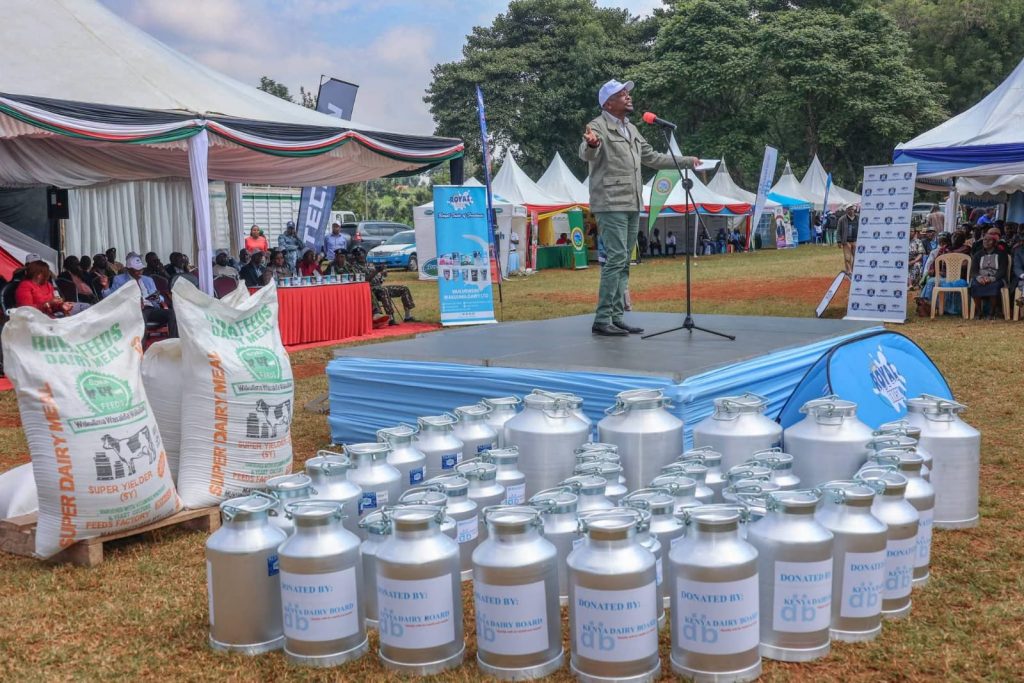
During the handover of milk coolers to Mukurweini Wakulima Dairy Farmers Limited in Nyeri county, Agriculture Cabinet Secretary Mutahi Kagwe said the facilities will play a critical role in preserving milk quality by reducing bacterial growth, maintaining freshness and minimizing post-harvest losses.
He described milk coolers as essential investments that enable farmers to consistently supply milk that meets high-quality standards required by processors and premium markets.
So far, 32 milk coolers have been distributed across Nyeri County, benefiting dairy cooperatives including Iriaini, Tekari, Gakindu, Gataragwa and Naromoru.
Beyond improving raw milk quality, the government is also encouraging farmers to embrace value addition through the production of processed dairy products such as milk powder, cheese, butter and yoghurt.
According to Kagwe, expanding dairy processing will help Kenya access regional and international markets, reduce losses during periods of surplus production, create employment opportunities and increase farmers’ earnings. He noted that milk powder, in particular, provides an effective way of preserving excess milk while ensuring year-round market access.
The government is also strengthening cooperative societies, which remain central to the success of the dairy sector. Strong cooperatives improve farmers’ bargaining power, lower production costs, facilitate access to credit and extension services, support quality assurance and open doors to export opportunities.
As part of efforts to improve dairy productivity, the Kenya Animal Genetic Resources Centre will provide 500 doses of sexed semen to farmers. The technology gives farmers up to a 90 percent chance of producing calves of the preferred gender, accelerating herd improvement and enhancing milk production efficiency.
The government’s agricultural support extends beyond dairy farming. Farmers have also received 70,000 coffee seedlings, 70,000 avocado seedlings and 50,000 macadamia seedlings as part of broader efforts to diversify agricultural production and improve household incomes.
With the planned rollout of quality-based milk payments, farmers are being encouraged to invest in improved dairy management practices and work through strong cooperative societies to maximize returns.
The shift signals a new era for Kenya’s dairy industry, where quality is expected to become the key determinant of farmers’ earnings and the country’s competitiveness in regional and global dairy markets.
Similar Posts by The Mt Kenya Times:
- Tax relief for Kenyans: Will more money in our pockets make life easier?
- Poisoned bottle: Are we drinking ourselves into early graves?
- How Kenya and South Africa constitutionalized concentration while preaching the gospel of the disadvantaged
- Discipline begins at home
- Onana escapes serious injury in three-car crash
About the Author