Kenya Unveils Bold 10-Year Action Plan To Save Endangered Pancake Tortoise

From right: Kenya Wildlife Service Director General Prof Erastus Kanga and Tharaka Nithi Deputy Governor Nyaga Muisrael at National Day for Endangered Species. Photo/Alex Njeru.
By Alex Njeru
In a landmark event held to mark the National Endangered Species Day, Kenya has launched its first-ever National Recovery and Conservation Action Plan (2025-2025) for the Pancake Tortoise at Chiakariga, Tharaka Nithi County.
Led by Kenya Wildlife Service (KWS) Director General Prof. Erastus Kanga and Tharaka Nithi Deputy Governor Nyaga Muisrael, the launch brought together conservation stakeholders including the Lewa Wildlife Conservancy and the National Museums of Kenya, signaling a renewed national commitment to protect one of the country’s most unique and critically endangered reptiles.
Prof. Kanga announced that a national census of the pancake tortoise would soon be undertaken to determine the current population of the elusive species, which is mainly found in Kenya’s arid and semi-arid landscapes — and almost entirely outside national parks.
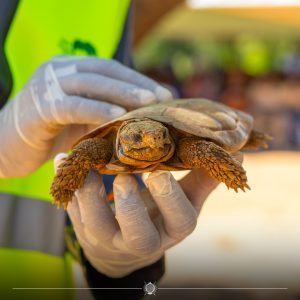
“Because nearly all pancake tortoises live on community and private lands, it is the responsibility of local residents to ensure their survival,” Prof. Kanga urged.
He also revealed a new partnership with Tharaka University, where KWS will establish a laboratory for venomous snakes, which will serve educational purposes and facilitate the safe harvesting of venom for medical use.
He noted that snake bites remain a significant threat in warmer regions and called for awareness and preparedness.
“The future will hold us accountable for the environmental legacy we leave behind. As KWS, we pledge to protect Kenya’s wildlife for generations to come,” said Prof. Kanga, who also encouraged locals to visit the nearby Meru and Tharaka National Parks.
Addressing broader security concerns, Prof. Kanga condemned livestock theft in Tharaka North, warning that such criminal activities would not be tolerated.
Deputy Governor Muisrael, representing Governor Muthomi Njuki, expressed pride in hosting the national event and called upon counties where the pancake tortoise is found to actively support its conservation.
“Local communities must be empowered to protect wildlife — not just the endangered species, but all of nature,” Mr. Muisrael said.
He also reinforced the county’s strict stance against charcoal burning, reminding enforcement officers to uphold the ban imposed by Governor Njuki.
“Let us preserve our creation for the sake of our future generations,” he urged.
Scientists from the National Museums of Kenya noted that the action plan is a culmination of over two decades of research into the species’ habits, habitat, and threats.
A Rare and Peculiar Reptile at Risk

The Pancake Tortoise (Malacochersus tornieri), native to East Africa, is unlike any other tortoise. With a flat, flexible shell, it slips easily into rocky crevices to evade predators — a unique evolutionary adaptation.
In Kenya, its strongholds include Marsabit, Samburu, Isiolo, Laikipia, Kitui, Meru, Embu, Tana River, and especially Tharaka Nithi, where populations thrive around Kijege Hill in the Chiakariga area.
Despite its agility and distinctiveness, the pancake tortoise is under siege — 95% of its population lives outside protected areas, making it extremely vulnerable to habitat loss and illegal wildlife trade.
Its rarity and unusual appearance have made it a target in the exotic pet market, despite legal protections under CITES and Kenyan law.
The action plan recognizes the critical role of community conservation, emphasizing that saving the species must go beyond parks and into the hearts of local residents.
“Without community involvement, there is no future for the pancake tortoise,” said a researcher from the National Museums of Kenya. “They are the real custodians of this species.”
A Call to Action
With Kenya now charting a course for the next decade of tortoise conservation, the success of the plan will depend on education, habitat preservation, community engagement, and law enforcement.
As the nation rallies to protect one of its most peculiar reptiles, the pancake tortoise stands as a symbol of a larger truth — that the future of biodiversity rests in the hands of the very people who share its habitat.
Similar Posts by The Mt Kenya Times:
- Diaspora Times Global Oct 17 – Oct 23, 2026
- Is social media a blessing or a curse for university students?
- Light at last: How electricity is reshaping Nandi and Uasin Gishu
- The triple squeeze: how EPRA’s fuel price hike is reshaping the survival equation for the common mwananchi
- Zelenskyy accuses Trump of rewarding Putin as Pope pleads for peace from a hospital bed
About the Author