Kenyan Coffee Can Fetch Ten Times Current Price If Counties Took Lead
 The Mt Kenya Times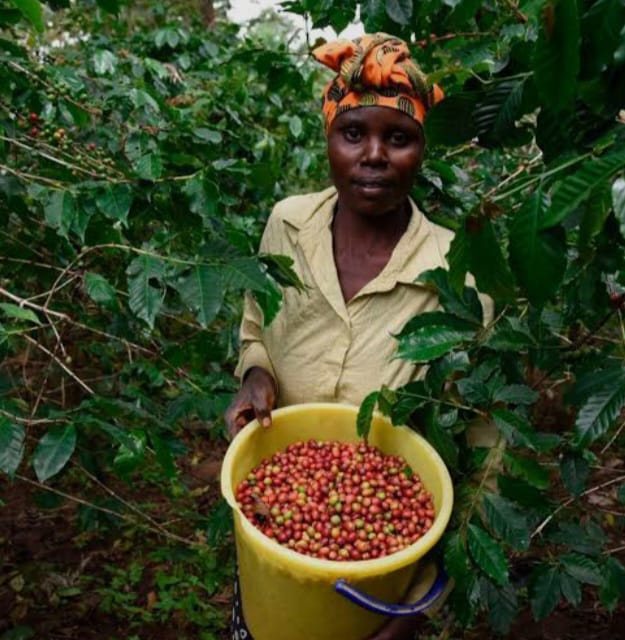
A farmer in a coffee farm
By Gachara Kamanga
For decades, Kenya’s coffee has tantalised the global market with its rich aroma and distinctive acidity.
Yet, paradoxically, the farmers who produce this world-class Arabica continue to live on the margins of poverty, selling their cherries at KSh50 to KSh150 per kilo.
Meanwhile, a kilo of processed Kenyan coffee retails abroad for over KSh2,000. That discrepancy is unacceptable. It’s time to turn a new leaf so that Kenyan coffee can fetch ten times its current price. This will require dismantling an entrenched system of inefficiency, middlemen, outdated laws and underutilised production potential. If we take the maximum possible international market price for a kilo of roasted speciality coffee as our north star, we can reverse-engineer the entire value chain. We must ask: what would it take for a farmer in Kirinyaga or Nyeri to earn Sh1,000 per kilo of cherries? What assumptions would have to hold? Who needs to do what?
According to the Kenya Institute for Public Policy Research and Analy-sis (KIPPRA), coffee output in Kenya has plummeted from 130,000 metric tonnes in 1988 to just 50,000 tonnes in 2021. The causes are poor returns, aging trees, climate change and a slow collapse of large-scale estates into housing estates. Farmers are giving up. But they don’t have to.
Revitalisation is possible through interventions already being tested in other countries. Kenya must scale up access to high-yielding and disease-resistant varieties, promote climate-smart agriculture, and invest in targeted soil improvement, irrigation, and extension services.
The government has already distributed close to five million seedlings. Now we must track their uptake.
But higher production alone will not raise incomes unless we address the scandal of value leakage across the supply chain. Nearly 98 per cent of Kenyan coffee is exported as green beans. That means most of the real value, including roasting, branding, packaging, and direct-to-consumer sales, is captured abroad.
We must flip that script. Counties and cooperatives constructing their own mills is a good start, but the real leap will come when we aggregate volumes, process at scale, and enter the speciality market with traceable, branded products.
The model is not theoretical. Tanzania’s late President Magfuli once bought all the country’s cashew nuts from farmers and then negotiated directly with bulk buyers. We can do the same with coffee.
This is where an innovative Public-Private Partnership (PPP) model comes in. Imagine a consortium where diaspora investors, local cooperatives, county governments, and private processors form a unified vehicle. This vehicle buys coffee directly from farmers, mills it, adds value, and sells it internationally through direct contracts with speciality buyers.
Farmers become shareholders, not just suppliers. Diaspora Kenyans bring in capital, access to global markets, and quality assurance systems. The county government provides logistics, data, and market linkages. Such a model, if well-governed, could return up to 40 per cent of the international price back to farmers. Up from the current 5-10 per cent.
But even this requires dismantling regulatory bottlenecks. Currently, the law splits licensing for buying, milling, and marketing into separate, often conflicting hands. That system must be harmonised. The proposed Coffee Bill 2023 offers some promise, especially by introducing minimum pricing and limiting predatory borrowing. But we must go further. Regulation should enable innovation, not entrench inefficiency.
Marketing is another weak link. Kenya’s auction system is opaque, unresponsive to market trends, and often controlled by entrenched interests. Meanwhile, small-scale farmers lack access to real-time price information or market intelligence.
We must embrace modern marketing strategies. Direct trade, e-commerce platforms, certification for specialty and organic markets, and branding of origin-based coffee. We can no longer afford to be raw exporters in a premium segment that rewards narrative, origin, and quality.
Then there is governance. Cooреrative societies must either reform or die. Rampant corruption, delayed payments, and lack of transparency have eroded trust in a system that was once the pride of smallholder agriculture.
If we dare to dream, to plan, invest, and execute accordingly, we can turn Kenya into a specialty coffee powerhouse..
Gachara Kamanga is a Development Expert based in Nairobi. He is widely expected to contest the Nyeri County gubernatorial position in the coming General Elections
Similar Posts by The Mt Kenya Times:
- Olise seals France win over Belgium in Nations League thriller
- Fatuma faces Senate scrutiny in PSC commissioner bid
- Birik: Lokichar first oil on course for December
- Eng Mwangi: Dangote refinery could reshape Kenya’s industry
- Mt Kenya Times ePAPER September 29, 2026
About the Author