The Mt Kenya Times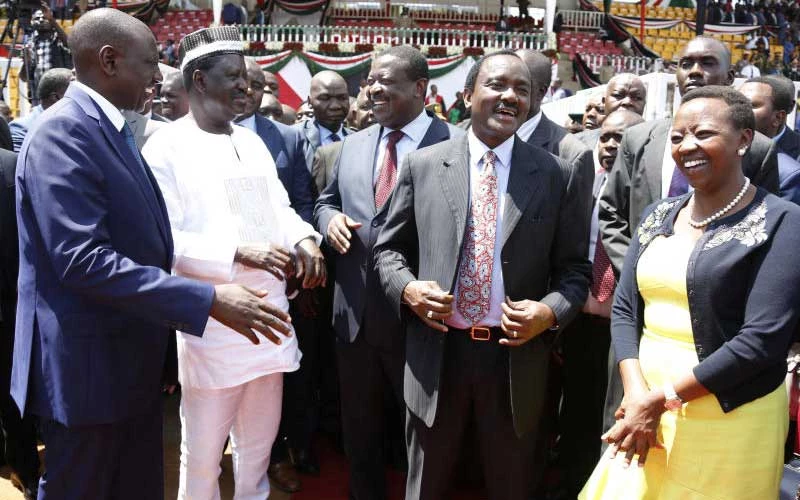
President William Ruto in a conversation with former PM Raila Odinga, former VPs Musalia Mudavadi and Kalonzo Musyoka flanked by Rachel Ruto during the Mashujaa Day celebration in 2018. (File)
By: Midmark Onsongo
Worth Noting:
- William Ruto, Kenya’s current president, is another figure who has employed the language of sympathy to great effect.
- During his campaigns, Ruto often referred to himself as a “hustler,” a term that resonates with many Kenyans who struggle daily to make ends meet. By calling himself a hustler, Ruto taps into the frustrations and aspirations of the common man, positioning himself as one of them, someone who understands their plight.
- This strategy proved effective, as it allowed him to connect with voters on a personal level. “He who has not traveled thinks his mother is the best cook,” an African proverb reminds us that one’s perspective is limited by their experiences.
It was once said, “When the elephants fight, it is the grass that suffers,” an African proverb that reflects the condition of the ordinary citizen when politicians engage in the battle for votes. In Kenya, a land rich in culture and history, politicians have mastered the art of language, twisting words and manipulating sentiments to attract voters. They employ sympathetic terms, often playing on the emotions of their audience, presenting themselves as saviors in a society fraught with challenges. However, as you will see, this language is sometimes superficial, designed more to entice than to bring real change.
Take, for instance, the case of Silvanus Osoro, a politician who hails from Kisii County. Osoro, in one of his political rallies, used the word “entakana,” a Kisii term that means orphan. This choice of words was meant to evoke sympathy, aligning himself with those who feel abandoned or neglected by the state. The idea here is to position oneself as a protector of the weak, someone who will fight for the rights of those who cannot defend themselves. But as the wise say, “A word is enough for the wise.” Osoro should be reminded that an orphan is someone who has lost their parents, not someone who is married. The concept of marriage signifies a partnership, a union that fills the void of loneliness. When a politician like Osoro uses such a term, it may resonate with those who feel disconnected or unsupported, but it also risks alienating those who see through the thin veil of rhetoric.
This strategy is not new, nor is it unique to Osoro. Throughout Kenya’s political history, leaders have employed similar tactics, using words that carry emotional weight to gain an advantage. During election periods, the air is thick with promises and sympathetic language. “A man who uses force is afraid of reasoning,” goes another proverb, highlighting how some politicians avoid the difficult task of addressing real issues by instead appealing to voters’ emotions.
Consider the case of Raila Odinga, a seasoned politician who has often positioned himself as the “father” of democracy in Kenya. In his speeches, he frequently refers to himself as “Baba” (Father), a term that carries with it connotations of guidance, protection, and wisdom. By using this word, Odinga taps into the deep-seated respect for elders and the cultural significance of the father figure in Kenyan society. This term not only garners him respect but also allows him to present himself as a unifying figure, someone who can bring stability to a fractured nation. However, as the saying goes, “A bird will always use another bird’s feathers to feather its own nest.” Odinga’s use of the term “Baba” is a calculated move to gain trust and loyalty, but it also raises questions about the authenticity of his intentions.
Another politician who has mastered the use of sympathetic language is Deputy President Rigathi Gachagua. Often referring to himself as “the son of Mau Mau,” Gachagua invokes the memory of Kenya’s freedom fighters, the Mau Mau, who fought for the country’s independence from British colonial rule. By aligning himself with these historical figures, Gachagua seeks to portray himself as a fighter, a leader who will continue the struggle for the betterment of Kenya. The term “son of Mau Mau” is a powerful one, as it connects him to the legacy of bravery and resistance. Yet, one must ask, as the proverb goes, “When a man promises to bring you a cow, hold on to your chicken.” Does Gachagua’s rhetoric match his actions? Is he truly carrying on the legacy of the Mau Mau, or is this another example of a politician using emotional language to gain votes?
William Ruto, Kenya’s current president, is another figure who has employed the language of sympathy to great effect. During his campaigns, Ruto often referred to himself as a “hustler,” a term that resonates with many Kenyans who struggle daily to make ends meet. By calling himself a hustler, Ruto taps into the frustrations and aspirations of the common man, positioning himself as one of them, someone who understands their plight. This strategy proved effective, as it allowed him to connect with voters on a personal level. “He who has not traveled thinks his mother is the best cook,” an African proverb reminds us that one’s perspective is limited by their experiences. Ruto’s self-identification as a hustler is meant to bridge the gap between him and the electorate, but it also risks oversimplifying the complex realities of governance and leadership.
Yet, not all sympathetic language in Kenyan politics is meant to deceive. There are instances where politicians use their words to genuinely connect with their audience, to inspire and to lead. “Wisdom is like a baobab tree; no one individual can embrace it.” This proverb speaks to the idea that leadership is a collective effort, and a leader’s words must be matched by actions. When politicians use language that reflects the true aspirations of the people, when they speak not just to win votes but to build a better future, their words carry weight. This is the kind of leadership Kenya needs—one where rhetoric is not just a tool for manipulation but a means of guiding the nation toward progress.
The language used by Kenyan politicians during election periods is often a blend of sympathy, cultural references, and emotional appeal. Terms like “entakana,” “Baba,” “son of Mau Mau,” and “hustler” are strategically chosen to resonate with voters, to create a connection that transcends policy and focuses on identity. However, as the proverbs remind us, words alone are not enough. “The lizard that jumps from the high iroko tree to the ground said he would praise himself if no one else did.” Politicians may laud themselves with grand titles and sympathetic terms, but the true measure of their leadership lies in their actions. Voters must look beyond the rhetoric, beyond the emotional appeals, and consider whether these leaders are truly working for the good of the nation. As Kenya continues to grow and evolve, it is crucial that its leaders do not merely speak the language of sympathy but also embody the principles of justice, equity, and progress.
I like addressing Millennials because they often pride themselves on being progressive and informed, yet they frequently fall prey to the same emotional manipulation they criticize. It’s time they stop being easily swayed by sympathetic rhetoric and demand substance over sentiment.
This article was scripted by;
MIDMARK ONSONGO
(Sustainable economist, Geopolitics strategizer)
Similar Posts by The Mt Kenya Times:
- Tax relief for Kenyans: Will more money in our pockets make life easier?
- Poisoned bottle: Are we drinking ourselves into early graves?
- How Kenya and South Africa constitutionalized concentration while preaching the gospel of the disadvantaged
- Discipline begins at home
- Onana escapes serious injury in three-car crash
About the Author