Kenya’s electoral clock starts ticking: Inside the 12-month countdown to the 2027 general election

With the IEBC formally gazetting the election period and binding timelines now in force, Kenya enters its most consequential political season in years — and the stakes could not be higher
By David Kimani
Kenya’s electoral clock began counting down in earnest yesterday when the Independent Electoral and Boundaries Commission formally gazetted the commencement of the 2027 General Election period, publishing Kenya Gazette Notice No. 13497 and bringing the Electoral Code of Conduct and the Election Offences Act into immediate legal force — placing every political party, aspiring candidate and campaign operative in the country under binding regulatory oversight with exactly twelve months to go before polling day.
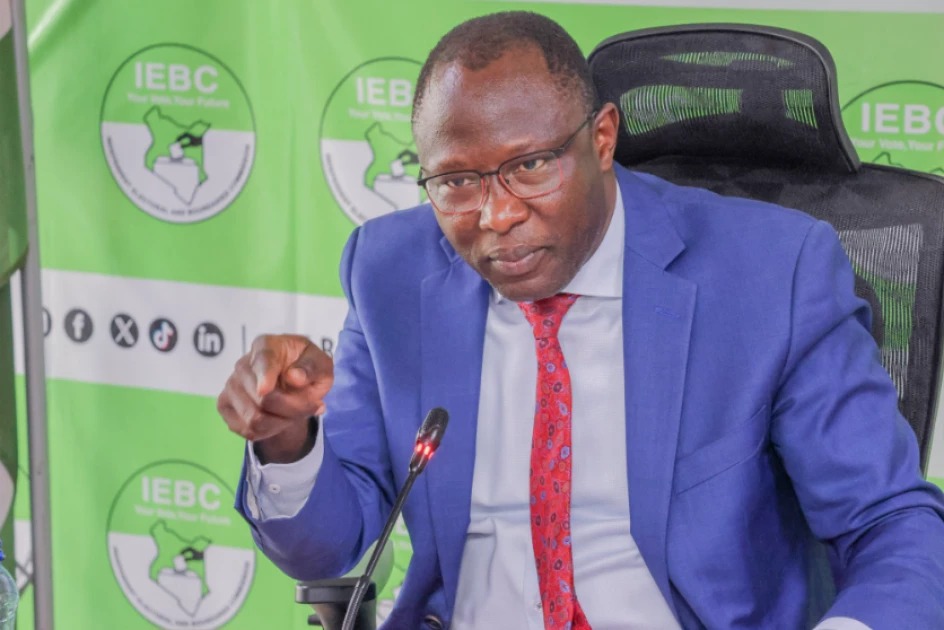
The announcement, made by IEBC Chairperson Erastus Edung Ethekon, was more than procedural. It was a starting gun. In a country where political competition has historically been intense, unpredictable and occasionally violent, the formal commencement of the election period carries weight that extends well beyond the gazette pages. Kenya will go to the polls on Tuesday, August 10, 2027, to elect a president, members of the National Assembly, senators, governors, county women representatives and members of county assemblies. The country that emerges from that election will in many ways be shaped by what happens during the twelve months that now lie ahead.
“The foundation of a credible election is a clean, accurate and verifiable register of voters,” Ethekon said as he laid out the commission’s preparations. It was a deliberately understated way of opening what is, in reality, an extraordinarily complex undertaking — one that will test Kenya’s democratic institutions, its political culture and its citizens in equal measure.
The political landscape into which this election period has been launched is, by any measure, one of the most fragmented and volatile Kenya has seen since the chaotic multi-party contests of the 1990s. President William Ruto’s Kenya Kwanza coalition, which swept to power in 2022 on a wave of popular sentiment from the so-called hustler movement, has spent much of the past two years defending itself against mounting public frustration over the cost of living, taxation and governance failures. The broad-based government arrangement that briefly brought opposition figures into the fold dampened political temperatures for a period — but that arrangement has since unravelled, and the opposition has reconstituted itself in new and more complex configurations that make the 2027 contest genuinely difficult to predict.
Perhaps the most striking development of recent months has been the emergence of the Democracy for the Citizens Party, led by former Deputy President Rigathi Gachagua, who was controversially impeached from office in late 2024. Gachagua has since repositioned himself as an opposition figure with a particular base in the Mount Kenya region, and his DCP has rapidly become one of the most talked-about political formations in the country. His alliance-building has been aggressive, drawing in governors, members of parliament and community leaders who have concluded that their futures lie outside the Ruto administration. DCP’s green branding, its “One Mountain, One Agenda, One Party” messaging and Gachagua’s combative public persona have given the formation a distinctiveness that few new parties in Kenya’s history have managed to establish this quickly.
Into this already crowded opposition landscape, Kiharu MP Ndindi Nyoro this week added yet another dimension, formally joining the People’s Party of Kenya as its leader and declaring his alignment with the opposition ahead of 2027. Nyoro’s departure from UDA, announced at Safari Park Hotel on Monday, was a carefully staged political moment — part policy statement, part personal reinvention. He spoke of consultations with Gachagua, Wiper Patriotic Front leader Kalonzo Musyoka, Jubilee deputy leader Fred Matiang’i, People’s Liberation Party leader Martha Karua, Siaya Governor James Orengo and Nairobi Senator Edwin Sifuna. The list was designed to signal reach, seriousness and coalition potential. Within 48 hours, three county assembly members — two from Kiambu and one from Murang’a — had followed him into PPK, suggesting that the defection is the beginning of a process rather than an isolated act. Matiang’i offered warm public congratulations, and the speed of the early momentum has caught the attention of political observers across the country.
The opposition, for all its energy, faces the same structural challenge it has confronted in every Kenyan election cycle: unity. The country’s political history is littered with opposition coalitions that formed with great fanfare, fractured under the pressure of competing ambitions and ultimately handed incumbent administrations a pathway to victory. The 2007 election led to post-election violence. The 2017 contest produced a Supreme Court annulment and a re-run boycott. In 2022, a united opposition under Raila Odinga came agonisingly close but still fell short. The 2027 election looks set to test whether the various opposition formations — DCP, PPK, Wiper, Jubilee, the remnants of Azimio and the various Linda Mwananchi networks — can suppress their individual interests long enough to mount a coherent challenge. The signs, so far, are mixed. Gachagua’s camp has been openly critical of Nyoro’s PPK, with DCP Secretary General John Methu describing it as a “green wheelbarrow” — a pointed reference to UDA’s wheelbarrow symbolism — designed to dilute the opposition vote in Mount Kenya. The suspicion that some new parties are state-sponsored entities deployed to divide the anti-government vote is widespread and, regardless of its accuracy, politically consequential.
For the Ruto administration, the terrain is no less challenging. The government enters the election period with its economic record as both its greatest vulnerability and its most important battleground. The promise of the Kenya Kwanza manifesto — affordable fertiliser, housing, healthcare, manufacturing and the empowerment of ordinary Kenyans — has delivered mixed results. The Affordable Housing Programme has attracted both genuine beneficiaries and fierce critics who question its financing model and its prioritisation over more urgent social needs. The Social Health Authority has replaced the National Hospital Insurance Fund amid significant controversy over implementation, access and cost. Taxation measures, including the Finance Bill that triggered nationwide protests in June 2024 and the subsequent deaths of young demonstrators, have left deep and lasting marks on the government’s relationship with the generation that will make up the largest share of the 2027 electorate. The administration will need to demonstrate, credibly and specifically, that it has delivered enough to deserve a second term.
The IEBC’s gazetted timelines add a further layer of complexity to this already charged environment. The commission has made clear that the deadlines it has published are not suggestions. “Adherence to the set timelines is non-negotiable. These are not mere guidelines, but legally binding requirements essential to the orderly and credible conduct of the electoral process,” Ethekon said. That is a warning directed at political actors who, in previous election cycles, have treated regulatory requirements as negotiable inconveniences to be managed through court orders and last-minute interventions. The commission’s tone throughout yesterday’s announcement was firm, and deliberately so.
The timeline is structured and demanding. Political parties must submit their authorised persons and specimen signatures to the IEBC by October 15, 2026. Nomination rules must be certified by the Registrar of Political Parties by October 30, with the certified rules submitted to the commission by November 6. Party membership lists must be with the commission by March 16, 2027 — the same date by which parties must submit the names of candidates seeking to contest internal primaries, along with dates and venues. All party primaries and intra-party disputes must be concluded by May 8, 2027. Presidential aspirants face the additional requirement of submitting, by May 24, a list of at least 2,000 registered voter supporters drawn from a majority of Kenya’s counties. Candidate registration runs from May 29 to June 11, varying by position. Campaigning may not legally begin before May 29 and must cease by August 7 — 48 hours before polls open.
Any public officer wishing to contest must resign by February 10, 2027 — exactly six months before Election Day. That requirement alone will force consequential decisions from sitting governors, cabinet secretaries, principal secretaries and other senior officials who harbour presidential or gubernatorial ambitions. The six-month clock is already creating political pressure in several counties where incumbents face the choice between the security of their current positions and the uncertainty of their electoral futures. Several cabinet secretaries are believed to be weighing exactly that calculation in the coming weeks.
The commission has also been explicit about what constitutes premature campaigning — and the consequences. “Any campaigning outside this prescribed period is unlawful. This includes the display of campaign posters, caravans, billboards and other forms of campaigning,” Ethekon said. In practical terms, this warning arrives at a moment when Kenya’s political landscape is already saturated with billboard campaigns, branded vehicles and what in Kenyan political parlance are described as “civic education” tours that bear a striking resemblance to election campaigns. The IEBC’s willingness to enforce this provision against well-connected political actors will itself become a test of the commission’s independence.
The IEBC has also addressed a legal question that has been hovering over the electoral process since last year. A Malindi High Court judgment found that, on a strict constitutional reading, the presidential election was due in August 2026 — not 2027. Justice Thande’s ruling, in a petition by Owiso Owiso, Khelef Khalifa and Ashioya Biko, held that the fifth year following the August 9, 2022 election commenced on August 9, 2026. The court suspended its decision pending the outcome of the 2027 election, and the matter remains subject to appellate processes. The commission has been clear that it continues to prepare for August 10, 2027. The legal ambiguity, while unlikely to derail the process, adds a layer of constitutional uncertainty that opposition actors have already begun exploiting in political messaging, and it will continue to generate litigation as the election approaches.
On voter registration, the numbers tell their own story about the scale of the exercise ahead. The commission projects that the 2027 register will contain approximately 28.5 million voters — a substantial expansion from the 22.1 million registered for the 2022 election. Continuous registration, which began in September 2025, has so far added 2,936,516 new voters. The commission is also expanding diaspora registration from 12 to 26 countries — a recognition that the Kenyan diaspora represents both a significant electoral constituency and an important source of political financing and public opinion. The integrity of the register will be reinforced through biometric verification and a forensic audit by an independent firm before the election.
The campaign financing rules gazetted on August 7 are among the most significant regulatory developments of this election cycle. The new Election Campaign Financing Regulations 2026, together with published contribution and spending limits, are designed to reduce the corrosive influence of money in Kenyan politics — an influence that has historically made competitive participation the preserve of those with access to substantial financial resources. Whether the regulations will be enforced with sufficient rigour to actually level the playing field remains an open question. The IEBC’s track record on campaign finance enforcement has been uneven, and the political will to pursue well-connected violators has not always materialised. The existence of the rules, however, at least creates a legal basis for accountability that did not previously exist in such explicit form.
The commission has also flagged a practice that has become increasingly common in Kenyan politics: the unauthorised use of the IEBC’s logo on campaign materials. Ethekon was direct. “Such use is irregular and unlawful and may falsely imply commission endorsement, thereby infringing on its independence, impartiality and non-partisan status,” he said, giving offenders five days to remove the materials or face action. It is a small but telling detail — a sign of how thoroughly the boundaries between institutional authority and political campaigning have been blurred in Kenya’s political culture, and a measure of how much work the commission faces in asserting its institutional independence in the months ahead.
The broader significance of what the IEBC has set in motion goes beyond the procedural. The 2027 election will take place in a country that is simultaneously more politically aware and more economically anxious than at any point in recent memory. The generation that took to the streets in June 2024 — young, digitally connected, politically unaligned and deeply impatient with the established political class — has not disappeared. It is watching. It is registering to vote. It is forming and expressing opinions through channels that traditional political structures are only beginning to understand. The party, coalition or candidate that finds a credible way to speak to that constituency will gain an advantage that no amount of political financing or regional mobilisation can easily offset. In 2027, the youth vote is not a footnote — it is the story.
The procurement challenges flagged by the commission — a temporarily halted tender for election technology and ballot papers following a review application at the Public Procurement Administrative Review Board — are a reminder that the administrative machinery of democracy is always more fragile than it appears. Delays in technology procurement, if not resolved promptly, could create pressures later in the calendar that force corners to be cut in ways that compromise the integrity of the process. The commission’s acknowledgement of the challenge is welcome; its resolution will require urgent attention.
 Ethekon’s closing appeal struck a tone that was deliberately measured given the turbulence of the moment. “Let us choose peace over violence, unity over division and issues over personalities,” he said. It is the kind of appeal that Kenyan electoral officials have made before every election for thirty years. Sometimes it has been heeded. Sometimes it has not. The difference, in 2027 as in previous years, will depend less on what the IEBC says and more on what the country’s political leaders decide to do with the space between now and polling day — and whether ordinary Kenyans hold those leaders to the standard that the moment demands.
The clock is running. The period has begun. Kenya’s next twelve months will be defined by the choices made within it.
Similar Posts by The Mt Kenya Times:
- Mt Kenya Times ePAPER October 7, 2026
- Ruto signs KSh389B electric vehicle deal at State House
- Kenya mobilises KSh70B to fight Ebola as US and World Bank step in
- High Court freezes law school admissions over disputed entry rules
- Grade 11 textbooks head to schools as CBC transition gathers pace
About the Author