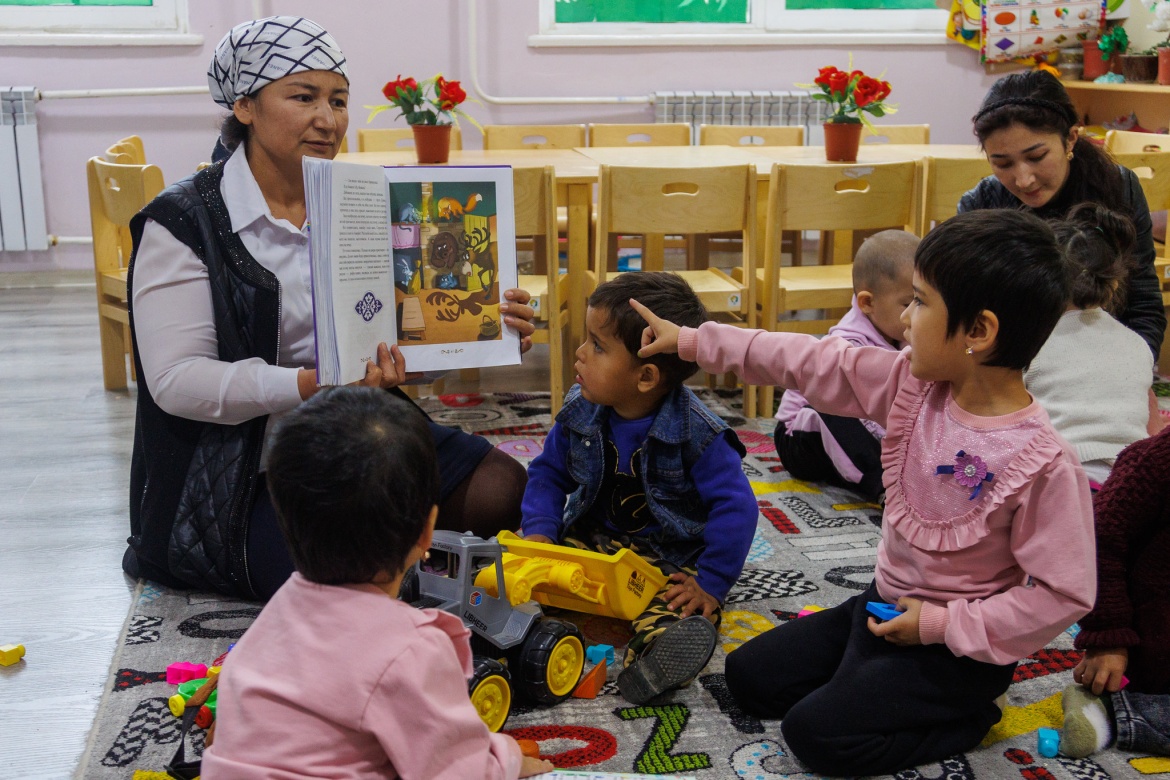
Methods Of Teaching Preschool Children in Uzbekistan

By: Raimkulova Dildora Rustam
Annotation: This article prepares preschool children to increase their knowledge of numeracy at the level of society’s demand. In addition, the stages of development of counting activities are revealed.Аннотация: данная статья готовит дошкольников к повышению их знаний по счету на уровне запроса общества. Кроме того, раскрываются этапы развития счетной деятельности.
Abstract: In this article, the preparation of preschool children to increase their knowledge of numeracy at the level of society’s requirements. In addition, the steps in the development of preschool children’s knowledge of elementary mathematics, the development of the methodology of interspersing lesso
Keys words: elementary mathematics, preschool education, games, counting, decimal system, quantity, calculation, mathematical ideas
INTRODUCTION
In our republic, great attention is paid to the issues of covering children with quality education from an early age, providing them with modern education, and socializing them into society.
A small group
One of the main tasks in teaching children of a small group of preschool age to count numbers is to teach children to compare sets by comparing the elements of one set with the elements of another set. This is of great importance in the development of counting activities of children in the future. The child does not know how to count, so he first learns to determine which of the compared sets is more and which is less, or if they are of equal strength. In many ways, the development of future mathematical ideas in children is the first step in teaching them to count.
In the second subgroup, the educator should develop the imagination of the children as a set of separate elements (items) of the same gender. Teaching in the activities devoted to elementary mathematical imagination in the small group should be of the nature of obvious effects. as well as learn by means of independent work with didactic materials.
It is necessary to start training with exercises on distinguishing the shape, color, quality, properties of objects. For example, the teacher takes a toy or some geometric shape and asks the children to describe it. The children have no difficulty in saying its color and shape when they see what they see with their eyes, and this makes it easier for the teachers to pass the lesson.
Middle group.
The main task of teaching 4-year-old children is to teach them to count objects, sounds, actions using the correct methods. In the initial training, the educator shows a sample of counting and counts by himself, and the children say only the total amount of the items he counted.
Teaching children to count numbers up to 3, 4, 5, to teach children to count ordinal numbers, to answer the questions “How many”, “Which”, “How many”, “How many in total”, “how many according to the count” and to use counting and ordinal numbers correctly training. It is formed on the basis of group comparison. The imagination, skills and competences necessary for teaching counting and introduction to numbers are strengthened.
To repeat the learned topic, the exercises recommended in the small group program are used in a slightly more complicated manner. Exercises in the program (allows you to complete 2-3 of the tasks at once). it is taught to distinguish the common signs.
Also, it is necessary to carry out exercises on comparing inequalities. In this case, it is necessary to show children that some items may be more, despite the fact that they occupy less space than the items of the second compared group (depending on the size of their location). Such exercises make the child understand that the number of objects does not depend on their size and location.
Didactic “What number is missing?” Children play in pairs. The teacher offers each pair to place the numbers in order from 0 to 10. Then one child switches the numbers on the number line with his eyes closed. He opens his eyes and tells what has changed in the row. If he finds it, he becomes the Leader. The game continues like this.
A big group
Teaching mathematics to older preschool children is a responsible and difficult task. How to tell a five-six-year-old child about time and space, numbers and sizes, so that it is interesting and informative? Various didactic games and game exercises help the teacher, and it is not necessary to buy materials for their implementation – you can do it yourself. 6-year-old children develop the ability to control their behavior; free memory, attention develops. At this age, they strive to complete the task and receive a positive assessment of their work. They look at the educational tasks (task) with great interest. Children should master the first ten numbers well in a large group. In the process of counting a set of various objects, determining the order of their arrival in a row, mastering the essence of numbers is carried out. All work done with children is organized on the basis of the knowledge they have acquired in the previous stages and taking them into account. Any new knowledge must be included in the previously acquired knowledge system. Only when there is a sufficient amount of exercises, students can develop thorough skills and abilities. Children should be trained to count objects, toys, geometric shapes, images on cards and pictures (recounting, adding, subtracting) and to determine the quantities of objects by feeling.
Didactic game “Let’s count together”. Purpose: to practice counting objects according to the named number and memorizing it, to learn to find the same number of toys. The teacher explains to the children that the more toys they say, the more they learn to count. He calls the children in turn and gives them the task of bringing a certain number of toys and placing them on a certain table. He instructs other children to check whether the task is done correctly, and for this count the toys, for example: “Seryozha, bring 3 pyramids and put them on the table. Vitya, check how many pyramids Seryozha brought. As a result, there are 2 toys on one table, 3 on the second, 4 on the third, and 5 on the fourth. Then the children are asked to count a certain number of toys and put the same number of such toys on the table to see if they are divided equally. After completing the task, the child tells what he did. Another child checks whether the task is done correctly
Literature analysis N.U. Bikbayeva, Z.I.Ibrahimova in the educational manual “Formation of mathematical concepts in preschool children”. Education of children of preschool age has its own characteristics. If the tasks that need to be solved at the age of preschool education are not solved, teaching at school will not be successful. One of these tasks is the transition to concrete knowledge and ways of thinking. This kind of pass level is especially necessary for teaching mathematics. The lack of such a level or its insufficiency leads to a double difficulty. On the one hand, children of preschool age often come to school with abstract mathematical methods, which are very difficult to overcome. On the other hand, when children acquire abstract knowledge at school, they often acquire it without understanding its formal, original content. Therefore, the possibility of applying mathematical knowledge in concrete conditions is very limited. Therefore, an important task of preschool education should be to form an intermediate level of knowledge and actions that ensure the connection between mathematical abstractions and concrete existence.
Investigations show that the content of the transition level in teaching mathematics to preschool children is as follows: first, it is necessary to master activities and problems in which the necessity of applying mathematical operations is clearly visible to children, on the one hand, the child’s issues directly related to practical activity (equalization, comparison), the second Dzhanpeisova G.E, Hodjimuratova B.N. Formation of mathematical ideas. Tashkent.: Tafakkur, 2020. p. 195
- E.M. Mardonov and others. “Organization of mathematical games in preschool education organizations”. Samarkand, publication of Samarkand State University, 2022. p. 235
3 3. E.M. Mardonov, G. Kushakova and others. Formation of mathematical ideas. Samarkand. Publication of Samarkand State University. 2020 page 200 Dzhanpeisova G.E, Khodzhimuratova B.N. Formation of mathematical ideas. Tashkent.: Tafakkur, 2020. p. 195
- E.M. Mardonov and others. “Organization of mathematical games in preschool education organizations”. Samarkand, publication of Samarkand State University, 2022. p. 235
3 3. E.M. Mardonov, G. Kushakova and others. Formation of mathematical ideas. Samarkand. Publication of Samarkand State University. From page 200 of 2020, such conditions are included in them that it is said that it will not be possible to implement these problems without using mathematical tools (for example, practically equalizing two sets separated in space).
Summary
In the preparatory group for school, children’s ideas about the structure of a number consisting of 2 small numbers are formed. It is taught to divide a number into 2 binary numbers and to form one large number from 2 small numbers. Children of preschool age should be introduced to all possible cases of forming and spreading (separating) numbers within 10. For example, it is advisable to start with number 3. The teacher places 3 oak leaves on the flannel, asks how many there are and what color they are. Then he replaces 1 green leaf with 1 yellow leaf. He asks what has changed, how many green leaves and how many yellow leaves (2 green and 1 yellow, 3 in total, so 3 is 2 and 1).
Raimkulova Dildora Rustam
2nd stage student of the Faculty of Pedagogy of the Namangan State Pedagogical Institute
Similar Posts by The Mt Kenya Times:
- Mt Kenya Times ePAPER September 19-20, 2026
- Kenya joins US and UK to put citizens on the terrorism frontline
- Kenya’s parliament races to tame the AI frontier
- Kalonzo calls Ruto to order over Uhuru attacks
- Gachagua takes his 2027 campaign to America
About the Author