OF DISINTERGRATING BUILDINGS: WHAT TALES CAN WE TELL OF THE CONSTRUCTION INDUSTRY IN KENYA
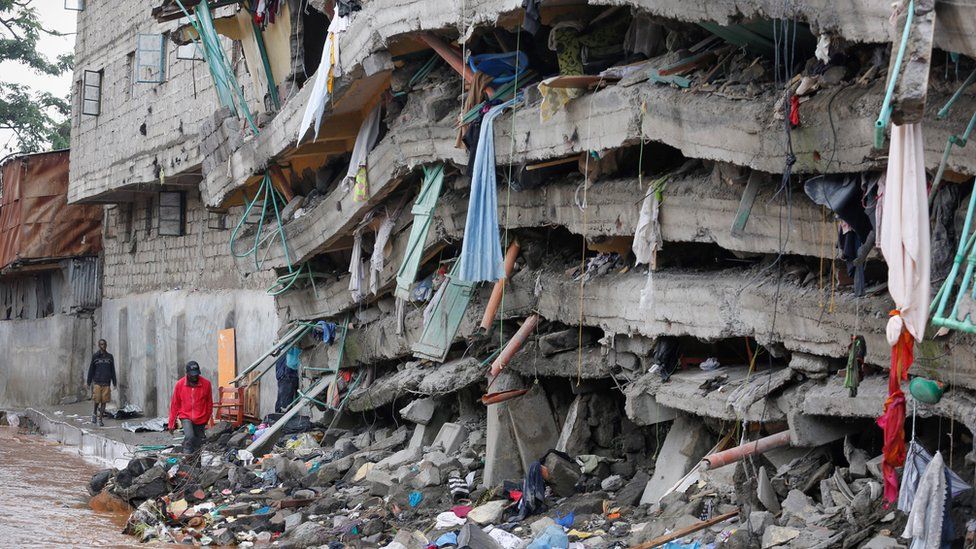
Collapsed Buildings

By: Odhiambo Jerameel Kevins Owuor
Worth Noting:
- Approved structural drawings: A Structural Engineer designs the structure aspects of a building. Once the architectural drawings have been approved, then, you are required to submit Structural Drawings for Approval. Having satisfied the requirements of the local authority, you are required to register your project before works commence on site.
- Project Registration –once you have received a construction permit, you are required to register the project with the National Construction Authority (NCA). Registration of a project is guided by National Construction Authority Regulations. Requirements for project Registration by NCA include NCA registration form- NCA fees have since been abolished; Approved architectural plans, Structural plans, Nema approvals, Contract agreement-commonly known as the Green Book), Quantity Surveyors, Architects and the Engineer’s practicing certificates; Here, you will get a compliance certificate.
Am almost tempted to begin this piece that long time ago when I was young. Then I have just remembered am few years old in this old planet. Now let me behave. Regardless, while I was in nursery school or pre-primary there is a song that we used to sing. The song was titled ‘London Bridge is Falling Down.’ The song goes:
London Bridge is falling down,
Falling down, falling down.
London Bridge is falling down,
My fair lady.
The original author still remains anonymous but it is believed that London Bridge is Falling Down was used for the first time as a passing reference in 1657. It was part of a comedy named The London Chaunticleres. However, it wasn’t until 1744 that the full rhyme was published in the collection Tommy Thumb’s Pretty Song Book. But when did it become a universally acclaimed nursery rhyme? Well, that has to be somewhere around the 1850s. But experts believe that the origin of this rhyme can be traced back to the medieval ages. Actually, it has more than one origin stories, though none seems to have been validated by history. There are theories, nonetheless.
Until the middle of the eighteenth century, the London Bridge was the only crossing for people on the Thames River in London. The structure was damaged in a big fire in 1633 and narrowly escaped more damage in the fire of 1666. With its 19 thin arches, the structure impeded river traffic and flow, experts say. Widening of the bridge took place in 1763, but even then it remained narrow and needed constant repairs. The bridge was replaced in the early nineteen century. The New London Bridge was opened in 1831 and survived until it, too, was replaced later in 1972. At that time, the 1831 bridge was taken apart and reconstructed in, of all places, Lake Havasu City, Arizona in the United States.
Enough of London Bridge, let me take you to Kenya to specific the counties of Nairobi and Kiambu which I dare say is the scene of crime. If truth be told, I should petition the folks who hold the rights to the song to change to ‘Houses in Kenya are falling down’ for those are the scenes that we have been witnessing in the past two weeks. Kiambu seems to lead in houses that are obeying the laws of gravity. The big question we need to ask ourselves is who should be held liable. For if we continue to treat the issue normally then definitely more victims will suffer in the near future. The best thing is prevent such incidences from happening.
Perhaps wisdom demands I get to highlight the due procedure and institutions mandated to approve construction of buildings in Kenya. The process of building a house usually begins with the purchase of land. Careful consideration should be taken when buying land since factors such as the size of land, location and terrain. One has to be sure to obtain documents demonstrating that the purchase/transfer of the respective parcel has been done legally with the approval of legal authorities. Once documentation has been completed, it is now time to decide on a house plan. One should discuss with the architect and, if possible, make a site visit with him. This is important because site features may influence the design of your house. On the construction phase one need to: prepare the site, lay foundation, reinforce foundation, superstructure, wall erection, lintel, roofing, wiring and plumbing, interior and exterior finishes, flowing, and painting and lastly get occupation licence from the respective county government.
The construction industry is regulated by governments all over the world so as to meet safety standards and avoid catastrophic effects of failed structures. This is achieved by having some bare minimums as compulsory regulations that must be observed when coming up with any structure. You need to meet the following requirements for you to get a construction permit. Approved architectural drawings: not anybody can come up with architectural drawings and submit for approval. The Architect is statutorily required to come up with a design that meets local authority building standards and submit to the relevant bodies for approval. In Nairobi, the process is online and the Architect is in charge of the process. However, the client is to provide any documentation that might be required to facilitate this. There are several documents that must be attached with architectural drawing such as: copy of survey plan, copy of land rates clearance certificate, proof of land ownership and change of user.
It is not automatic that you receive approvals by just providing the information mentioned above. A plan could be rejected if it does not meet statutory requirements as stipulated in the Physical Planning Act and Building Codes. Once the authorities are satisfied with Architectural drawing, you will receive an Approval Letter. Even though Architectural drawings are submitted first, always make sure that the Structural Engineer is simultaneously working on the structural drawings; this will make it possible to submit the drawings immediately the Architectural approvals are given and therefore save on construction time.
Approved structural drawings: A Structural Engineer designs the structure aspects of a building. Once the architectural drawings have been approved, then, you are required to submit Structural Drawings for Approval. Having satisfied the requirements of the local authority, you are required to register your project before works commence on site.
Project Registration –once you have received a construction permit, you are required to register the project with the National Construction Authority (NCA). Registration of a project is guided by National Construction Authority Regulations. Requirements for project Registration by NCA include NCA registration form- NCA fees have since been abolished; Approved architectural plans, Structural plans, Nema approvals, Contract agreement-commonly known as the Green Book), Quantity Surveyors, Architects and the Engineer’s practicing certificates; Here, you will get a compliance certificate.
Approved NEMA Report: every development has both positive and negative implications on the environmental. This is why it is imperative that the implications of implementing a project are well understood and documented. Once, the effects of a project are identified, mitigation plans are put in place in a NEMA Report. A licensed environmental Expert prepares a NEMA Report and submits it for approval.
The documents needed above are a must have on site and local authorities will always interfere with your work by stopping any further construction in the event that you don’t have any of them. Having permits is not enough; a developer needs to engage a contractor who is registered with The National Construction Authority. It is extremely important that a contractor has a Performance bond, relevant insurances to cover the works or the staff and Health Safety which needs to be observed on site as a mitigation measure of respective outcomes.
These are the four steps that need to be carried out and adhered to religiously. For the buildings that have been kissing the ground, one thing is being said over and over again. That is failure to adhere to the regulations presented before the various relevant authorities. In my past articles on this issue revealed that the problem is that of enforcement and implementation of the various laws, policies and regulations relating to construction industry. As well by virtue that we are in bad society with bad manners there are times in which permits are given yet the site isn’t conducive to hold the structure the folks have in mind.
What might be damn interesting is to the fact despite these numerous incidences in a cyclic nature, the relevant authorities seem not be in a hurry to solve this problem. Kiambu is the epicentre of falling buildings. One can predict when the next incident will happen in Kiambu either in Kinoo or Ruaka. The Construction industry in Kenya is deeply rooted with evil that need to be exorcised the sooner the better. For how long will we continue losing properties and lives in the hands of folks in the construction industry?
Given the increased numbers of failed structures that have caused loss of lives to the Public, the government should be committed to safeguarding the interest of the ordinary population. Government officials should frequently do impromptu site visits just to make sure that all the regulations are met, failure to which a construction site is closed and fines paid which is expensive at the end of the day. May this message reach to those it is aimed at.
Odhiambo Jerameel Kevins Owuor is a law student at University of Nairobi, Parklands Campus. He is an ardent socio-legal commentator not forgetting political issues. He can be reached at kevinsjerameel@gmail.com
Similar Posts by The Mt Kenya Times:
- How Kenya and South Africa constitutionalized concentration while preaching the gospel of the disadvantaged
- Discipline begins at home
- Onana escapes serious injury in three-car crash
- Kompany rushed to hospital after training collapse
- Mt Kenya Times ePAPER October 23, 2026
About the Author