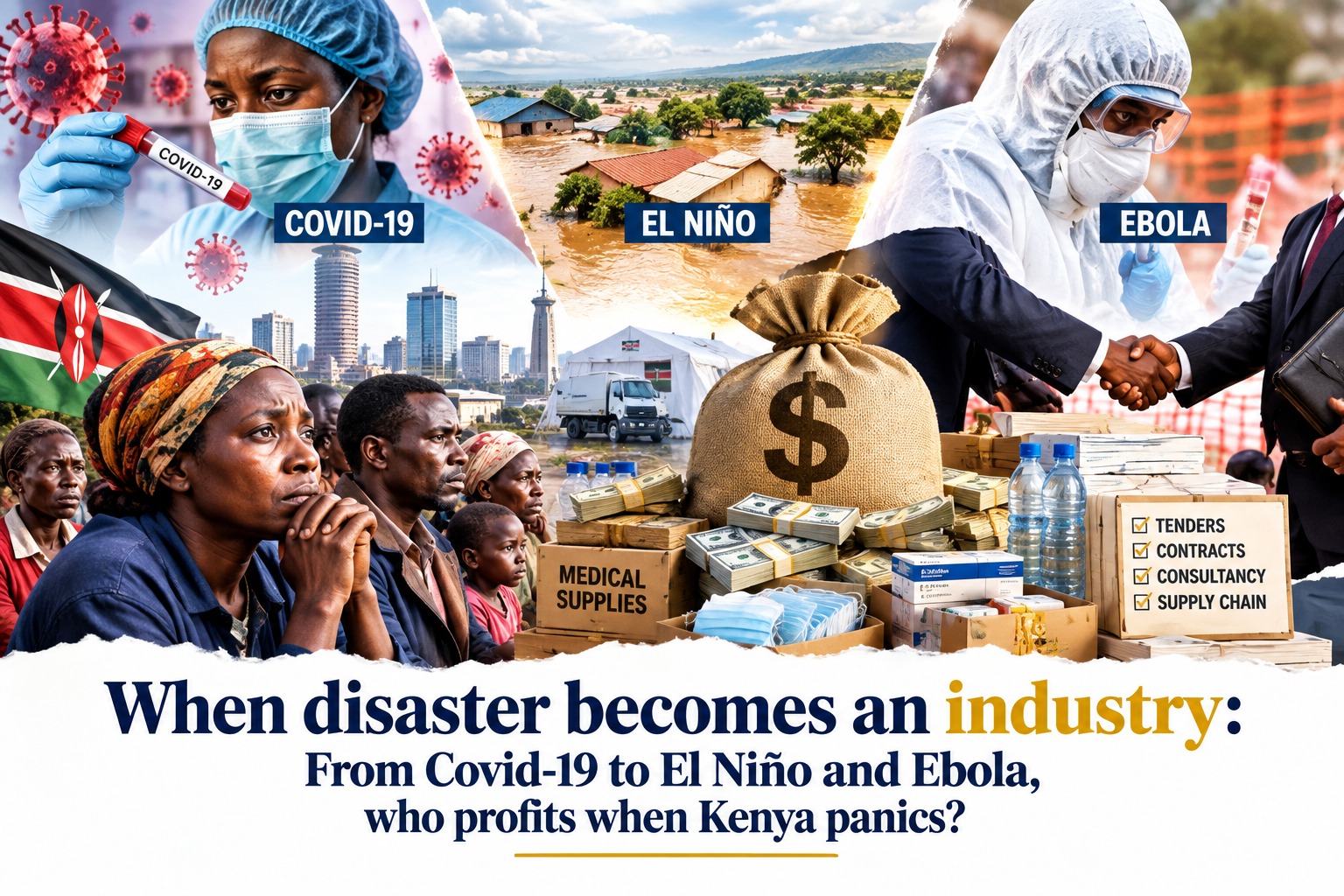
When disaster becomes an industry: From Covid-19 to El Niño and Ebola, who profits when Kenya panics?
 The Mt Kenya Times
By Mr. Fredrick Kipchumba Chelimo – PWD
Email; fkipchelimo@yahoo.com
“The true character of a government is revealed not only by how it confronts a crisis, but also by how honestly it accounts for the money spent in the name of saving lives.”
Kenya has become familiar with a disturbing rhythm of national emergencies: alarming warnings, urgent official announcements, political declarations, hurried mobilisation of resources and promises of comprehensive preparedness. Then, sometimes, public attention moves on before citizens receive satisfactory answers about what was spent, what was delivered and what lessons were learned. COVID-19 came with a global health catastrophe; El Niño warnings brought fears of floods, displacement and destruction; now Ebola has renewed anxieties about infectious disease. These are different threats, grounded in different scientific processes, yet their intersection with public expenditure raises one uncomfortable question: are we becoming better at managing emergencies, or merely more accustomed to financing them? To ask this question is not to deny science or diminish human suffering. It is to insist that the protection of life and the protection of public money are inseparable responsibilities.
Historically, infectious diseases have shaped human civilisation long before modern medicine emerged. The 1918 influenza pandemic demonstrated how rapidly an infectious agent could overwhelm societies. The discovery of viruses, advances in microbiology and the development of epidemiological surveillance subsequently transformed humanity’s ability to identify and contain disease. Ebola itself was first recognised in 1976 following outbreaks in what are now the Democratic Republic of Congo and South Sudan. Its scientific reality is beyond reasonable dispute. Similarly, El Niño is a naturally occurring climate phenomenon involving periodic changes in Pacific Ocean temperatures and atmospheric circulation, influencing rainfall patterns far beyond the Pacific. Neither Ebola nor El Niño needs political invention to pose a genuine threat.
COVID-19, caused by the SARS-CoV-2 virus, brought these scientific realities into ordinary households with extraordinary force. The world confronted illness, bereavement, disrupted education, economic hardship and unprecedented restrictions. Kenya, like many countries, had to procure medical supplies rapidly and strengthen its healthcare response. Yet the emergency also exposed serious weaknesses in public procurement. A 2020 special audit of KEMSA’s COVID-19 expenditure identified irregularities and significant concerns about procurement controls and value for money. Parliament publicly examined the findings, including substantial supplies that remained in warehouses. These were documented accountability concerns, not proof that the pandemic itself was fabricated or that every person involved in the response acted improperly.
That distinction matters. A genuine emergency can simultaneously demand urgent intervention and expose opportunities for abuse. The existence of corruption concerns does not invalidate the disease; the reality of the disease does not excuse corruption.
El Niño presents a comparable accountability challenge. Kenya’s experience of destructive flooding, damaged infrastructure, displaced families and lost livelihoods makes early warnings and disaster preparedness essential. The Office of the Auditor-General published a performance audit of the government’s response to floods in 2023, demonstrating that disaster management is a legitimate subject of independent scrutiny. The fundamental questions are straightforward: were vulnerable communities adequately prepared, were drainage and evacuation measures effective, did relief reach intended beneficiaries, and did expenditure produce measurable results? A warning is not a result, a committee is not preparedness, and a budget allocation is not proof of delivery.
Ebola now brings the debate into sharper focus. On 7 October 2026, Kenya’s Ministry of Health announced an imported case linked to the Democratic Republic of Congo. By 20 October, Reuters reported nine confirmed cases associated with the same cluster, with authorities reporting no evidence of transmission beyond it at that time. Contact tracing, isolation, surveillance and healthcare-worker protection are therefore matters of genuine public importance. These developments should encourage informed cooperation rather than panic or complacency.
Nevertheless, the public is entitled to ask whether emergency spending is proportionate, transparent and effective. Why does the mobilisation of resources sometimes appear more urgent than the publication of clear accounts? Why do procurement questions attract attention after public anxiety has peaked? Why must citizens repeatedly demand evidence that supplies reached hospitals, flood victims received assistance and preparedness commitments translated into practical capacity? Such questions do not establish a conspiracy. They expose the need for stronger safeguards.
Is this a viral business, a pharmaceutical business or a purely scientific phenomenon beyond reproach? The answer requires intellectual honesty. Viruses and climate systems are not commercial inventions merely because responses to them generate markets. Pharmaceutical manufacturers, diagnostic laboratories, equipment suppliers and logistics companies may legitimately earn profits by providing essential goods and services. Profit alone is not proof of wrongdoing. The danger emerges when commercial interests distort scientific advice, procurement favours connected suppliers, prices become indefensible or public health becomes secondary to private enrichment.
Science deserves respect precisely because its conclusions rest on evidence, testing and revision. Scientific recommendations must remain open to legitimate examination, while public authorities must explain the evidence behind interventions and acknowledge uncertainty where it exists. Equally, commercial allegations must be supported by evidence rather than suspicion. We should neither worship official pronouncements nor dismiss established science because institutions have previously failed.
The test of time will be whether Kenya learns from these recurring crises. Parliament, the Auditor-General, procurement oversight institutions, the Ethics and Anti-Corruption Commission, journalists and organised citizens must scrutinise emergency budgets, contracts, suppliers, deliveries and outcomes. Independent audits should follow major interventions, and proven irregularities should attract lawful consequences. Emergency procurement may require speed, but speed must never become a permanent licence for secrecy.
Ultimately, citizens do not demand a government capable of preventing every virus, controlling every weather pattern or eliminating every disaster. They demand competent preparation, honest communication and demonstrable value for money. They want to know that public fear is being met with practical protection rather than political theatre, and that resources entrusted to government reach the people whose lives they are intended to safeguard. COVID-19, El Niño and Ebola may be scientifically distinct, but they converge on one enduring test of governance: whether public institutions can protect human life without compromising public integrity. Kenya must answer that question before the next emergency arrives—not after the headlines fade and accountability becomes yesterday’s concern.
“When the danger passes, Kenya must not be left mourning its victims while wondering where the money went; a nation that can account for its emergencies is a nation better prepared to survive the next one.”
Similar Posts by The Mt Kenya Times:
- KWS launches KSh160B conservation programme in Tsavo
- Agriculture is not a refuge for idlers: Why we treat farming as a last resort
- Kenya’s competition law as the velvet glove on AfCFTA’s iron fist of unequal power
- Mt Kenya Times ePAPER October 21, 2026
- Kenya confirms ninth Ebola case as outbreak remains contained within single cluster
About the Author