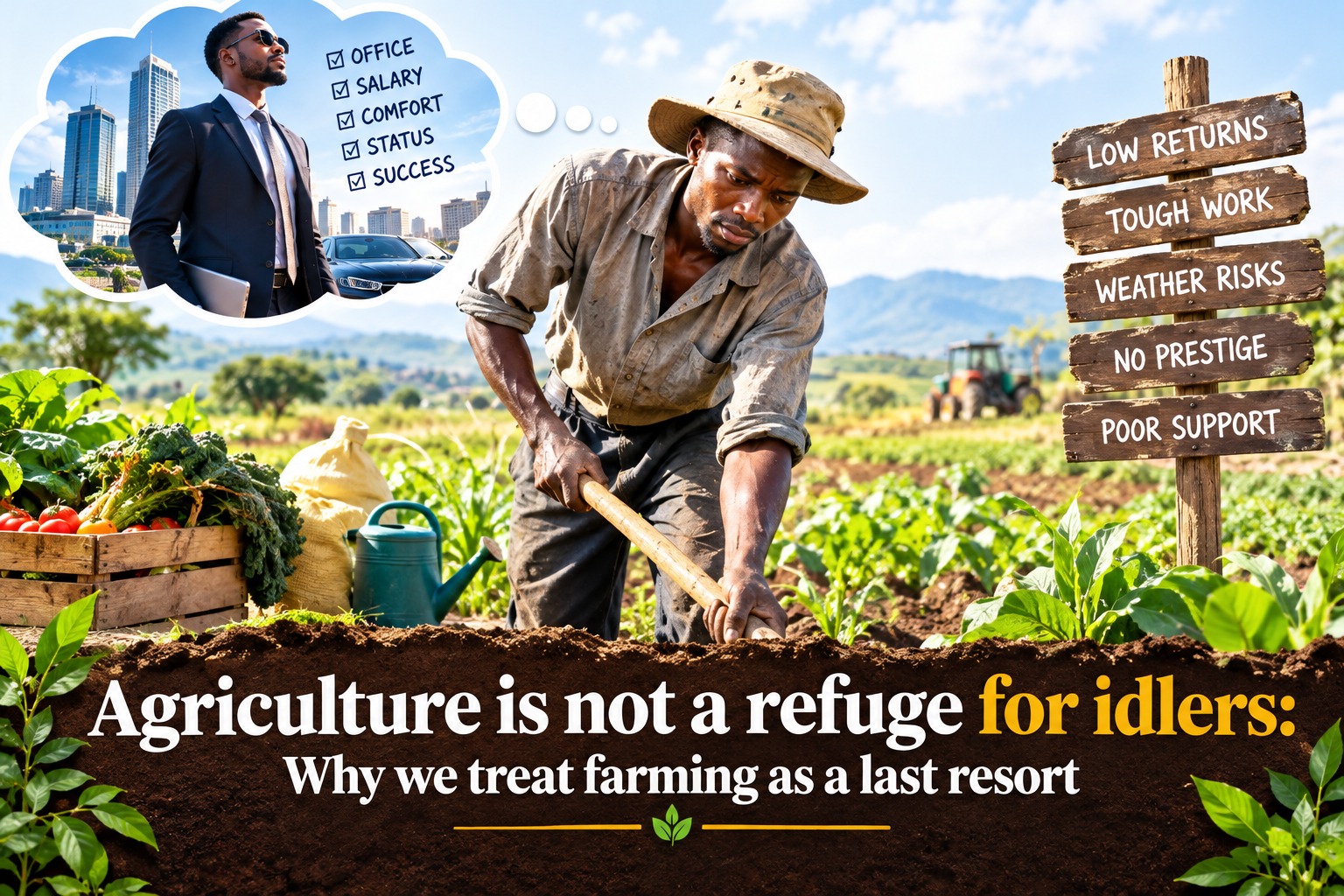
Agriculture is not a refuge for idlers: Why we treat farming as a last resort
Kenya’s dismissive attitude towards agriculture undermines one of its most vital economic sectors
By Ashford Kimani
Every time I overhear elderly people, those approaching retirement or unemployed graduates talking about their futures, one subject features prominently: agriculture. They speak of venturing into farming as though they have suddenly discovered a forgotten treasure.
What strikes me most is not their interest in farming but the attitude with which they discuss it. Their conversations suggest that agriculture is an occupation reserved for people with nothing better to do — a last resort for those who have exhausted every other option. Why do we continue treating farming as a refuge for the desperate rather than a serious economic enterprise worthy of ambition, investment and professional respect?
There is something fundamentally wrong with a society that regards farming as a fallback. We spend years educating our children, urging them towards prestigious careers, white-collar employment and the corporate ladder. We celebrate the doctor, the lawyer, the engineer and the banker. Their achievements are proof of success. Yet when those same people lose their jobs, retire or fail to secure the positions they expected after graduation, they suddenly remember that the soil exists. Agriculture becomes their plan B — too ordinary for someone with ambitions, yet conveniently available for someone whose ambitions have stalled.
This attitude raises an important question: why should agriculture be associated with failure? Is farming less intellectually demanding than sitting in an office? Does managing crops, livestock, agricultural finances, market fluctuations, labour, weather patterns and supply chains require less intelligence than managing files and attending meetings? Anyone who has seriously engaged in commercial farming understands it is a complex undertaking demanding planning, technical knowledge, patience, financial discipline and sound decision-making. The successful farmer is not necessarily the person who owns the largest piece of land but the one who understands how to turn available resources into sustainable profit.
Our education system and social environment have helped perpetuate this misconception. From childhood, learners are encouraged to study hard so they can obtain good jobs and avoid the hardships associated with farming. Agriculture is treated as a school subject to be passed rather than an industry to be explored. Young people consequently grow up associating farming with poverty, physical exhaustion and low educational achievement — rarely seeing it as a field where scientific knowledge, innovation, entrepreneurship and technology can combine to create wealth.
The irony is that agriculture remains central to our survival. Regardless of professional status, everyone needs food. Teachers need food, doctors need food, engineers need food — even those who dismiss farming need food. Salaries and business revenues cannot replace the fundamental importance of agricultural production. We may postpone buying a television or delay a holiday, but we cannot permanently postpone eating. Food production is a necessity, and those who produce it deserve recognition, not condescension.
In Kenya, agriculture offers opportunities across numerous value chains: crop production, dairy farming, poultry, horticulture, aquaculture, beekeeping, agroforestry, seed production, food processing, storage, transportation and marketing. A person does not need to own hundreds of acres to participate. With appropriate planning, market research and access to resources, ventures suited to one’s land, capital and skills are well within reach. What matters is not the glamour attached to the activity but whether the enterprise is viable, productive and sustainable.
That said, we must avoid romanticising agriculture. Farming is not a magical solution to unemployment, retirement anxiety or financial difficulty. It carries genuine risks: unpredictable weather, pests, diseases, expensive inputs, limited market access, post-harvest losses and volatile commodity prices. Anyone entering agriculture without preparation may simply exchange unemployment for debt. The answer is not to encourage everyone to rush into farming because other opportunities have failed. Rather, people should approach agriculture with the same seriousness they would give any other business.
This is particularly important for retiring public servants and private-sector employees. Retirement should not automatically mean buying land, keeping a few cows and planting crops without a clear business plan. Years of employment may provide savings, experience and useful networks, but none of those advantages confer agricultural expertise. Before investing retirement benefits, prospective farmers should study their intended enterprises, assess market demand, understand production costs and seek professional guidance where necessary. Retirement savings deserve protection, not impulsive investment driven by the assumption that farming is easy.
The same caution applies to unemployed graduates. A degree should not become a source of shame when formal employment fails to materialise, nor should agriculture be seen as an admission of defeat. Graduates bring skills that can meaningfully contribute to agricultural transformation. Those trained in information technology can develop digital solutions for farmers. Accountants can improve financial management. Engineers can support irrigation and mechanisation. Marketing graduates can connect producers to markets. Even graduates from unrelated disciplines can acquire the relevant skills and build successful enterprises. Education should equip people to solve problems, not merely qualify them to apply for jobs.
Our society must therefore change the language it uses when discussing farming. Instead of asking why an educated person is wasting time in agriculture, we should ask whether that person is creating value, producing food, employing others and building a sustainable enterprise. Instead of assuming that someone who retires into farming has run out of options, we should examine whether they are making a deliberate, informed investment. Equally, we must stop presenting agriculture as an effortless escape from unemployment. Farming deserves neither contempt nor blind glorification. It deserves informed engagement.
The problem is not that elderly people, retirees and unemployed graduates are considering agriculture. Their interest could, in fact, strengthen food production, create employment and stimulate rural economies. The problem is the mindset that leads them to approach farming as though they are settling for something inferior. If agriculture is good enough to rescue us when salaries disappear, why is it not good enough to inspire us while we are still employed?
The soil does not discriminate between a professor and a school dropout. It does not reward academic certificates, former job titles or social standing. It responds to knowledge, preparation, appropriate investment and effective management. Agriculture is not a dumping ground for frustrated ambitions. It is an industry capable of supporting livelihoods, generating wealth and sustaining nations. The sooner we stop treating farming as a last resort and start approaching it as a serious business, the sooner we will appreciate that working the soil is not a sign of failure — it is an opportunity to create value.
Similar Posts by The Mt Kenya Times:
- Como dismantle Manchester United 4-1 to deepen Carrick’s crisis
- Kvaratskhelia ruled out for months after ACL injury in PSG win
- Beyond the banter: Uganda’s university rivalry should be about impact
- KWS launches KSh160B conservation programme in Tsavo
- When disaster becomes an industry: From Covid-19 to El Niño and Ebola, who profits when Kenya panics?
About the Author