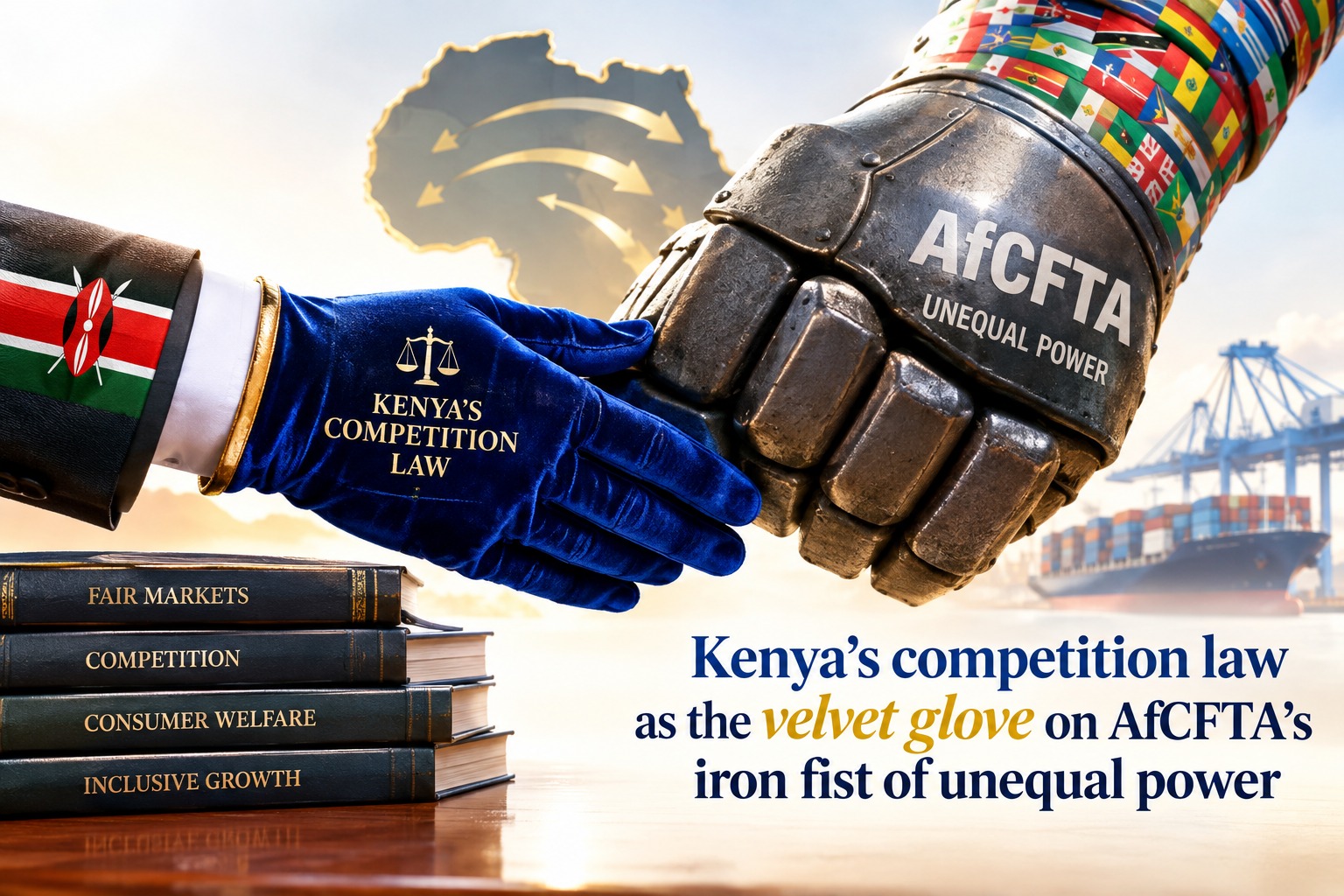
Kenya’s competition law as the velvet glove on AfCFTA’s iron fist of unequal power
 The Mt Kenya Times
By Jerameel Kevins Owuor Odhiambo
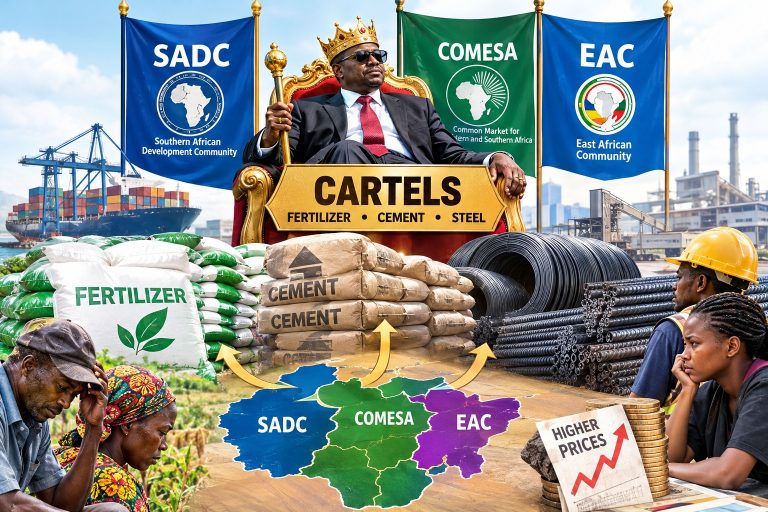
In the financial year 2024/25 the Competition Authority of Kenya processed 128 merger applications and investigated 75 behavioural antitrust matters 28 of them cartels, 39 alleged abuses of dominance nevertheless the OECD’s 2026 peer review records a starker truth: Kenya has issued no formal infringement decision for abuse of dominance in more than a decade. Eight large banks still command nearly 70 per cent of the weighted market-share index. Commercial state-owned enterprises generate revenues equivalent to at least 4.2 per cent of GDP while crowding competitive sectors. These are not isolated statistics; they are the living architecture of unequal power dressed in the language of open markets. The African Continental Free Trade Area promises a single market of 1.4 billion people. Kenya’s competition framework, however, remains calibrated more to manage concentration than to dismantle it thereby threatening the very democratic economic sovereignty the free-trade project claims to deliver.
History does not whisper here; it shouts. Colonial commerce in East Africa was never free. It was a system of chartered monopolies and racialized market access that concentrated economic power in few hands while the majority labored at the margins. Independence promised rupture. Instead, the post-colonial state often substituted one form of concentrated power for another state corporations, politically connected conglomerates, and regulatory forbearance that allowed private empires to ossify. The Competition Act of 2010 was meant to mark a decisive break: a modern statute with tools against cartels, dominance, and anti-competitive mergers. Sixteen years later the tools exist on paper while the market structure still mirrors the old hierarchy. Telecom remains heavily concentrated. Retail and manufacturing investigations recur. Logistics associations attempt price-fixing. The law is present; the power to reshape markets remains largely theoretical.
Consider the correlation that should disturb every serious observer of African integration. Tariff liberalisation under AfCFTA is designed to expand opportunity. Yet private restrictions cartels, abuse of superior bargaining position, strategic market positions in digital platforms can recreate the very barriers governments have dismantled. World Bank estimates suggest that lowering barriers to competition and trade could raise Kenya’s real GDP growth by several percentage points and expand formal employment. The inverse is equally true: if dominant firms and coordinated behaviour capture the gains of continental openness, the promised 7 per cent continental income boost by 2035 becomes a transfer of surplus upward rather than a broadening of prosperity. Logistics costs already erase tariff advantages for many Kenyan SMEs attempting to reach Rwanda or Nigeria. When a small producer pays almost as much to move goods as the goods themselves are worth, “open markets” become an ironic slogan.
The Competition (Amendment) Bill of 2026 attempts to close some gaps. It introduces notions of digital markets, strategic market position, and abuse of superior bargaining power concepts that do not always require the old 40 or 50 per cent market-share thresholds. These are necessary updates. Yet legislation without institutional courage is calligraphy on water. The Authority’s resources remain constrained relative to the scale of the economy and the multiplicity of overlapping regimes national, COMESA, EAC, and the emerging AfCFTA Competition Protocol. Businesses face compliance costs inflated by concurrent jurisdictions. Legal uncertainty becomes a tax on the ambitious and a shield for the entrenched. The protocol itself, adopted in 2023, correctly identifies cartels, abuse of dominance, and anti-competitive mergers as threats to continental trade. Its effectiveness will depend on whether national authorities treat it as a ceiling or a floor.
Democratic economic sovereignty is not the right of a government to protect favoured firms. It is the capacity of a people to shape the rules of exchange so that markets serve broad welfare rather than narrow capture. When eight banks control seven-tenths of the measured market, when mobile money and data markets exhibit persistent concentration, when state enterprises operate with soft budget constraints in competitive sectors, the claim of sovereignty rings hollow. Sovereignty without competitive markets is merely the freedom of the powerful to write the rules. AfCFTA without robust competition enforcement risks becoming a continental stage on which the same actors perform under a larger spotlight.
The literary irony is almost perfect. We open the borders with one hand while the other hand, through under-enforced competition rules and regulatory complexity, keeps the ladders of entry carefully guarded. The small manufacturer in industrial area Nairobi, the horticultural exporter in Naivasha, the digital start-up in Kilimani all are invited to the continental banquet only to discover that the seating chart was drawn long ago. History’s lesson is unambiguous: markets do not democratize themselves. They require deliberate, continuous reconstruction of the rules that govern them.
Action, therefore, cannot remain rhetorical. Parliament must pass the amendment bill with provisions that give the Authority real teeth in digital and bargaining-power cases, and it must fund the institution adequately. The Competition Authority must move beyond investigations to decisive infringement findings and structural remedies where markets are already concentrated.
The National Treasury and line ministries must confront the distortions created by the 209 state-owned enterprises operating in competitive spaces; commercial SOEs that cannot compete without privilege should be reformed or exited. At the continental level, Kenya should champion rapid operationalisation of the AfCFTA Competition Protocol with clear cooperation mechanisms that reduce rather than multiply jurisdictional friction. Civil society and the media must treat competition enforcement as a democracy issue, not a technical footnote. Business associations that once coordinated minimum tariffs must now compete on merit or face the consequences.
The alternative is a continental free-trade area that expands the theatre of inequality rather than the circle of opportunity. Open markets without equal power are merely larger cages. Kenya’s competition framework stands at a hinge moment. It can remain a sophisticated instrument that manages the status quo with elegance, or it can become the architecture of genuine democratic economic sovereignty one that treats the African Continental Free Trade Area not as a gift to the already powerful but as a hard-won commons for the many. The data are clear. The history is instructive. The choice is categorical. Reconstruct the law, or watch the promise of open markets dissolve into the familiar pattern of unequal power wearing continental colours.
The writer is a social commentator.
Similar Posts by The Mt Kenya Times:
- KWS launches KSh160B conservation programme in Tsavo
- Agriculture is not a refuge for idlers: Why we treat farming as a last resort
- When disaster becomes an industry: From Covid-19 to El Niño and Ebola, who profits when Kenya panics?
- Mt Kenya Times ePAPER October 21, 2026
- Kenya confirms ninth Ebola case as outbreak remains contained within single cluster
About the Author