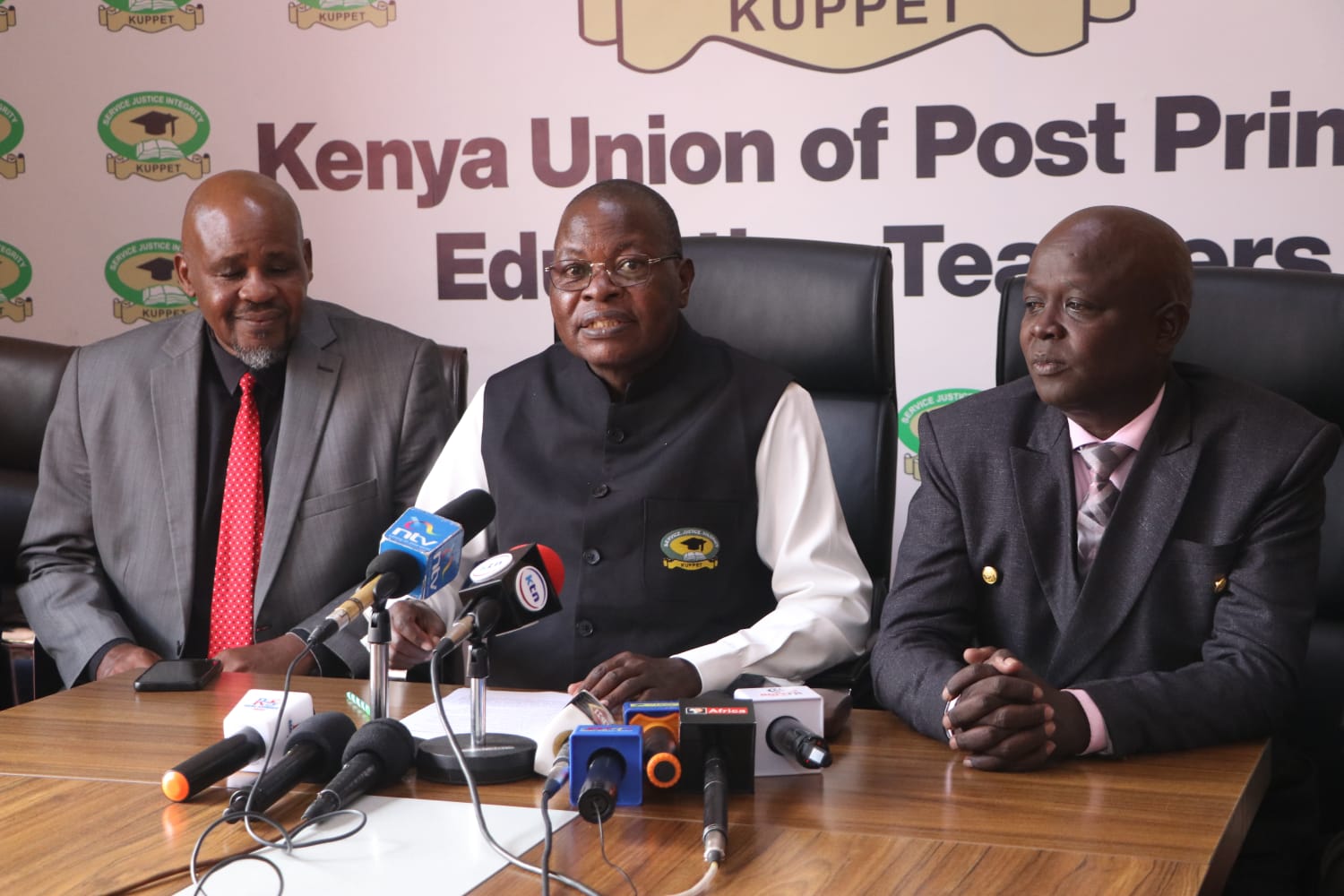
In picture, KUPPET Secretary General Akelo Misori (middle),Deputy Secretary General Moses Nthurima, and National Vice Chairman Julius Korir during a press briefing at the KUPPET headquarters in Nairobi. Picture credits (Elijah Odanga)
By Aoma Keziah
The Kenya Union of Post-Primary Education Teachers (KUPPET) has warned over what it terms as a systematic defunding of the country’s public education system by the national government. According to the union, the 2025/2026 budget estimates currently before the National Assembly point to a disturbing trend of undermining critical educational programs and services.
For the third consecutive year, the education sector has suffered significant budget reductions. The latest estimates reveal a staggering Sh62 billion shortfall compared to projections made in the Budget Policy Statement (BPS). Many allocations initially proposed in the BPS have been either drastically trimmed or eliminated altogether.
KUPPET is particularly concerned that the estimates allocate no funding for essential services such as the management of national examinations, quality assurance inspections, and the modernization of the school information management system. The union argues that this will effectively cripple the Ministry of Education’s ability to maintain academic standards across the country.
“The quality assurance department, already struggling, will now be rendered completely dysfunctional, and by shifting the costs of exam administration to parents, the government risks further eroding access to fair and equitable education,” said KUPPET Secretary General Akelo Misori.
They also stated that the budget slashes support for the school feeding program, which is vital for students in underprivileged areas, and reduces capitation grants for both primary and junior secondary schools. In what the union calls a “betrayal” of promises made to educators, the Teachers Service Commission (TSC) has been denied funds to confirm 20,000 intern teachers or to hire 20,000 new ones, as President William Ruto pledged during Labour Day celebrations earlier this month.
“These are not just numbers on a spreadsheet. These are promises to educators, lifelines for students, and pillars of our nation’s future,” added Misori .
The union sees these developments as part of a larger rollback in social spending, with education being hit hardest. Previous budget cycles have already seen the scrapping of critical programs such as Edu-Afya, university research funding, and student loan support schemes.
In a parallel concern, they also took issue with what it calls a “confused and contradictory” policy environment surrounding Junior Secondary Schools (JSS). A recent directive from the Ministry of Education aims to integrate JSS teachers into the leadership structures of primary school sports associations, what they view as a reversal of gains made in securing the independence of Junior Schools, which are legally distinct institutions.
“We demand the immediate withdrawal of the circular and a fresh framework that respects the autonomy of Junior Schools while supporting co-curricular development,” the Secretary General continued to say.
With the new financial year approaching, The union is calling on Parliament and other stakeholders to reject the current budget estimates and push for the full restoration of funding as originally outlined in the BPS.
Similar Posts by Aoma Keziah:
- Nationwide Youth Business Drive Enters Last Lap With New Nyota Trainings
- Green Light From Washington Sets G42 On Fast Track to Build Region’s Most Powerful AI Network
- Safina Eyes Kariobangi North Seat in Intensified Push Before Poll Day
- KEBS Opens Talks With Manufacturers On New Standards Levy Order 2025
- Kenya, Uganda And South Sudan Chart Way Forward On East Africa Rail Corridor
About the Author


 The Mt Kenya Times