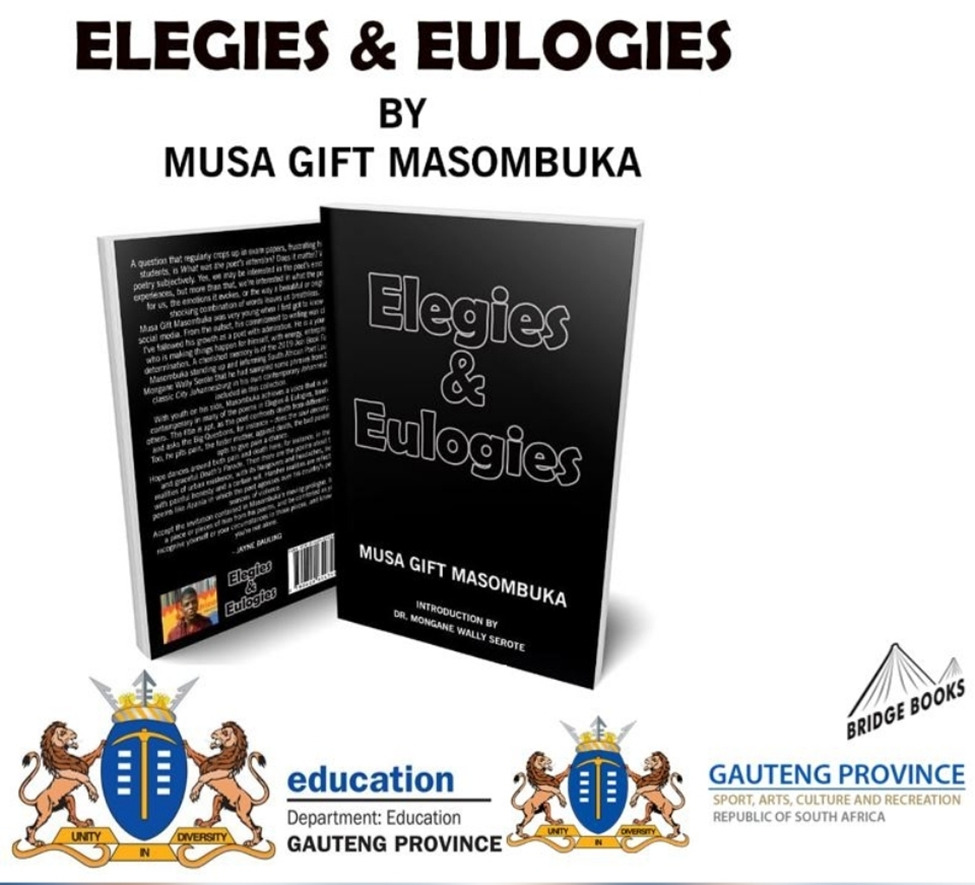
SOUTH AFRICAN MULTI AWARD WINNING WRITER MUSA GIFT MASOMBUKA, AUTHOR OF ELEGIES & EULOGIES.
Musa Gift Masombuka

By: Themba Emanuel Mashobane
Worth Noting:
- As a writer you become a mouthpiece for those who shy away from coming into the light and declare themselves victims of social ailments. Of course, to some certain extent we ought to not separate an artist from their artwork. The poems are a narrative of everyday experiences which affected me directly and indirectly, therefore I find myself writing about these experiences. The poems in Elegies & Eulogies are centered around themes of post-trauma, depression, identity, death and loss, and hope.
- The collection has 40 poems, which increased in successive impressions. The book is currently at its third impression which stands at 45 poems.
Let us get the tone and mood of a young man when he heartily express his sorrow through a collection of poems in his book titled: “Elegies & Eulogies” which was published in the year 2020, as we reflect on it since many of us we are still facing death. His book focuses on mortal loss and consolation. Musa explored the poetry genre in great detail and addressed matters of human love, which to his metaphysically inclined mind often resemble death. In most people, death is still a hurting ghost which can run away from, so such poems definitely help us in healing from our human loses. In his poems he give mourners a comic relief.
Who are you and what do you stands for?
Musa Gift Masombuka is a professional educator and writer. I believe in sharing experiences and caring for our society, starting off by caring for ourselves and those around us. I believe in communication, cherished memories, and little efforts or reciprocity.
Where were you were born?
I was born in Siyabuswa Mpumalanga, then spent the rest of my childhood and schooling in Regae village in Limpopo. I relocated to Johannesburg in 2016, and I am currently based in Yeoville.
Your poetry book Elegies & Eulogies, how did you come up with this title?
An elegy is a lament, a sad poem, mourning a loss of a loved one in general. Whereas a eulogy is still a lament but different in a sense that eulogies often reflects on the life of the deceased. A eulogy serves as a record of good deeds, a praise. Merging the two concepts, brings us to the title of the book. Elegies are poems about all the things we lost along the way, and eulogies are for our resilience, endurance, and strength in difficult and dire situations we frequently found ourselves in.
Where did you get an inspiration to write these kind of poems?
As a writer you become a mouthpiece for those who shy away from coming into the light and declare themselves victims of social ailments. Of course, to some certain extent we ought to not separate an artist from their artwork. The poems are a narrative of everyday experiences which affected me directly and indirectly, therefore I find myself writing about these experiences. The poems in Elegies & Eulogies are centered around themes of post-trauma, depression, identity, death and loss, and hope.
How many poems in this book?
The collection has 40 poems, which increased in successive impressions. The book is currently at its third impression which stands at 45 poems.
Are all your poems in this book about elegies and eulogies?
The poems in this book are not only elegies, and eulogies per se, rather the book is filled with poems addressing social ailments and its injustices. There are also poems of hope and rebirth, and of love – because who doesn’t enjoy a love poem afterall?
Do you give a little anecdote on your poems?
In the collection, I did not provide any anecdote on any poem, however, I do get consultations from readers about some of the poems and I do provide such additional or anecdotal information.
Take us through your elegies and eulogies, how is the tone, mood can make someone cry or gain strength?
Poetry is subjective. As the saying goes, there is no bad poem, you are just reading it wrong. Poems are short pieces that are meant to be read slowly and with short breaks in between, so as to ensure that each carefully chosen diction serves its purpose on the line, stanza, and / or whole poem. There are poems in this collection which scratches healing wounds and deepens the void, awakens the past, and fills our minds with nothing but questions. There are also those which gives us courage and strength to persevere throughout challenges we find ourselves in.
What is your favourite poem on your book?
It is difficult to choose, but if I have to, My Father’s Head trilogy becomes my favourite series. It reflects deeply and in great detail the livelihoods in black communities, the life of absent fathers, single mother headed families, the search for identity and need to belong, child bearing as a token for marriage, and many of other challenges which are dominant in the black community.
Can you briefly tell us about your father’s eulogies you wrote for him?
A search for identity and the need to belong is by a journey I have well travelled. And topics about absent fathers never make it to the dinner tables, and the walls never hear of, in most black families. Therefore, it became a lonely journey of discovery. Both elegy and eulogy poems written for my father, are meant to compensate for the lost time while I make peace with harsh reality.
What is a different between eulogies and tribute?
There is no greater significance between the two, they are synonymous and used interchangeably.
Who is supposed to read your book?
The book features a collection of poems with varied themes, making it suitable to be read by anyone. However, I would encourage the target audience to be young adults, adults, and the elderly.
Do you regard your book as therapy to people who still suffering from their loss?
Definitely. One thing I have noticed is that people fear being alone, and that is what depression or any mental disorder does to you. Therefore, people want to read to relate, to know that they are not alone, and to be reassured that such tribulations in life are not permanent. However, one thing about loss and its after effect is that it affects you going forward, physiologically and psychologically. People must learn to live with loss before they become victims of it too.
What are reader’s favorite poems on your book?
Readers have had different top picks in this collection, but the most enjoyed poems in the collection are My Father’s Head trilogy, Johannesburg, Hair, Nothingness.
Mourning it is a good healing practice according to you?
Yes, mourning is recommended. The challenge is that in black communities we do not get enough time to grieve and mourn because life does not standstill as we mourn, it has to carry on, therefore we substitute mourning with ‘working to provide’.
How long should mourning take for a person to heal, or it will be an ongoing process where someone will find himself or herself in?
Trauma is instant and spontaneous, but healing is not. Therefore healing takes time, one day at a time. There is no timeframe, you will feel it when you have healed. Another thing people should know is that healing sometimes does not require change, it is found in memories and old habits. To heal we should asking “why” and start embracing what was or has been.
What is the synopsis of your whole book to put a reader in a state of your mind on this book?
Elegies & Eulogies is a collection of 40 poems by Musa Gift Masombuka. The themes explored in the book include but not limited to: depression and anxiety, women and children abuse, the normalcy of absent fathers, teenage love affairs, and hope. Most of the poems in this collection addresses the social ills and the injustices which are still prevalent in the democratic South Africa, such as poverty, unemployment, discrimination, absent fathers, as well as single mothers headed families. It also seeks to respond to the wave of depression which has hit the 21st century young adults.
The book is introduced by Dr. Mongane Wally Serote; prefaced by Jayne Bauling, with a foreword from Edwin Mabodimo Mphaga.
Does death concerns you?
I am not much concerned about death but by the way people die. I am concerned about the ever increasing rate of people losing lives through suicide, because they could not be heard or given a platform to be listened to and express themselves and belch out all the storms brewing in them.
Do you think is wiser for community or country to host death awareness and debates on such topic?
I would rather say, as black communities we should normalize having difficult conversations, and be comfortable with expressing ourselves to the fullest. Encourage positive lifestyles and living habits. An awareness campaign about major contributing factors to suicide and how to curb them or rather coexist functionally with such.
Who is your world’s author role model?
I have read a lot, okay maybe a little, there is an inverse relationship between buying books and reading them. I prefer reading stories that invoke nostalgic feelings, and stories where we are / I am represented as a black person living in South Africa. Therefore, I do not have a role model, for now, but I shall have, soon.
Do you have a mentor?
No, but I have grown in the writing industry in the presence of legendary writers such as M.S Machitela, Jayne Bauling, Fred Khumalo, Gcina Mhlophe, and many others. These were writers whose work was taught in the classroom and academic space, and I had never imagined them as people who existed, but having to grow and finally working with them, is one of the greatest honours.
Where can a potential reader get hold of your book?
The book is available at Bridge Books Johannesburg, they can even order it on their website. Alternatively, I can be contacted directly for a signed copy. Musagiftmasombuka@gmail.com , 072 983 6716. On social networks, it’s Musa Gift Masombuka.
Similar Posts by The Mt Kenya Times:
- Mt Kenya Times ePAPER October 24-25, 2026
- Muturi calls on IEBC to keep election technology tender clean and on schedule
- Ruto meets UAE minister in push to deepen trade ties
- Gideon Moi breaks silence on Ruto fallout, cites broken promises
- The doctor who refused to abandon a sick Uganda
About the Author