The algorithmic rift: When Africa’s failure to forge its own intelligence becomes the architecture of permanent inequality
 The Mt Kenya Times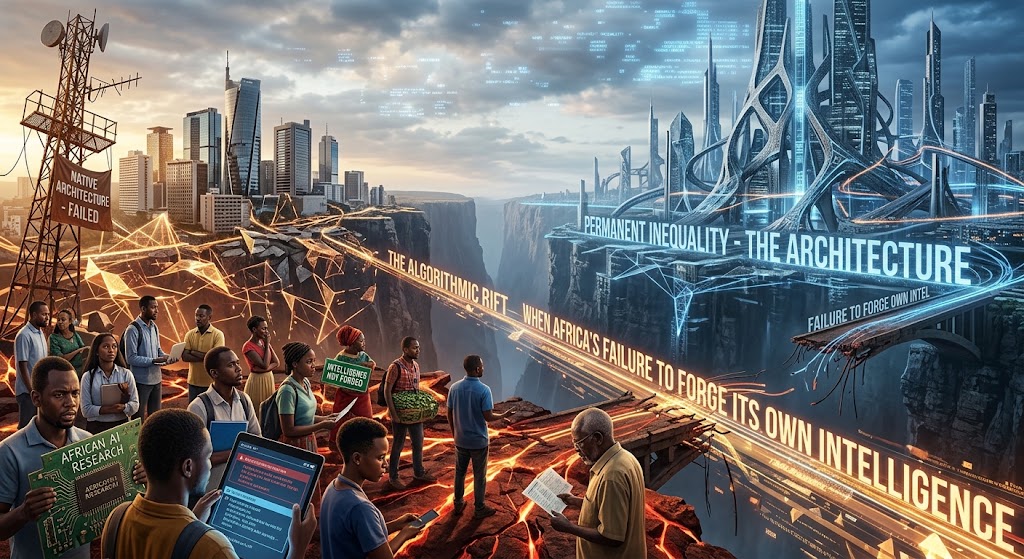
By Jerameel Kevins Owuor Odhiambo
In 2024, only 38 percent of Africans used the internet, against a global average of 68 percent. Sub-Saharan Africa produced roughly 0.89 percent of the world’s AI research publications. The continent that is home to nearly one-fifth of humanity controls less than one percent of global data-centre capacity and AI compute. These are not abstract statistics. They are the opening coordinates of a new geography of power.
If Africa does not deliberately and urgently build its own AI future its own models, its own data infrastructures, its own talent pipelines, its own regulatory sovereignty the emerging AI divide will not remain a technical lag. It will harden into a social divide of unprecedented depth, amplifying inequality and locking in a structural power imbalance that no later redistribution can easily undo. The algorithm will become the new soil, and those who do not till it will find themselves permanent tenants on land they once owned.
Consider the correlation that history keeps teaching and we keep forgetting. For centuries, raw materials left African shores while finished value returned as dependency. Today the pattern mutates. African data mobile money trails, agricultural patterns, health records, linguistic diversity feeds global models trained elsewhere. The finished intelligence returns as expensive cloud services, foreign platforms, and black-box systems that neither understand local languages nor serve local priorities. Compute is the new mine. Talent is the new ore. Without indigenous capacity, Africa risks becoming a data colony in an intelligence economy it did not design.
The numbers make the danger vivid. Africa’s AI market is projected to grow from roughly $3.7–4.5 billion toward $16.5 billion by 2030. Optimistic scenarios from the African Development Bank and others speak of up to $1 trillion in additional GDP by 2035 if AI is deployed inclusively across agriculture, finance, health, and manufacturing. The IMF estimates that accelerated adoption could lift Sub-Saharan Africa’s output by about 4 percent over a decade twenty times the anaemic 0.2 percent expected under current trajectories. These gains are not automatic. They require electricity that does not vanish, broadband that is affordable, data centres that are local, and models that speak Swahili, Yoruba, Amharic, and Zulu rather than treating African languages as afterthoughts.
Instead we see concentration so extreme it borders on the pathological. Four countries Nigeria, Kenya, South Africa, and Egypt absorb the overwhelming majority of AI startup funding, data-centre capacity, and skilled talent. More than 80 percent of AI venture capital on the continent flows to this quartet. The rest of the continent watches from the margins. Within countries the urban–rural chasm yawns: internet use reaches 57 percent in cities and collapses to 23 percent in rural areas. Women, older citizens, and the informal majority remain disproportionately offline. When generative AI traffic is measured, Africa’s contribution is a rounding error around one percent.
This is not merely a lag. It is the early architecture of a caste system written in code. Those who control the models will set the terms of credit scoring, medical diagnosis, agricultural advice, educational pathways, and even political discourse. Those who only consume will find their opportunities filtered, ranked, and rationed by systems optimized for other realities. The young Africa’s greatest asset, with a median age near 19 and more than 60 percent of the population under 25 will confront a world in which the tools of advancement are owned elsewhere. Their creativity will be invited to annotate, to label, to clean data for foreign models, while the highest-value creation remains offshore. The demographic dividend risks becoming a demographic disappointment.
Intellectual honesty demands we name the mechanisms. First, compute scarcity. Training frontier models requires energy and silicon at scales most African grids and capital markets cannot yet sustain. Second, data asymmetry. Global models are trained on internet-scale corpora that under-represent African contexts; the result is systems that hallucinate local knowledge or simply ignore it. Third, talent leakage and thin pipelines. Only a minority of African universities offer dedicated AI programmes; many of the brightest leave for denser ecosystems. Fourth, regulatory and strategic fragmentation. While some nations have drafted AI strategies, continental coherence remains fragile, and many governments still treat AI as a fashionable add-on rather than a foundational infrastructure of sovereignty.
The emotional weight of this is not sentimental. It is the quiet fury of watching a generation’s potential rationed by infrastructure that never arrived. A farmer whose yield prediction model was trained on European or North American data will mis-time planting. A clinic whose diagnostic tool cannot parse local disease patterns will misdiagnose. A student whose language is invisible to the dominant large language models will find her ideas harder to express and her opportunities narrower. Inequality compounds: those already connected accelerate; those offline fall further behind. The social fabric frays not through sudden violence but through the slow, algorithmic sorting of life chances.
There is a deeper insight here that must be stated without apology. AI is not neutral technology. It is crystallized power, power over classification, prediction, and allocation. When a continent outsources that power, it outsources part of its future agency. The countries that currently dominate AI development did not arrive there by accident; they invested, protected, and directed. Africa’s own history of technological leapfrogging mobile money, for instance—proves the capacity exists when political will and local problem-definition align. The same energy must now be directed at sovereign compute, representative datasets, open African-language models, and educational systems that treat AI literacy as basic citizenship rather than elite privilege.
To refuse this work is to accept a future in which the AI divide becomes the primary social divide of the twenty-first century. Wealth gaps will widen not only between continents but within them, as a thin urban technocratic class connects to global systems while the majority remains spectators. Power imbalances will calcify: decisions about African resources, African health systems, African financial inclusion will increasingly be mediated by algorithms whose values and training data were shaped far from African soil. Dependency will deepen, dressed in the language of partnership and cloud credits.
Nevertheless, the window remains open. The same demographic youthfulness that makes the stakes so high also supplies the urgency and the numbers. The same linguistic and cultural diversity that current models ignore is precisely the richness that could produce more robust, less biased systems. The same necessity that once produced mobile money can produce AI solutions tailored to informal economies, climate-vulnerable agriculture, and fragmented healthcare. What is required is not mimicry of Silicon Valley or Shenzhen, but the deliberate construction of African AI capacity public and private, continental and national, technical and ethical.
The factual starting point is stark: 38 percent online, less than one percent of global compute, a vanishing share of research. The issue that follows is existential. If Africa does not build its own AI future, the divide will not stay digital. It will become the organising principle of inequality and the quiet architecture of diminished power. History will not ask whether the technology was impressive. It will ask whether a continent of a billion and a half people chose to shape the intelligence that will shape them or allowed others to write the code of their tomorrow. The choice is still open. The cost of hesitation is not.
Similar Posts by The Mt Kenya Times:
- Media warns: Information gaps fuel 2027 disinformation risk
- Gachagua’s DCP holds strategic NEC meeting ahead of 2027 polls
- Sifuna’s unending party ownership hurdles
- From leading within to changing the world: The Fredah Mainah story
- Kagwe launches nationwide soil testing drive to guide fertiliser use
About the Author