The architecture of neglect: Why consideration and humanity must become our fierce rebellion
 The Mt Kenya Times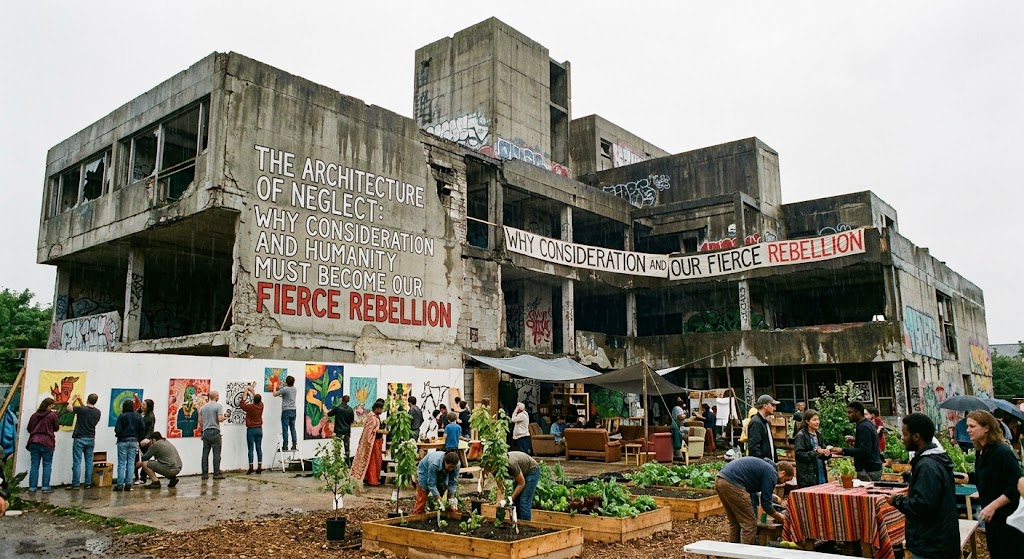
By Jerameel Kevins Owuor Odhiambo
Nearly six in ten Americans report feeling lonely. The Surgeon General has called loneliness an epidemic whose mortality risk rivals smoking fifteen cigarettes a day. It raises the odds of heart disease by roughly 29 percent, stroke by 32 percent, and premature death by 26 to 29 percent. Face-to-face time with friends among young people has collapsed by nearly 70 percent in less than two decades. These are not soft feelings or cultural mood swings. They are measurable fractures in the social body, and they reveal a deeper failure: the progressive atrophy of consideration and the quiet abandonment of the humane.
Consideration is not politeness. It is the disciplined act of treating another consciousness as real. Humanity is not sentimentality; it is the refusal to let efficiency, convenience, or self-protection erase the person standing in front of you. When these capacities weaken, isolation does not merely increase it becomes structural. We design our days, our apps, our workplaces, and our politics around the assumption that other people are optional or, worse, obstacles.
Look at the pattern. Empathy scores among college students dropped sharply across earlier decades; even where some measures later stabilized or partially recovered, a persistent “empathy perception gap” remains: people systematically underestimate how much others care. Loneliness and reduced prosocial behavior reinforce each other. The more isolated we feel, the less we reach outward; the less we reach outward, the more isolated we become. Digital life accelerated the loop. We optimized strangers and even intimates out of the texture of ordinary existence. One app at a time, we removed the small frictions waiting in line, asking directions, noticing the person next to us that once forced us to practice seeing others. The result is not freedom. It is a thinner existence in which the self becomes both sovereign and starved.
This is not nostalgia for a gentler past that never fully existed. Cruelty and indifference are ancient. What is new is the scale and the sophistication of the systems that reward emotional minimalism. We have built environments that make it easier to look past than to look at. In workplaces, loneliness costs organizations thousands per employee annually through absenteeism, turnover, and diminished performance. Teams that practice genuine regard managers who notice, colleagues who adjust without being asked show higher engagement, lower burnout, and stronger results. The data are unambiguous: prosocial motivation and acts of consideration improve well-being for both giver and receiver. Kindness is not a soft luxury. It is a performance enhancer and a public-health intervention.
Nevertheless, we treat it as optional. We call out toxicity when it is loud and spectacular, but we rarely name the quieter violence of habitual inconsideration: the message left unread for days, the meeting scheduled without regard for the other person’s constraints, the conversation that never asks how someone is actually doing because the answer might require time. These small withholdings accumulate. They teach people that their inner weather does not matter. Over years, the lesson becomes identity. People begin to move through the world armored, assuming scarcity of care, and therefore offering little themselves. The correlation is vicious and circular.
True consideration demands intellectual acuity. It requires the capacity to hold two truths at once: that one’s own needs are legitimate and that another’s are equally so. It is not self-erasure. The person who collapses every boundary in the name of “being nice” is not humane; they are depleted and eventually resentful. Mastery lies in the calibrated act knowing when to yield, when to hold firm, when to speak the difficult truth with precision rather than blunt force. It is the difference between the surgeon who cuts with care and the one who hacks. Both remove the problem; only one leaves the patient whole.
Consider the vivid mechanics. A colleague is struggling with an invisible deadline pressure or a private grief. The inconsiderate response is to proceed as if the calendar is the only reality. The considerate response does not require solving their life. It requires a single adjusted sentence: “I can shift this by a day if that helps.” Or simply noticing the tightness in their face and asking once, without performance. That small recognition can interrupt the loneliness cascade. Neuroscience and behavioral studies show that being seen reduces physiological stress markers and increases feelings of connection and purpose. The giver benefits as well: acts of kindness reliably elevate mood and meaning. The exchange is not zero-sum. It is generative.
We must also confront the harder cases. Consideration does not mean endorsing harm or pretending all perspectives are equal. It means refusing to dehumanize even those we oppose. The person who disagrees with you still has a nervous system that flinches, a history that shaped them, a capacity for pain. To deny that is to practice a selective blindness that eventually blinds us to ourselves. Societies that perfect the art of othering eventually turn the same machinery inward. History is littered with the evidence.
Original thought demands we stop treating consideration as a personality trait some people luckily possess. It is a skill that atrophies without deliberate practice and strengthens with it. In an age of constant partial attention, the practice is radical: put the phone down when someone is speaking. Leave the meeting early enough that the other person is not left scrambling. Write the email that anticipates the question the recipient will have rather than forcing them to ask. These are not grand gestures. They are the daily architecture of a society that still believes people are ends rather than means.
The alternative is already visible. Rising rates of anxiety and depression among the young track the collapse of unstructured social time. The perception that others care less than they do fuels withdrawal. Workplace cultures that treat people as interchangeable units produce higher burnout and lower loyalty. The data form a coherent picture: when we starve the capacity for mutual regard, everything downstream suffers health, productivity, creativity, the simple willingness to risk connection.
Even so, the same data contain the remedy. Interventions that simply inform people that their peers report higher empathy than expected increase social risk-taking and expand networks months later. Empathy-focused conversations reduce loneliness and depression even when delivered by trained laypeople. Prosocial acts improve the giver’s mental health. The machinery of disconnection can be run in reverse.
This is the call. Stop romanticizing rugged individualism when it has become a cover for emotional freeloading. Stop treating kindness as weakness when the evidence shows it is a form of strength that compounds. Demand of yourself the intellectual honesty to notice when you are optimizing people out of your path. Demand of institutions that they measure not only output but the human cost of how that output is achieved. Teach children not merely to achieve but to attend to the person beside them, to the subtle shift in tone that signals distress, to the quiet labor of making another’s day fractionally lighter.
Consideration and humanity are not the soft underbelly of progress. They are the load-bearing structure. Without them the edifice cracks: first in private loneliness, then in public distrust, then in a culture that can no longer imagine the interior life of the stranger. The statistics are already speaking. The question is whether we will answer with the only force strong enough to reverse the trend deliberate, skilled, unapologetic regard for one another as fully real.
The writer is a social commentator
Similar Posts by The Mt Kenya Times:
- Mt Kenya Times ePAPER September 30, 2026
- Ruto mocks UNGA critics: “That requires someone with sense”
- Media warns: Information gaps fuel 2027 disinformation risk
- Gachagua’s DCP holds strategic NEC meeting ahead of 2027 polls
- Sifuna’s unending party ownership hurdles
About the Author