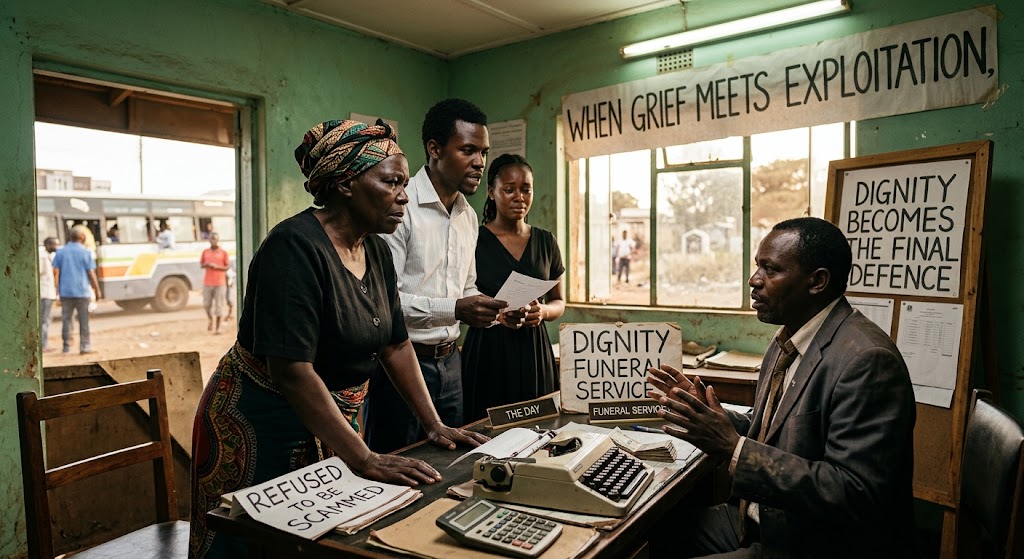
When grief meets exploitation, dignity becomes the final defence.
By Mukama Phillip Kahigiriza
Africa recently lost one of its most resonant voices, a man whose presence could silence conversations and whose passing brought an entire nation to a halt. Flags were lowered, WhatsApp groups fell quiet, and even the strongest men wept openly. The funeral was prepared with solemnity, the casket suspended between worlds, when an uninvited figure arrived.
He was a self‑styled pastor, dressed too sharply for a graveyard, microphone already in hand. Pushing past mourners, he declared that God had revealed the deceased would rise again. In their grief, the family and crowd gave him space. He stood over the coffin, shouting commands at death, stamping his polished shoes, demanding the grave obey. For a fleeting moment, hundreds believed. Then silence. The body did not move. Death refused to be bribed.
The spectacle collapsed. His promises, loud and theatrical, were denied by the dignity of a silent corpse. When the silence grew heavier than his shouting, he slipped away, leaving the family to bury their loved one twice — once in death, and once in deceit.
This was not an isolated incident. Exploitation thrives where desperation lives. There is a breed of opportunists who wait not for death but for despair. They appear when jobs are lost, marriages falter, children fall ill, or rent is overdue. They arrive smiling, oiled, and concerned, offering shortcuts that are chains.
They come disguised as friends: “My dear, I heard what you’re going through.” As relatives: “Bring something small, just 200,000, I have a connection.” As lovers: “If you love me, prove it. Sleep with me and I will open doors.” As bosses: “We are family here, just be more cooperative.”
They turn pain into their platform. Your joblessness becomes their testimony. Your sick mother becomes their prayer point. Your broken marriage becomes gossip wrapped in advice. They sell hope at extortionate interest, ensuring you remain needy enough to keep their stage alive.
We live in an age of extraordinary machines. Phones unlock with a glance. Scans reveal unborn children. Satellites search the earth for oil. Robots compose letters. Yet no machine can erase suffering. There is no button for heartbreak, no app for betrayal, no password to delete grief. Suffering is not a glitch but part of the human condition. Even Christ did not bypass it; he carried it.
The fake pastor mistook pain for a demon to be shouted away. But real pain does not obey noise. It is not removed; it is endured. It is walked through slowly, with tears, until the feet remember the ground again. The question left by that funeral was not who can raise the dead, but who will stay when the dead refuse to rise.
The man with the microphone could not stay ten minutes after his lie collapsed. He needed a stage, not sorrow. Yet there are others — rare companions who do not promise miracles or demand mobile money before prayer. They do not film your tears. They simply stand at the foot of your pain. They cannot fix unemployment, but they will sit with you through your hundredth application. They cannot cure your mother, but they will hold your hand in the hospital corridor. They weep with you. They stay.
That is the difference. The merchant says, “Watch me fix you so you can praise me.” The companion says, “I cannot fix you, but I will not leave you alone.”
So if you have paid for a job that never came, given your body for love that never stayed, trusted a friend who betrayed your secret, or knelt before a preacher who turned your tears into content — you are not foolish. You are human. Grief makes believers of us all.
Let your grave refuse their false promises. Let it teach you. Let the merchants seek another funeral to hijack. Stay with those who know how to stand in silence. Because even when miracles fail, even when the ground stays closed, dignity remains. And where there is dignity, life — stubborn, honest, and unscammable — begins again.
Similar Posts by The Mt Kenya Times:
- When young lives become disposable
- Statement win at the Gtech: Brentford outclass Chelsea to claim all three points
- When disability funds become a frontier for accountability: Kenya’s PWDs refuse to be invisible
- Public voices concerns over proposed education laws
- Manufacturing hope at the ballot, accumulating fortunes after the count
About the Author