The goon’s paycheque: When political intolerance turns Kenya’s streets into killing fields
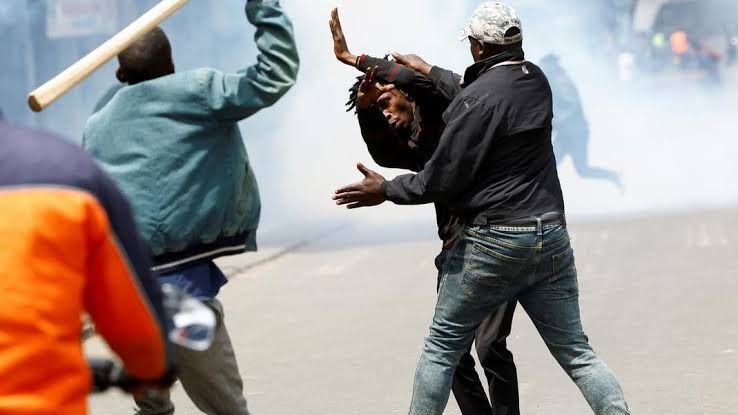
Goons
By Jerameel Kevins Owuor Odhiambo
On 16 August 2026, in Homa Bay County, hired youths paid between two and four thousand shillings each blocked roads with boulders and burning tyres, stormed the Homa Bay Tourist Hotel to hunt for perceived political opponents, torched at least six vehicles, attacked and robbed journalists of cameras and personal belongings, vandalized shops, and left a trail that included a dead police officer, a second civilian fatality, and dozens of injured civilians and officers. Some reports place the injury toll near forty-six. The targets were supporters and leaders of the Linda Mwananchi movement, a breakaway faction within the opposition orbit. The attackers were not spontaneous rioters; they were organised, instructed, and remunerated.
This is not an isolated brawl. It is the latest, most brazen expression of a rising political intolerance that treats dissent especially opposition linked dissent as a licence for violence. Kenya has seen this movie before. In the weeks after the 2007 elections, organised ethnic and political violence killed more than 1,100 people and displaced between 300,000 and 500,000. Homes burned. Churches became slaughterhouses. Neighbours turned on neighbours because someone whispered that the other side had “stolen” the vote. We swore never again. We established the National Cohesion and Integration Commission. We wrote a new constitution. We told ourselves we had learned. Nevertheless, here we stand, watching the same script played out with cheaper actors and higher stakes as 2027 approaches.
The Homa Bay operation was not chaotic improvisation. Sources describe meetings days in advance, recruitment drives that sought more than a thousand youths, some ferried from neighbouring Migori, and clear instructions: block the entry of Siaya Governor James Orengo, Nairobi Senator Edwin Sifuna, Embakasi East MP Babu Owino and their team. The goons who received the higher rates were the ones brought in from outside. At four thousand shillings a head, a thousand men cost four million pocket change for those who traffic in power, yet enough to purchase the temporary surrender of a young man’s conscience. That price tag is the purest expression of contempt: human life and public order reduced to a day’s wage for someone who will never sit at the table where the real decisions are made.
What makes the episode unforgivable is not only the blood and the broken glass. It is the atmosphere of impunity that hangs over it like smoke after a fire. The financiers and directors are widely whispered about in the political corridors of Nyanza and beyond. Even so, the machinery of the state moves with studied lethargy when the trail leads upward. Thirty-seven suspects have been arrested, crude weapons recovered machetes, metal rods, knives. One named individual remains at large. But the men who wrote the cheques, who issued the orders, who calculated that a few dead bodies and a few burned cars would send the necessary message those men remain, for now, untouchable. The National Cohesion and Integration Commission, already limping under the weight of its own limitations, has been conspicuously quiet. The security apparatus, which claims intelligence capabilities, somehow failed to reinforce the area despite clear warning signs: the hotel raid the night before, the open calls to flush out “intruders,” the roadblocks forming in broad daylight. When the state cannot or will not protect citizens and its own officers from politically directed thuggery, it is not merely negligent. It is complicit in the slow erosion of its own monopoly on legitimate force.
That monopoly is the thin line between a constitutional republic and a vigilante marketplace. Once private armies whether dressed in party colours or simply paid in cash begin to contest the streets, the country slides toward the logic of Haiti: competing centres of violence, each claiming to represent the people while preying upon them. Kenya is not there yet. But the distance is shrinking every time a politician calculates that a few thousand shillings and a few dozens hired hands can redraw the political map of a county. The weaponisation of protest is no longer the desperate cry of the disenfranchised; it is the calculated instrument of those who already hold power and fear its dilution.
History is not a museum. It is a warning system. The 2007–2008 catastrophe did not erupt from nowhere. It was preceded by years of inflammatory rhetoric, the quiet recruitment of youth gangs, the normalization of ethnic scoring, and the failure of institutions to punish the architects rather than the foot soldiers. Today the same pattern is visible in miniature: the labelling of political opponents as invaders, the mobilisation of local identity against “outsiders,” the cash payments that turn idle young men into temporary mercenaries. The difference is that the stakes are higher and the tools more efficient. Social media amplifies the signals. Smartphones record the orders. Yet the accountability remains as porous as ever.
Journalists were not collateral damage; they were deliberate targets. Cameras were stolen because cameras are witnesses. Press cards were taken because the press is the only institution still capable of naming the powerful. When the media is beaten and robbed while covering a political event, the message is clear: the public’s right to know ends where the goon’s club begins. A democracy that allows its watchdogs to be muzzled by hired muscle has already begun to die from the inside.
The police, too, must answer. If intelligence indicated that chaos was probable, why were reinforcements not positioned in strength? Why did officers find themselves outnumbered and outmaneuvered on familiar roads? The death of a colleague under a hail of stones is not an occupational hazard of democracy; it is the direct result of institutional failure. Heads must roll not as theatrical sacrifice, but as the minimum requirement of seriousness. Commanders who sleep while their men die and civilians bleed have no business wearing the uniform of the republic.
Campaigning is not a blood sport. The right to assemble, to persuade, to challenge incumbents is not a privilege granted by the dominant faction in any county. It is a constitutional guarantee. When that guarantee is enforced only for the strong and suspended for the inconvenient, the constitution itself becomes a decorative document. Those who recruit, finance, mobilise, arm or otherwise facilitate these criminal elements must be treated as the organisers of organised crime that they are. The judiciary must recognise the pattern and refuse to treat each incident as an isolated disturbance. The National Assembly must demand answers under oath. Civil society must refuse the polite language of “both sides” when one side is paying cash for violence.
Kenyans are not destined to live under the permanent shadow of the next paid mob. But destiny is not automatic. It is the sum of choices made by those who still possess agency: the voters who can still withhold their silence, the officers who can still insist on doing their job without political instruction, the prosecutors who can still follow the money, the judges who can still apply the law without fear or favour, and the ordinary citizens who can still refuse to cheer when the goons of their preferred side “defend” the county. The alternative is a slow descent into a place where every political disagreement is settled by the highest bidder for muscle, and where the only remaining question is how many thousands of shillings a human life is worth this week.
We have already paid that price once, in blood and displacement and national shame. To pay it again, knowingly, with the memory of 2007 still living in the bones of this generation, would be not tragedy but choice. And choice, unlike tragedy, can still be refused. The time for that refusal is now before the next convoy is ambushed, before the next journalist is dragged along a dusty road, before the next police officer dies for the crime of standing between hired rage and the rest of us.
The writer is a social commentator
Similar Posts by The Mt Kenya Times:
- Mt Kenya Times ePAPER October 7, 2026
- Ruto signs KSh389B electric vehicle deal at State House
- Kenya mobilises KSh70B to fight Ebola as US and World Bank step in
- High Court freezes law school admissions over disputed entry rules
- Grade 11 textbooks head to schools as CBC transition gathers pace
About the Author