The Moral Interregnum: Why Kenya Must Embark On A National Search For Its Soul
 The Mt Kenya Times
International law and global legal system concept as a justice scale shaped as the world as a metaphor for diplomatic treaty agreement or relations among nations as a 3D illustration.
By Jerameel Kevins Owuor Odhiambo
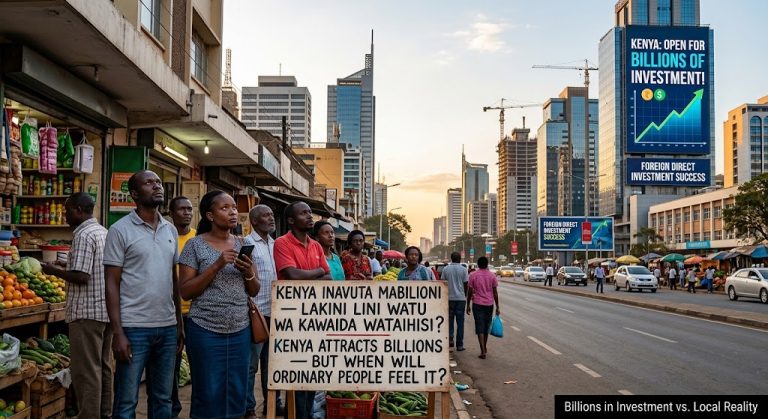
Kenya stands at a precarious crossroads, defined by a stark statistical and social paradox. While we boast a literacy rate of over 82% and an economy that often leads the East African region, our “Social Capital Index” continues to be eroded by a pervasive culture of systemic graft and civic apathy. According to recent governance indices, the nation loses billions of shillings annually to corruption resources meant for the sick, the young, and the vulnerable. These are not merely economic figures; they are the ledger of a dying conscience.
The “bad manners” mentioned in our common parlance have evolved from minor social irritants into a terminal rot. We see it in the motorist who overlappingly defies traffic laws, the public official who demands a bribe for a basic right, and the citizen who applauds the “cleverness” of the thief. This normalization of deviance suggests that we have lost the ability to distinguish between success and plunder. When a society begins to admire the shortcut over the hard-earned path, its foundations are no longer built on stone, but on shifting sand.
A nation is more than its borders, its flag, or its GDP; it is a collective agreement on a set of values. Currently, that agreement in Kenya appears to be in tatters. We are witnessing a “moral interregnum” a period where the old values of Undugu and communal integrity have been discarded, and in their place, a nihilistic “every man for himself” philosophy has taken root. If this persists, we are not merely facing a political crisis, but a civilizational decline that no amount of infrastructure development can fix.
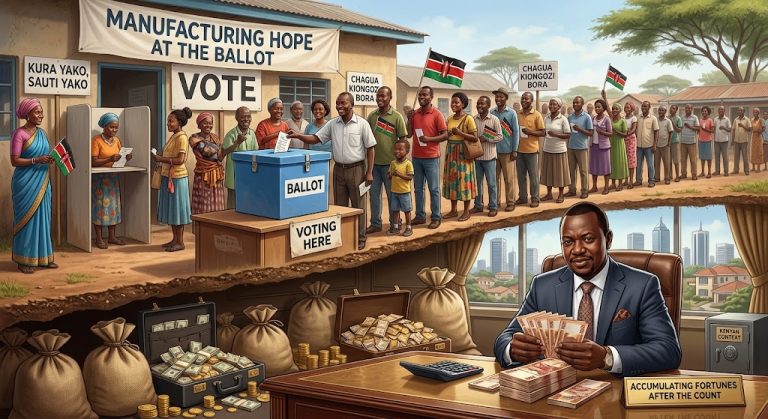
The search for the Kenyan soul must begin with an honest acknowledgment of our complicity. We have become a theater of the absurd where we cry for change but vote for the very architects of our misery. This cognitive dissonance is a symptom of a soul that has been bartered for temporary convenience. Maturity demands that we stop blaming a vague “system” and realize that the system is a mirror of our collective character. A corrupt leadership cannot thrive in a soil of integrity; it requires the nutrients of a compromised populace.
Should this culture of impunity and “bad manners” persist, we are doomed to follow the historical trajectory of failed states. History is littered with the carcasses of nations that possessed immense wealth but lacked the moral fiber to manage it. When trust the invisible currency of any economy evaporates, the cost of doing business becomes prohibitive, and the social contract becomes a worthless piece of paper. We are currently flirting with this void, where the law is seen as a suggestion rather than a mandate.
The decline of a nation usually happens in silence before it happens in screams. It starts when we stop feeling outraged by injustice. It continues when our religious and educational institutions become factories for conformity rather than bastions of character. We have built schools that produce doctors and engineers, but we have failed to build a society that produces honest men and women. The technical skill is present, but the moral compass is spinning aimlessly.
To find our soul, we must revisit the concept of the “Common Good.” This requires a radical shift from the transactional nature of our interactions to a transformational one. We must foster a culture where shame is reintroduced into the public square. A society that cannot feel shame is a society that cannot be redeemed. We must make it socially expensive to be “bad-mannered,” ensuring that the rogue, the bribe-taker, and the law-breaker are no longer celebrated as “hustlers” but are shunned as pariahs.
This search for our soul is not a religious endeavor, though it may carry spiritual undertones; it is, at its core, a strategy for national survival. It calls for an unflinching and deliberate introspection into what it truly means to be Kenyan beyond slogans, flags, and constitutional promises. Are we primarily defined by our tribes, by an insatiable appetite for accumulation, or by a shared humanity anchored in mutual responsibility and dignity? If the answer remains trapped in the narrow confines of ethnicity and greed, then decline is not a possibility but an inevitability. We will continue to mistake proximity for unity and coexistence for nationhood. At present, we resemble a collection of strangers occupying the same geographical space, bound together not by a common moral purpose but by the relentless pursuit of the shilling. Such a bond is transactional, shallow, and profoundly fragile. It cannot endure the pressures of economic inequality, political manipulation, or historical reckoning. A nation built on convenience rather than conscience will always fracture at the first serious test.
There is no comfortable middle ground in this reckoning. We are confronted with a stark choice: either we undertake the painful but necessary journey of national atonement and ethical reconstruction, or we resign ourselves to a slow descent into chaotic mediocrity, punctuated by periodic crises and collective amnesia. The “Kenya We Want” is frequently invoked in political manifestos and development plans, yet it remains hollow rhetoric unless it is first inscribed in the hearts, habits, and daily conduct of citizens. True national renewal cannot be outsourced to leaders alone; it must be cultivated from the ground up, in how we work, how we vote, how we treat one another, and how we respond to injustice. We must summon the courage to demand of ourselves the same discipline, excellence, and honesty we so loudly demand of those in power. Without this moral symmetry, reform will always be performative, and hope will remain perpetually deferred.
In conclusion, the destiny of Kenya is not written in the stars, but in our daily conduct. The “bad manners” that currently define our public and private lives are a cancer that will eventually consume the host if not treated with the radiation of truth and the surgery of reform. Let us embark on this search for our soul with the urgency of a people who realize their house is on fire. Only then can we move from the brink of decline toward the promise of a dignified, enduring republic.
The writer is social commentator
Similar Posts by The Mt Kenya Times:
- Sengwer youth: When will Kenya stop treating a minority like an afterthought?
- When young lives become disposable
- The day death refused to be scammed
- Statement win at the Gtech: Brentford outclass Chelsea to claim all three points
- When disability funds become a frontier for accountability: Kenya’s PWDs refuse to be invisible
About the Author