The Silent Erosion: How Extrajudicial Killings And Enforced Disappearances Threaten Kenya’s Democratic Soul
 The Mt Kenya Times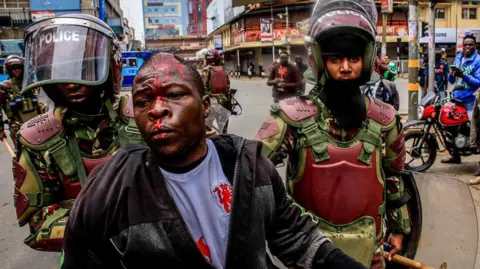
By Jerameel Kevins Owuor Odhiambo
Kenya’s democracy which was hard-won through decades of struggle, stands as a beacon in East Africa, yet it is fraying at the edges. Beneath the surface of vibrant elections and a vocal civil society, extrajudicial killings and enforced disappearances cast a long shadow, undermining the nation’s democratic ideals. These acts, often perpetrated by state actors or with their complicity, represent a betrayal of the social contract that binds citizens to their government. They erode trust, stifle dissent, and hollow out the institutions meant to protect Kenya’s democratic promise. While the issue is not unique to Kenya, its persistence in a country with a robust constitution and a history of reform movements demands a fresh perspective one that views these violations not just as human rights abuses but as deliberate assaults on the democratic spirit.
Extrajudicial killings, unlawful executions without trial or due process have become a grim feature of Kenya’s security landscape. From the slums of Nairobi to the coastal regions, reports of police shootings targeting alleged criminals or protesters are alarmingly common. The Independent Policing Oversight Authority (IPOA) documented over 200 such cases between 2017 and 2022, though the true number is likely higher due to underreporting. These acts, often justified as necessary for public safety, bypass the judiciary, rendering the rule of law a mere formality. When state agents act as judge, jury, and executioner, they usurp the democratic principle of checks and balances, creating a culture of impunity that emboldens further abuses. This is not merely a policing problem; it is a democratic crisis, as it signals that the state can operate above the law it is sworn to uphold.
Enforced disappearances, equally insidious, involve the abduction and secret detention of individuals, often without a trace. In Kenya, these cases have spiked during periods of political tension, such as the 2017 and 2022 elections, targeting activists, journalists, and perceived government critics. The case of Willie Kimani, a human rights lawyer abducted and murdered alongside his client and driver in 2016, remains a chilling reminder of the state’s capacity to silence dissent. According to the Kenya National Commission on Human Rights (KNCHR), over 700 disappearances were reported between 2010 and 2020, with many linked to counterterrorism operations. These vanishings create a climate of fear, discouraging citizens from engaging in political discourse or holding power to account core tenets of any democracy. The absence of accountability for these acts sends a message: dissent is dangerous, and the state is untouchable.
What makes this issue uniquely corrosive in Kenya is its intersection with the country’s ethnic and socioeconomic fault lines. Extrajudicial killings and disappearances disproportionately affect marginalized communities, particularly in urban slums and regions like the Northeast, where counterterrorism operations are concentrated. Young men from low-income areas, often stereotyped as criminals, are frequent targets, as seen in cases like the 2018 Dandora killings, where police operations left dozens dead. This selective targeting deepens social inequities, alienating entire communities from the democratic process. When certain groups feel systematically hunted rather than protected, their faith in democratic institutions elections, courts, or parliament erodes. Democracy cannot thrive when whole segments of society are excluded from its protections.
The ripple effects extend beyond victims and their families, poisoning public trust in governance. Kenya’s 2010 Constitution, lauded for its progressive framework, guarantees the right to life and security of person, yet these violations expose a gap between constitutional ideals and reality. When citizens witness state agents flouting the law without consequence, they grow cynical about democratic promises. Voter apathy, already a concern with turnout hovering around 65% in recent elections, is exacerbated as people question whether their participation matters in a system that seems to protect the powerful. This disillusionment is a slow poison, weakening the democratic culture that Kenya has fought to nurture since the multiparty era began in the 1990s.
An original perspective lies in viewing these acts as a form of “democratic sabotage” by the state itself. Unlike overt authoritarianism, extrajudicial killings and disappearances operate in the shadows, allowing the government to maintain a democratic facade while suppressing dissent. This tactic is particularly effective in Kenya, where global perceptions of a stable democracy attract investment and diplomatic goodwill. By targeting individuals rather than entire groups, the state avoids the backlash of mass repression while achieving similar ends: control and compliance. This covert approach undermines democracy more insidiously than outright coups, as it erodes trust and participation without triggering immediate international condemnation. It’s a strategy of attrition, chipping away at democratic norms until only a hollow shell remains.
The path forward requires confronting this sabotage head-on. Strengthening institutions like IPOA and the KNCHR is critical, but their mandates must be backed by political will to prosecute perpetrators, including high-ranking officials. Civil society, a cornerstone of Kenya’s democratic resilience, must amplify marginalized voices and document abuses relentlessly, leveraging platforms like X to galvanize public outcry. Judicial reforms to expedite cases of extrajudicial violence and disappearances can restore faith in the rule of law. Moreover, community-led initiatives, such as grassroots truth commissions in affected areas like Mathare or Lamu, could foster healing and accountability where state mechanisms fail. These steps, while challenging, are essential to reclaiming the democratic space that these violations seek to shrink.
In conclusion, extrajudicial killings and enforced disappearances are not mere aberrations but existential threats to Kenya’s democracy. They undermine the rule of law, deepen inequality, and erode public trust, creating a democracy that exists in name only for many citizens. By recognizing these acts as deliberate sabotage, Kenya can begin to address their root causes and rebuild a democratic culture rooted in justice and inclusion. The nation’s history of resilience through the Moi era, the 2007 post-election violence, and beyond proves its capacity to overcome. But the silent erosion must be named and confronted, lest it unravel the democratic soul of a nation that has long aspired to be a light in the region.
The writer is a legal researcher and lawyer.
Similar Posts by The Mt Kenya Times:
- Mt Kenya Times ePAPER October 1, 2026
- Museveni backs Lamu but keeps Uganda’s money at home
- Sifuna’s party wins its name — and Kenya’s opposition race begins in earnest
- Lamu’s $16B gamble: Africa’s biggest refinery divides the region
- Ruto launches KSh2.2 trillion Lamu refinery in East Africa’s biggest energy bet
About the Author