The Unbearable Weight Of Messianic Politics: Why Kenya’s Raila Phenomenon Warns Against Single-Person Leadership Cults
 The Mt Kenya Times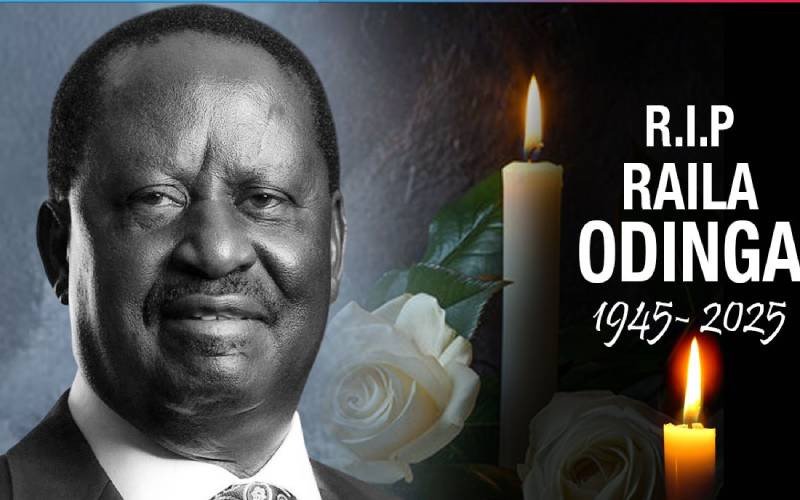
By Jerameel Kevins Owuor Odhiambo
The arc of Kenya’s democratic journey is indelibly etched with the silhouette of one man, a figure so dominant that he became synonymous with the very idea of opposition and reform. Raila Amollo Odinga, a statesman whose passing has closed a momentous chapter, bore the impossible burden of an entire nation’s deferred dreams on his shoulders. This reliance, an almost fanatical devotion that positioned him as the sole custodian of the people’s vision, created a profound paradox: it enabled colossal democratic strides while simultaneously exposing him to the intense human pressure of perpetual compromise. His political odyssey, marked by extraordinary highs and controversial turns, serves as a powerful testament to the danger of a political culture that elevates one person to the status of a semi-deity, for even a giant is ultimately just a man.
The death of Raila Odinga strips bare a truth that Kenyan democracy has long needed to confront: the catastrophic fragility of political movements built around single individuals. For four decades, millions of Kenyans invested their democratic aspirations, their ethnic pride, their economic hopes, and their political futures in one man. Now that man is gone, and the opposition he led faces an existential crisis not because its ideas died with him, but because it never developed ideas independent of him. This is not simply a Kenyan problem or even an African one it is the eternal danger of messianic politics, where movements confuse personality with principle and mistake charisma for ideology.
Raila Odinga’s extraordinary career demonstrates both the power and peril of charismatic leadership in young democracies. No one can deny his courage the years in detention, the torture endured, the risks taken for multiparty democracy. His ability to mobilize masses across ethnic lines was genuine political genius. His articulation of progressive values spoke to millions who felt excluded from Kenya’s post-independence settlement. Yet these very strengths created a dependence that ultimately weakened the democratic project he claimed to champion.
Consider what happened in Kenya’s opposition politics whenever Raila made a major decision. When he merged with Moi’s KANU in 2001, opposition figures could only watch there was no institutional mechanism to debate or override his choice. When he declared “Kibaki Tosha” in 2002, entire parties dissolved their presidential ambitions on his word alone. When he agreed to the Grand Coalition in 2008, the streets that had erupted in his name fell silent at his command. When he shook hands with Uhuru Kenyatta in 2018, his supporters swallowed their bitterness because Baba had spoken. When he sent ODM members into Ruto’s cabinet in 2024, party structures rubber-stamped a decision already made.
This pattern reveals the fundamental problem with leadership cults: they replace democratic deliberation with deference, institutional process with individual fiat, and collective wisdom with singular vision. The Orange Democratic Movement, despite its progressive rhetoric and ostensibly democratic structures, functioned in practice as an extension of Raila’s will. Party elections were postponed when succession battles threatened to challenge his authority. Officials measured their standing by proximity to him rather than popular support or ideological clarity. The party’s positions on critical issues often remained ambiguous until Raila clarified them, leaving supporters and even MPs uncertain where they stood.
The psychological dynamics of messianic politics are insidious. Supporters invest so much hope, time, and identity in their chosen leader that criticism becomes impossible not because it’s forbidden, but because it feels like self-betrayal. When Raila made questionable alliances, supporters developed elaborate rationalizations. He was playing three-dimensional chess while critics saw only checkers. He was being strategic when it looked like capitulation. He had information others lacked, insights others couldn’t grasp. The alternative that he might simply be wrong, or self-interested, or making it up as he went became psychologically untenable for those who had centered their political lives around him.
This dynamic creates what social psychologists call “motivated reasoning” the tendency to process information in ways that confirm pre-existing beliefs rather than challenge them. When Raila’s handshakes with Moi, Kibaki, Uhuru, and Ruto followed similar patterns initial promises, popular mobilization, eventual accommodation, insider benefits, popular disappointment his most devoted supporters saw four separate strategic moves rather than one repeating pattern. Each time, they convinced themselves this handshake would be different, this coalition would deliver, this accommodation would yield the transformation they sought.
The alternative model building movements around ideas rather than individuals requires more work, offers less immediate gratification, and provides fewer emotional certainties. Ideas must be debated, refined, compromised upon. Institutions must be built, maintained, reformed. Leadership must be distributed, authority must be earned repeatedly rather than assumed permanently, and succession must be planned rather than fought over. None of this provides the psychological satisfaction of rallying behind a charismatic figure who embodies your aspirations and battles your enemies.
Yet the institutional model is precisely what sustainable democracy requires. Consider the difference between saying “I support progressive taxation, universal healthcare, devolution of power, and electoral integrity” versus “I support Raila.” The first statement grounds political commitment in verifiable policy positions that can be held by any leader and evaluated by concrete outcomes. The second grounds it in a person whose positions might shift, whose judgments might err, and whose mortality is guaranteed. One builds durable movements; the other builds cults of personality that collapse when the personality exits.
Kenya’s 2024 Gen Z protests illuminated this distinction powerfully. Young protesters articulated clear demands reject the Finance Bill, prosecute police brutality, address corruption, reduce the cost of living. They explicitly rejected the traditional model of rallying behind opposition figures. When Raila tried to position himself as their champion, they rebuffed him. When he sent ODM members into Ruto’s cabinet, they called it betrayal not because they had personally followed Raila, but because his actions contradicted the principles they were fighting for. This was politics grounded in policy rather than personality, in demands rather than deference.
The tragedy is that Raila himself might have built this kind of movement had he prioritized institution-building over personal brand management. The ODM could have developed robust internal democracy, clear ideological positions, and leadership structures that didn’t require his presence. Instead, like so many charismatic leaders, he seemed to view institutional strength as potential constraint on his freedom of action. Party structures existed to mobilize his supporters, not to check his authority. Officials were selected for loyalty rather than independence. Succession was an unspoken topic because planning for it would acknowledge his mortality and potentially challenge his centrality.
This pattern has deep historical roots. Charismatic leaders who emerge from liberation struggles or democratic transitions often carry such moral authority from their sacrifices that normal political accountability seems petty or disloyal. Raila’s detention and torture, like Nelson Mandela’s imprisonment or Julius Nyerere’s independence leadership, created a reservoir of legitimacy that transcended ordinary political calculation. But moral authority earned through historical sacrifice doesn’t automatically translate into wise contemporary governance. The skills required to fight dictatorship differ fundamentally from those needed to build democratic institutions. The same single-mindedness that makes a revolutionary effective can make a democratic leader inflexible.
The international community’s role in reinforcing messianic politics deserves scrutiny. When crises erupted in Kenya, foreign mediators consistently sought out Raila as the indispensable opposition voice. Kofi Annan negotiated with him personally in 2008. International observers validated his electoral complaints. Western diplomats maintained relationships with him as the key opposition figure. This attention was understandable; Raila was genuinely important and genuinely popular, but it further centralized opposition politics around one individual rather than strengthening opposition institutions that might outlast him.
The media, both domestic and international, contributed to the cult of personality by covering politics primarily as a contest between big men rather than a competition between ideas. Every story became about Raila versus Kibaki, Raila versus Uhuru, Raila versus Ruto reducing complex policy disputes to personality conflicts. This framing encouraged citizens to see politics as choosing which leader to follow rather than determining which policies to support. It made governance about loyalty rather than accountability, about identifying with your champion’s victories rather than evaluating actual outcomes.
Kenya’s ethnic arithmetic made messianic politics particularly dangerous. When Raila became not just a popular leader but the embodiment of Luo political aspirations, his personal fortunes became inseparable from community identity. His losses felt like ethnic humiliation; his victories like ethnic vindication. This dynamic extended beyond the Luo supporters from other communities invested their regional or economic grievances in his success. The result was politics where rational evaluation became nearly impossible because so much identity was tied to one man’s fate.
The succession battles that consumed ODM in Raila’s final years revealed the inevitable crisis of personality-driven movements. Hassan Joho, Wycliffe Oparanya, John Mbadi, and others jockeyed for position not by articulating different visions for Kenya or ODM, but by demonstrating superior loyalty to Raila and greater claim to inherit his mantle. This succession model common in monarchies, corporations, and religious movements sits uneasily with democratic principles. Democracy shouldn’t be about identifying the rightful heir but about choosing between competing visions through open contest.
The challenge for Kenya’s opposition post-Raila is whether it can transform from a personality cult into an ideological movement. This requires several difficult steps. First, articulating clear policy positions independent of any leader’s preferences. What does the opposition stand for on taxation, healthcare, education, devolution, electoral reform? These positions must be sufficiently specific to evaluate and sufficiently consistent to build trust. Second, developing leaders plural multiple voices and faces representing the movement rather than a single indispensable figure. This redundancy provides resilience when any individual leader disappoints or departs.
Third, creating genuine internal democracy where leaders are selected through competitive processes rather than anointment by predecessors or elder consensus. Fourth, establishing accountability mechanisms where leaders face consequences for broken promises or corrupt behavior, regardless of their historical contributions or personal charisma. Fifth, grounding political mobilization in citizens’ material interests and policy outcomes rather than ethnic identity or personal loyalty to leaders. These transformations are difficult precisely because they require surrendering the psychological comforts and mobilization efficiency that messianic politics provides.
The broader lesson extends far beyond Kenya. Across Africa and throughout the developing world, democratic movements repeatedly make the same mistake building around charismatic individuals rather than durable institutions. The African National Congress in South Africa struggled to maintain its liberation credentials while governing; its identity remained tied to Mandela’s legacy rather than contemporary policy vision. Zimbabwe’s opposition centered around Morgan Tsvangirai to the point where his death created crisis. Uganda’s opposition has cycled through various figures Kizza Besigye, Bobi Wine without building institutional capacity that transcends individual leaders.
Even in established democracies, the temptation toward messianic politics persists. Donald Trump’s hold on Republican Party supporters, regardless of policy shifts or norm violations, demonstrates how personality can subsume principle. Emmanuel Macron’s “En Marche” in France was built so completely around his personal brand that it struggles to articulate coherent ideology independent of his positions. India’s BJP has increasingly centered around Narendra Modi personally rather than its historical ideological foundations. Messianic politics is not a development problem; it’s a human tendency that only strong institutions can check.
The antidote to messianic politics is boring, unglamorous, and essential: institution-building. This means political parties with clear platforms debated and approved by members, not decreed by leaders. It means leadership selection through competitive primaries rather than coronation. It means policy think tanks that develop positions through research and debate rather than waiting for leaders to pronounce them. It means civil society organizations that can mobilize citizens around issues rather than personalities. It means media that covers policy substance rather than reducing everything to personality contests.
It also means citizens willing to do the harder work of political engagement. Following a charismatic leader requires only showing up when called and trusting in their wisdom. Participating in democratic institutions requires reading policy documents, attending meetings, debating positions, accepting compromise, and holding leaders accountable regardless of how much you like them personally. The first path is emotionally satisfying; the second is politically effective.
Raila Odinga’s death offers Kenya a painful opportunity: to build opposition politics that doesn’t depend on finding the next Raila. This requires acknowledging that no such figure exists or should be sought. The task isn’t identifying which current politician most resembles Raila in charisma or historical credentials, but building institutions that can function with merely competent rather than charismatic leadership. The goal isn’t finding another father figure for the nation, but creating political structures where millions of Kenyans can exercise agency rather than deference.
This transformation will be resisted, and not only by aspiring messiahs. Citizens who invested decades following Raila may find institutional politics alienating too procedural, too prone to compromise, too lacking in the emotional highs of mass rallies and political drama. Politicians who built careers on proximity to Raila may lack the skills or inclination for the harder work of persuading rather than commanding followers. The infrastructure of messianic politics rally culture, loyalty networks, personality-driven fundraising doesn’t easily convert to institutional politics.
Yet the alternative is continued cycling through charismatic figures, each promising transformation, each eventually disappointing, each leaving their movements in crisis when they depart. This pattern doesn’t just fail to build sustainable democracy; it actively undermines it by training citizens to see politics as choosing which strongman to follow rather than determining collectively how society should be governed. It creates learned helplessness where citizens wait for leaders to save them rather than organizing to solve problems themselves.
Kenya’s challenge now is to learn from Raila’s career without being paralyzed by it. The handshakes were symptoms, not causes, of Kenya’s political dysfunction. They happened because the country’s institutions remained too weak to enforce electoral integrity, because ethnic mobilization remained the most effective path to political power, because the presidency retained too much authority and wealth for losers to accept defeat gracefully. Raila didn’t create these dynamics; he navigated them with varying degrees of success and compromise.
The young generation that has watched Raila’s final acts with dismay has learned a crucial lesson: no single individual, however charismatic or credentialed, can carry the burden of a nation’s democratic aspirations. The Gen Z protesters who rejected the broad-based government weren’t necessarily rejecting Raila personally; they were rejecting the entire model of elite accommodation that his career had come to represent. Their insistence on systemic change over personality politics may be his most important legacy, even if it arrived as rejection rather than endorsement.
As Kenya mourns Raila Odinga, the honest tribute is not to canonize him as a saint or dismiss him as a sellout, but to recognize him as deeply, complexly human, a man who fought courageously, compromised repeatedly, believed genuinely, and disappointed profoundly. His life’s work built foundations for democracy even as his later compromises threatened to undermine them. He mobilized millions for change even as his political calculations sometimes seemed more about position than principle. He suffered for Kenya even as his ambitions occasionally seemed indistinguishable from Kenya’s interests.
Raila Odinga’s death closes a chapter, but the questions his career poses remain unanswered. Can Kenya build politics beyond ethnicity when every major coalition has exploited ethnic arithmetic? Can reformers maintain their principles while navigating a system built on patronage? Can opposition figures hold power accountable without eventually joining the very cabinets they once denounced? These questions transcend Raila, but his life’s work for all its contradictions at least had the courage to ask them.
The final assessment of Raila Odinga must acknowledge what younger Kenyans increasingly understand: he did his part, made his mistakes, and now the work passes to others. His generation fought for multiparty democracy and won it. His generation crafted a progressive constitution and passed it. But his generation could not, or would not, break the cycle of elite accommodation that has frustrated Kenya’s democratic promise at every turn. That task falls to those coming after, who must honor Raila’s genuine contributions while refusing to repeat his compromises. That is the tribute his complex legacy demands not worship, but clear-eyed continuation of the unfinished work.
The final irony is that Raila himself might have accomplished more lasting change had he prioritized institution-building over personal political fortunes. A strong, ideologically coherent, institutionally robust opposition party that could have survived his departure would have been a more significant legacy than five presidential campaigns and multiple handshakes with the establishment he opposed. But that would have required surrendering the immediate power and satisfaction that messianic politics provided accepting constraints on his authority, empowering potential rivals, building structures that might one day constrain or replace him.
Kenya now faces the question that confronts all societies that lose charismatic leaders: Can the movement outlast the man? If ODM and the broader opposition simply search for the next Raila another charismatic figure to center politics around; they will have learnt nothing. If they instead build institutions that can function without requiring extraordinary individuals, they will have honored Raila’s sacrifices better than any funeral oration. The measure of Raila’s legacy isn’t the offices he held or the crowds he drew, but whether his movement can survive and thrive without him. That answer will only emerge in the difficult years ahead as Kenya’s opposition either matures into institutional politics or fragments in search of its next messiah.
The writer is a lawyer and legal researcher
Similar Posts by The Mt Kenya Times:
- Mt Kenya Times ePAPER August 28, 2026
- Kenya is losing fifteen mothers a day — and the numbers are getting worse
- Consolata International University opens new academic year with call to humanise artificial intelligence
- Written in gold, wielded in iron: Katiba@16 and the realities of power
- Mang’eni challenges universities to put entrepreneurship at the heart of learning
About the Author