The Uninvited Parent: Africa’s Silent War Between Step-Parents and Step-Children
 The Mt Kenya Times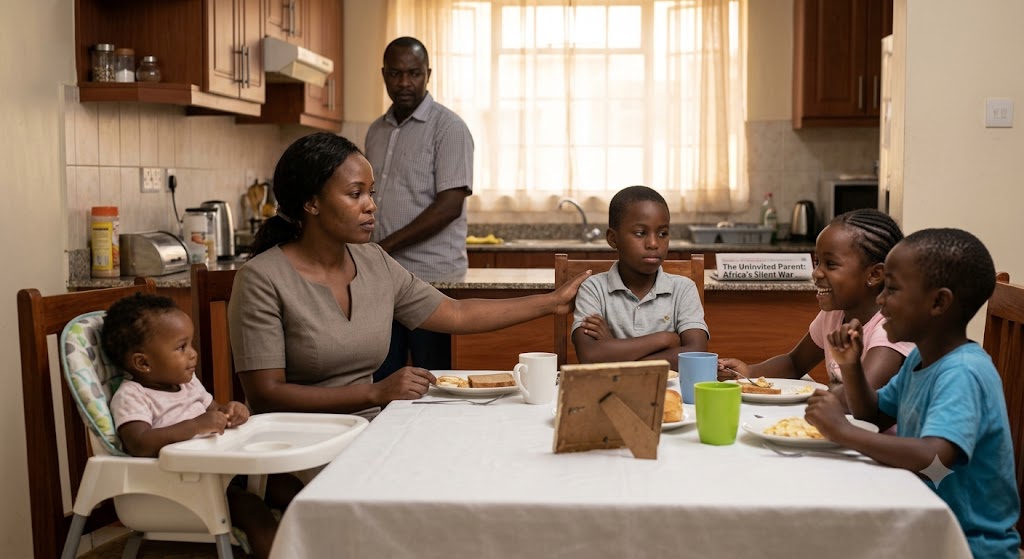
A tense family breakfast: While two children share a laugh, their mother attempts to bridge the emotional distance with her stoic step-son.
By Silas Mwaudasheni Nande
Introduction: A Battle Fought Behind Closed Doors
In villages, townships, and cities across Africa, a quiet war rages inside thousands of homes. It is not fought with weapons, and it rarely makes headlines, yet it destroys marriages, wounds children, and leaves adults exhausted and confused. This is the war between step-parents and step-children, a conflict born not of malice but of history, circumstance, and unmet expectations. It is a war without villains, though each side often casts the other as one.
The African family has never fitted neatly into the nuclear model imported through colonial administration and Western media. Long before marriage certificates and church weddings became markers of legitimacy, African societies organised kinship through lineage, clan, and extended family networks that absorbed children born within and outside formal unions. Yet modern economic pressure, urban migration, delayed marriage, and the erosion of communal safety nets have placed a new kind of strain on this old flexibility. Today, when a man or a woman remarries after bearing a child with a previous partner, the new spouse inherits not simply a partner but an entire relational history, one that includes a child who did not choose the arrangement and frequently does not welcome it.
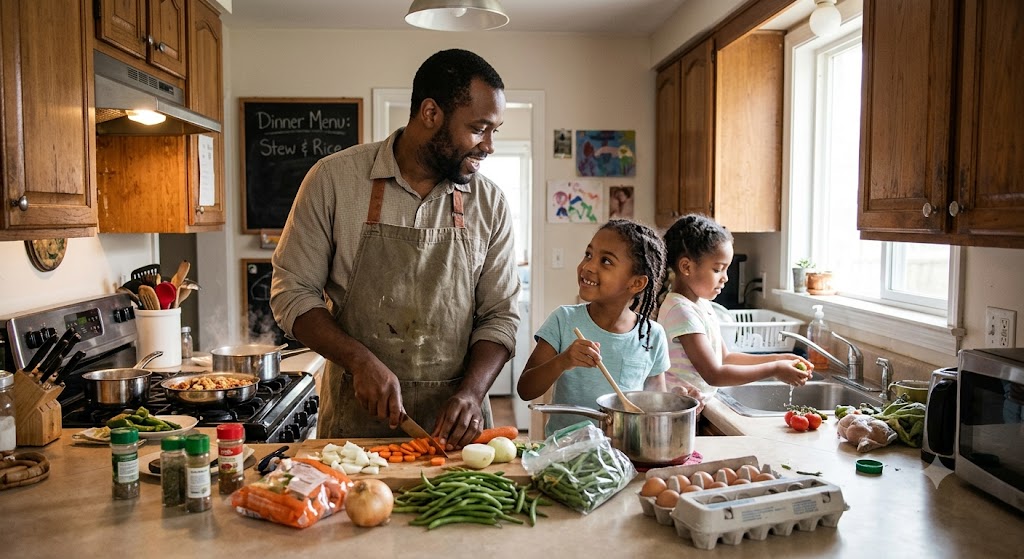
Consider a composite scenario drawn from patterns common across the region, representing no single family but many. A woman raises a daughter alone for eight years after the child’s father departs the relationship. She later marries a man who has never had children of his own. He arrives in the household determined to be a good father, yet within months finds himself locked in daily friction with a daughter who ignores his instructions, mocks his attempts at discipline, and repeatedly reminds her mother, within earshot, that her real father would never have behaved a certain way. The mother, torn between defending her husband’s authority and protecting her daughter from a man she fears her daughter does not yet trust, begins to withdraw from both relationships. Neither the husband nor the daughter is behaving unreasonably given what each has experienced, yet without intervention, the marriage itself absorbs the strain of a conflict neither party fully understands. This scenario, repeated with variation in countless African households, is the subject of the analysis that follows.
This article examines the roots of stepfamily conflict in African households, the diverging perspectives of step-parents and step-children, the particular difficulty faced by adolescents who enter stepfamily life later than younger children, the influence of gender on the step-parent role, the cultural and kinship frameworks that shape belonging, and the practical measures that families, communities, and institutions can adopt to build homes where both step-parents and step-children can thrive.
The Demographic Reality Behind the Conflict
Stepfamily conflict in Africa cannot be understood without first acknowledging how common non-marital childbearing has become across the continent. Patterns vary considerably between regions and religious traditions, but research from rural South Africa illustrates the scale of the phenomenon in parts of Southern Africa. A long-running demographic surveillance study in the Agincourt sub-district found that roughly a fifth of all births, and almost half of births to women in early adulthood, occurred to women who had never married. This pattern reflects a broader trend in South Africa, where premarital first births are common and women typically do not marry until around the age of twenty-nine, even though sexual relationships and childbearing often begin much earlier in a woman’s life.
This gap between the age of first childbearing and the age of first marriage, often a decade or more, means that many African women and men build families in stages. A child is born, sometimes into a cohabiting relationship and sometimes into no formal union at all, and years later a parent marries someone who is not that child’s biological parent. By the time the wedding takes place, the child may already be a toddler, a schoolgoer, or a teenager with an established personality, loyalties, and memories of a different family configuration.
Globally, the pattern of non-marital childbearing has been rising for decades. Demographer Joseph Chamie has observed that out-of-wedlock childbirth has increased markedly worldwide since the 1960s, with the proportion of such births varying widely both between and within countries, and with roughly fifteen percent of the world’s births in 2016 occurring outside marriage. Reported figures for African countries differ sharply depending on region, religious context, and how strictly non-marital births are recorded, but the underlying reality across much of Southern and Eastern Africa is one of frequent premarital childbearing followed, often years later, by marriage to a different partner. The consequence is a continent-wide surplus of stepfamilies that receives far less attention, research, and institutional support than its scale warrants.
What Step-Parents Feel: Invaders in Their Own Homes
Step-parents entering an existing family unit often arrive with hope. They imagine a household united by love, discipline, and shared purpose. Instead, many report confusion, resentment, and a persistent sense of being tested. Step-parents frequently describe stepchildren as unruly, disrespectful, or carrying unexplained anger, an anger step-parents often interpret as directed personally at them.
This interpretation, while understandable, frequently misreads the source of the child’s distress. Research on blended families indicates that a stepparent’s arrival can trigger deep loyalty conflicts in a child, conflicts unrelated to the stepparent’s character. A child who appears to enjoy a new stepparent may simultaneously feel disloyal toward the absent biological parent, producing behaviour that swings between warmth and hostility. Studies have consistently found that many children reject their parent’s new spouse, sometimes for years, driven by a sense of disloyalty toward the parent who is no longer present in the home.
Step-parents in African households add a further layer of cultural expectation to this dynamic. In many communities, an adult who shares a home with a child is expected to exercise authority over that child, correcting behaviour, enforcing chores, and disciplining wrongdoing exactly as a biological parent would. When a step-child resists this authority, the step-parent often experiences it not merely as childish defiance but as a rejection of their legitimate place in the household, a rejection that can feel deeply humiliating in societies where an adult’s standing is partly measured by the respect commanded within their own home.
Research on parenting approaches within blended families supports the observation that step-parents commonly seek clearer boundaries and firmer limits with stepchildren, even as biological parents tend to prioritise warmth, patience, and understanding toward the same children. Research by clinical psychologist Patricia Papernow has found that stepparents generally want more limits placed on their stepchildren, while biological parents want more warmth and understanding extended toward those same children, a mismatch that frequently becomes the central point of friction inside blended households. This mismatch is not evidence of a flawed marriage. It is a structural feature of nearly every stepfamily, and recognising it as such is the first step toward managing it constructively rather than treating it as a personal betrayal.
Step-parents also carry an emotional burden rarely acknowledged in African discourse on family life. They are expected to love unconditionally, discipline fairly, and provide financially, all while accepting that their authority may never be fully recognised by the child, the child’s biological parent, or the wider extended family. This produces a form of chronic, low-grade stress that can erode the step-parent’s own sense of identity and belonging within the household they are working to sustain.
What Step-Children Feel: A Stranger with New Rules
From the step-child’s vantage point, the arrival of a step-parent is rarely experienced as a gift. It is more often experienced as an imposition, a stranger who arrives in the home carrying rules, expectations, and a claim on the child’s parent that the child never sanctioned. The step-child did not choose this new adult, did not vote on the marriage, and frequently was not consulted before decisions that reshape daily life, from sleeping arrangements to school fees to the division of a parent’s attention.
Children in stepfamilies commonly experience a confusing mixture of emotions rather than straightforward rejection. A stepchild may genuinely want a parent to find happiness in a new relationship while simultaneously feeling that welcoming the new spouse constitutes an act of disloyalty toward the parent who is absent from the home. This internal conflict frequently produces behaviour adults misread as simple rudeness: withdrawal, sullenness, testing of boundaries, or open defiance that is, at its root, an expression of grief, confusion, and divided allegiance rather than a personality defect.
Research from Ghana offers a rare African perspective on how young people cope with this transition. A study exploring the experiences of adolescent stepchildren found that they draw on a wide range of coping strategies, most of them focused on managing their own emotions rather than confronting the stepfamily situation directly. The study found that stepchildren adopted a considerably wider range of coping strategies than stepparents did, with both groups relying on strategies aimed at managing emotional distress. This suggests that many African stepchildren are quietly absorbing and processing significant emotional strain, often without adult recognition, formal support, or an outlet through which to express what they are experiencing.
A study conducted among adolescents in blended families in Kabete Sub-County, Kenya, adds further texture to this picture. It found that trust between stepchildren and stepparents was frequently low, with many children preferring to confide in biological parents or relatives rather than in stepparents, even when the relationship with the stepparent appeared outwardly close. The study found that adolescents in blended families often struggled to build trust and commitment toward stepparents, and that most respondents in the study preferred to trust biological parents or relatives with personal secrets rather than confiding in their stepparents. This finding matters because trust, not affection alone, is the foundation on which a step-parent’s authority ultimately rests. A step-parent may be liked, even admired, and still not be trusted with a child’s inner life.
The frustration step-children feel toward rules imposed by a step-parent is also, in many cases, a proxy for a deeper and less speakable grievance: the sense that the step-parent’s presence confirms the permanent absence or diminished role of the biological parent they have lost through separation, death, or estrangement. Correcting a child’s behaviour, however reasonable the correction, can inadvertently reawaken this grief each time it happens.
Age Matters: Why Younger Children Adjust More Easily
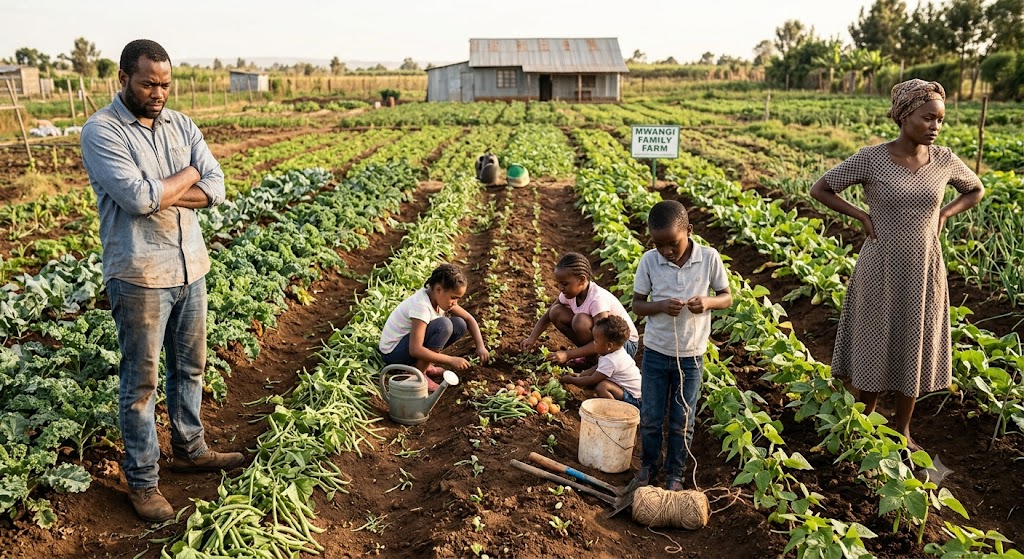
One of the most consistent findings across research on stepfamilies, and one widely observed within African households, is that the age at which a child enters a stepfamily strongly shapes how the relationship develops. Children who acquire a step-parent while still young tend to integrate the new adult into their sense of family with comparatively little resistance. Toddlers and young schoolgoers have not yet formed a fully developed narrative of their biological parent as an irreplaceable figure, and they generally respond well to consistent affection, play, and patient engagement from a new adult in the home.
Adolescents present a markedly different picture. Research indicates that conflict between stepparents and stepchildren intensifies during adolescence, a period when children are simultaneously negotiating their own identity, independence, and memory of family history. Research indicates that children in stepfamilies may experience academic, emotional, and behavioural difficulties, particularly during adolescence, when conflicts with stepparents tend to intensify, and studies show that adolescent stepchildren report more conflict with stepparents than adolescents living in nuclear families.
This is precisely where the sentiment described in African households as “my mother could never have married this one” takes root. An adolescent who remembers a biological father or mother clearly, who has internalised comparisons of appearance, temperament, or social standing, often measures a new step-parent against an idealised or simply familiar image of the parent who is gone. The step-parent may be perceived as physically less attractive, socially less accomplished, or simply less deserving of the family’s affection, regardless of the step-parent’s actual character or conduct. These comparisons are rarely spoken aloud, yet they colour the adolescent’s daily interactions with a step-parent, producing coldness, sarcasm, or outright hostility that appears disproportionate to any specific incident.
Adolescents also possess the cognitive and social capacity that younger children lack: the ability to question parental decisions, to compare their household with those of peers, and to articulate resentment in ways that can wound a step-parent far more sharply than a toddler’s tantrum ever could. A teenager who declares, in front of visitors, that a step-parent is not their real parent inflicts a targeted injury that younger children are simply not yet equipped to deliver. This does not make older step-children malicious. It makes them more articulate carriers of a pain that younger children feel just as deeply but cannot yet express in words.
Step-Mothers and Step-Fathers: Does the Difference Matter?
African households often assume that step-mothers face harsher resistance than step-fathers, drawing on folklore in which the step-mother is cast as a scheming rival to her husband’s children. The evidence, however, presents a more nuanced picture. A study of blended families in Kabete Sub-County, Kenya, found no statistically significant difference in the level of closeness children reported with step-mothers compared to step-fathers. The study found that the difference in closeness between children in step-mother families and those in step-father families was not statistically significant, suggesting that most children maintained a reasonably close relationship with their stepparent regardless of whether that stepparent was a step-mother or a step-father. This finding challenges the popular assumption that step-mothers inherently struggle more than step-fathers to bond with stepchildren.
Where the two arrangements diverged in the same study was not in closeness but in where children turned when facing difficulty. Children in step-father households were markedly more likely to seek help from someone other than the step-father when in trouble, compared with children in step-mother households seeking help outside the step-mother relationship. The study found that a significantly higher proportion of children in step-father families sought help from other people rather than from the step-father, compared to the proportion of children in step-mother families who sought help outside the step-mother relationship. This suggests that step-fathers, despite achieving comparable closeness to step-mothers on an everyday level, may be perceived by children as less approachable during moments of genuine crisis, perhaps reflecting broader cultural expectations about which parent traditionally handles emotional distress within African households. Families navigating a step-father arrangement should therefore make deliberate effort to establish the step-father as a credible source of support during difficulty, not only during ordinary daily life.
Culture, Kinship, and the Weight of Belonging
African stepfamily dynamics cannot be separated from the wider cultural and legal frameworks that shape how belonging, inheritance, and identity are understood. In many communities, a child’s standing within a homestead has historically depended heavily on lineage and clan, a system that predates and sits uneasily alongside the modern nuclear ideal of two parents raising their biological children under one roof. Customary practices around bridewealth, guardianship, and inheritance frequently distinguish, whether explicitly or through informal practice, between children born within a current marriage and children a spouse brings into that marriage from an earlier relationship.
This distinction can surface painfully at moments that ought to affirm family unity, such as the division of land, the payment of school fees, or representation at family ceremonies. A step-child who senses that extended family members quietly categorise them as an outsider’s child, even while the step-parent at home treats them with genuine warmth, absorbs a form of exclusion that no amount of household harmony can fully offset. Pejorative labels for step-children exist in numerous African languages, and children are rarely shielded from hearing them used, whether by neighbours, classmates, or extended relatives who have not accepted the blended arrangement.
Religious institutions, by contrast, often provide a countervailing source of inclusion. Churches, mosques, and other faith communities across Africa frequently emphasise the equal worth of every child regardless of parentage, and pastors, imams, and church elders are commonly approached by families seeking guidance on blended-family disputes long before any formal counsellor would be consulted. This positions religious leaders as a practical, underused resource for exactly the kind of structured support this article has already identified as largely missing from African stepfamily life.
The Cost to the Marriage
Stepfamily conflict rarely remains confined to the relationship between step-parent and step-child. It routinely spills into the marital relationship itself, placing pressure on the very union that brought the stepfamily into existence. A biological parent caught between a spouse and a child faces one of the most emotionally exhausting positions in family life, torn between loyalty to a partner and protectiveness toward a child.
Research on blended family dynamics identifies parenting disagreements as among the most difficult challenges facing remarried and cohabiting couples. Biological parents can feel that their authority over their own children is being challenged by a spouse, while step-parents can feel disrespected by both the child and, at times, by the very partner who invited them into the household. Many couples find that biological parents feel their authority is being challenged by a partner or former spouse, while stepparents often feel like outsiders disrespected by both stepchildren and their own spouse, leaving children caught in the crossfire and feeling confused, angry, or sad.
Left unresolved, this dynamic can corrode a marriage from within. A biological parent who consistently sides with a child against a spouse teaches the child that the step-parent’s authority can be defeated through sufficient resistance, while alienating the spouse who feels perpetually undermined. A biological parent who consistently sides with a spouse against a child, by contrast, risks the child’s sense of security and can produce lasting resentment that outlives the marriage itself. Divorce and separation attributable, at least in part, to unresolved stepfamily tension is a recurring pattern reported in family counselling literature and widely recognised anecdotally within African communities, where blended households are common but rarely receive structured support.
The Debate Over Limits and Authority
At the heart of the step-parent versus step-child conflict lies an unresolved question that every blended family must eventually confront: how much authority should a step-parent hold over a child they did not father or mother? Two positions dominate this debate within African households.
The first position, often held by step-children and sometimes by the biological parent, insists that step-parents must exercise restraint. This view holds that a step-parent who did not raise a child from infancy, who lacks the accumulated relational history of a biological parent, should not claim the same disciplinary authority as a biological parent. Rules imposed too quickly, discipline administered too firmly, or corrections issued without an established relationship of trust are experienced as overreach, an outsider claiming rights that have not been earned.
The second position, commonly held by step-parents, insists that anyone living under a shared roof and contributing to a household’s welfare must abide by the standards of that household, regardless of biological connection. From this vantage point, exempting a step-child from the rules that govern every other member of the family undermines the step-parent’s standing, models double standards for other children in the home, and effectively grants the step-child veto power over the household’s functioning.
Family research suggests a resolution that neither position fully anticipates but that both can accept. Authority earned through relationship, rather than authority claimed through position, tends to produce far better outcomes for everyone involved. Connection must precede correction. According to this framework, connection needs to be established before correction by a stepparent, and once a stepparent has built a caring relationship with a stepchild, that stepparent can move gradually into a more authoritative disciplinary role. A step-parent who spends the first months or years of a new marriage investing in genuine relationship with a step-child, through shared activities, patient listening, and demonstrated reliability, earns a form of authority that imposed rules alone can never manufacture. This does not mean step-parents should abandon household standards altogether. It means the sequence matters: relationship first, rules second, and rules delivered in partnership with the biological parent rather than unilaterally.
Why Counselling Matters, and Why It Is Often Missing
Across the sources examined in preparing this article, one recommendation recurs with striking consistency, and one absence is equally striking. The recommendation is that families benefit enormously from structured, professional support during the transition into stepfamily life. The absence is that such support remains largely unavailable, unaffordable, or culturally unfamiliar to the majority of African families who need it most.
In wealthier contexts, family therapists, school counsellors, and blended-family support groups routinely help children and adults navigate the emotional turbulence of remarriage. Across much of rural and even urban Africa, no equivalent infrastructure exists at scale. A child entering a stepfamily arrangement is rarely offered any preparatory conversation, any safe space to express fear or resentment, or any professional guidance on managing the loyalty conflicts research consistently identifies as central to stepfamily distress. Similarly, the biological parent introducing a new spouse into the household rarely receives guidance on how to manage the delicate balancing act between partner and child that this article has already described.
The case for counselling, or at minimum for structured family conversations facilitated by a trusted elder, pastor, teacher, or community leader, is strong. Children who understand in advance what a stepfamily transition involves, who are given permission to feel conflicted rather than being expected to simply comply, and who are reassured that loving a step-parent does not betray an absent biological parent, adjust considerably better than children thrust into the arrangement without preparation. Likewise, step-parents who receive guidance on pacing their involvement, prioritising relationship before discipline, and coordinating consistently with their spouse are far less likely to become entangled in the corrosive authority battles described earlier in this article.
Namibia and much of the Southern African region possess strong existing community structures, extended family networks, church congregations, traditional leadership, and school counselling departments, that could be mobilised to fill this gap without requiring costly new institutions. What is required is recognition, at community and policy level, that stepfamily transitions are a distinct and predictable source of childhood distress deserving of deliberate, organised attention rather than being left to resolve themselves through trial and error inside individual households.
Building a Mutual and Conducive Environment
Having examined the roots and the depth of this conflict, the more urgent question is how African families can build homes in which step-parents and step-children coexist not merely tolerably but genuinely well. Several practical principles emerge from the research and reasoning set out above.
First, biological parents must serve as active bridges rather than passive bystanders. A parent who introduces a new spouse into a child’s life carries a continuing responsibility to prepare the child in advance, to validate the child’s mixed emotions rather than dismissing them, and to remain visibly involved in disciplining their own child rather than delegating that role entirely to a new spouse before trust has developed.
Second, step-parents must resist the urge to assert authority before establishing relationship. Patience during the earliest phase of a blended household is not weakness. It is strategy. A step-parent who spends the first year building rapport through shared interests, consistent kindness, and genuine curiosity about a child’s inner life is investing in an authority that will prove far more durable than any rule imposed by decree.
Third, step-children deserve age-appropriate honesty about the realities of the new household, alongside explicit permission to feel whatever they feel. A child, particularly an adolescent, should never be made to feel that loyalty to an absent or deceased biological parent must be surrendered in order to accept a step-parent. Both relationships can coexist without either being diminished.
Fourth, households benefit from clearly agreed rules developed jointly by the biological parent and step-parent, rather than rules imposed unilaterally by either. When a step-child understands that household expectations reflect a shared parental decision rather than a step-parent’s personal preference, resistance tends to diminish because the rule no longer reads as a stranger’s imposition.
Fifth, extended family and community structures, uncles, aunts, grandparents, church leaders, and school counsellors, should be actively engaged as informal mediators and sources of support, particularly in a continent where formal family therapy remains inaccessible to most households. This mirrors longstanding African traditions in which the raising of a child has never been the sole responsibility of two parents alone.
Finally, both step-parents and step-children benefit from an explicit acknowledgement that the arrangement they find themselves in was not, in most cases, of their own choosing. The step-parent did not create the circumstances that produced a child born outside the current marriage. The step-child did not request a new adult in the home. Recognising this shared absence of choice can soften the adversarial framing that so often defines stepfamily relationships, replacing a war between two unwilling combatants with a shared project between two people who, however reluctantly they arrived at this point, now share a home and a future.
Conclusion
The war between step-parents and step-children in African households is real, widespread, and rooted in genuine structural tension rather than in the personal failings of any single parent or child. It is fuelled by high rates of premarital childbearing across much of the continent, by the mismatch between a step-parent’s instinct for limits and a biological parent’s instinct for warmth, by the particular difficulty adolescents face in accepting a step-parent who did not raise them from infancy, and by the near-total absence of structured counselling support for families navigating this transition.
Yet this war is not inevitable, and it is certainly not unwinnable. Families who understand its roots, who resist the temptation to assign blame, and who deliberately build relationship before imposing rules, stand a far better chance of transforming an uninvited stranger into a trusted parent, and a resentful child into a settled member of a genuinely blended home. The task belongs not to step-parents or step-children alone, but to biological parents, extended families, and communities willing to treat stepfamily formation as the significant life transition it truly is, deserving of preparation, patience, and deliberate support rather than silence.
The stakes extend well beyond any single household. As non-marital childbearing and subsequent remarriage remain common across much of Africa, the blended family is not a marginal arrangement awaiting replacement by the nuclear ideal. It is, for a substantial proportion of African children, simply what family looks like. Schools, churches, traditional leadership structures, and policymakers concerned with child welfare would do well to recognise stepfamily formation as a routine, predictable feature of the African family landscape, and to build the counselling, mediation, and community support structures this article has argued are so evidently needed. Doing so would not eliminate the tension between step-parents and step-children entirely, for some friction is an inescapable feature of blending two histories into one household. It would, however, replace silent, unsupported struggle with informed, guided adjustment, giving both step-parents and step-children a far better chance of discovering, in time, that the stranger who walked through the door has become, genuinely and without qualification, family.
Similar Posts by The Mt Kenya Times:
- Mt Kenya Times ePAPER September 17, 2026
- Ruto and Uhuru: The rupture at the heart of Kenya’s 2027 election
- Gakoromone traders and rights group demand closure of sewage discharge
- Retirement is not disenfranchisement: Reclaiming the constitutional rights of Kenya’s former presidents
- Kenya’s 2027 election: Can technology strengthen democracy or manipulate voters?
About the Author