The unwanted guardians: How Kenya’s civil society is hunted for defending the very democracy it built
 The Mt Kenya Times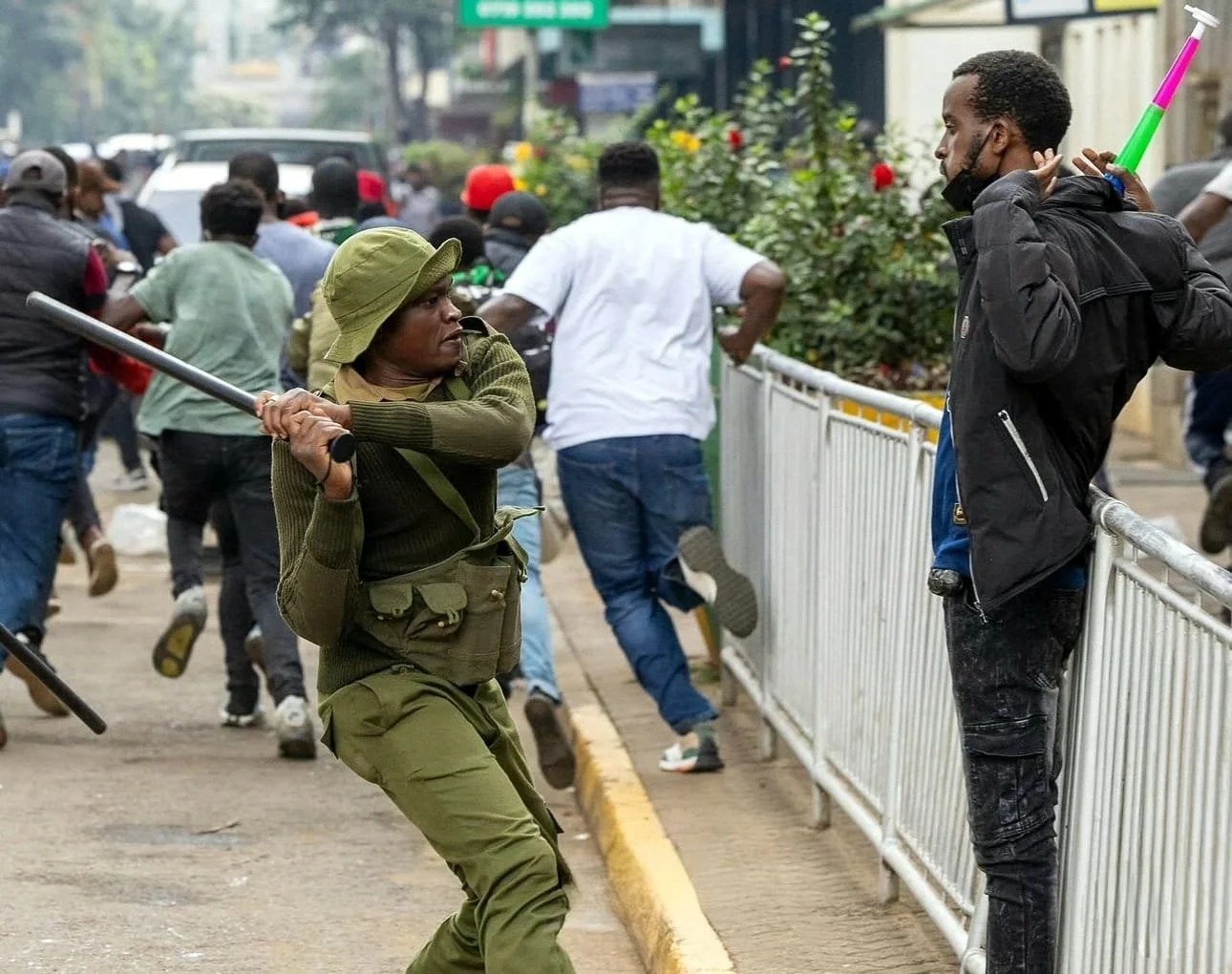
Police brutality
By Jerameel Kevins Owuor Odhiambo
In December 2024, the global civil society alliance CIVICUS formally downgraded Kenya’s civic space from “obstructed” to “repressed.” At the same time, a national assessment found that 59 percent of respondents rated the status of human rights and the rule of law as bad or very bad, while over 71 percent said conditions had deteriorated in the previous two years. Freedom of association was judged bad or very bad by 54 percent. These are not abstract rankings. They are the measured pulse of a nation whose Constitution of 2010 still ranks among the most progressive on the continent, yet whose streets and digital spaces have become hunting grounds for those who dare insist that the document be obeyed.
This is the central irony of our time: the very institutions and actors that once forced Kenya out of one-party darkness are now treated as national security threats. Civil society the churches, human rights groups, professional associations, youth networks, and grassroots organisations did not invent the demand for multiparty democracy in the late 1980s. They simply refused to let it die. When the Moi regime criminalized dissent, the Catholic, Anglican, and Presbyterian churches became the last free pulpits. When the state monopolized the airwaves, civil society and a defiant independent press became the alternative public square. When the 2007–2008 post-election violence exposed the hollowness of elite pacts, civil society helped midwife the 2010 Constitution devolution, a robust Bill of Rights, public participation as a national value, and independent commissions meant to restrain executive excess.
That Constitution did not fall from heaven. It was extracted, clause by painful clause, through sustained civic pressure. Diagonal accountability the pressure that comes not from elections or rival politicians but from organised citizens, media, and independent voices has been Kenya’s most reliable democratic shock absorber. Without it, the return to multiparty politics in 1992 would have remained a paper exercise. Without it, the 2010 Constitution would never have been born. Without it, the Finance Bill 2024 would have passed unchallenged, and the Gen Z uprising of June and July that year would have remained a hashtag rather than a force that compelled presidential retreat.
Even so, the same state that benefits from this resilience now seeks to neutralize it. The pattern is familiar and therefore more dangerous. During the 2024 protests against punitive taxation and corruption, security forces responded with live ammunition, abductions, and enforced disappearances. Official and independent tallies spoke of dozens killed, hundreds injured, and scores still missing months later. Journalists covering the demonstrations were assaulted; media houses had signals switched off. Activists were labelled foreign agents, unpatriotic, or terrorists. The Public Benefit Organisations Act, long delayed and only recently operationalized, has been accompanied by regulatory harassment and accusations that foreign funding equals foreign control. The irony is almost literary: a government that courts international capital and diaspora remittances brands its own citizens traitors for receiving support to defend constitutional rights.
This is not mere overreach. It is a deliberate strategy of democratic erosion. When the executive intimidates the judiciary, paralyses independent commissions, and treats public participation as a procedural nuisance rather than a constitutional command, the only remaining counterweight is an organised and vigilant civil society. Neutralize that counterweight and what remains is elective authoritarianism periodic elections without the continuous accountability that makes elections meaningful. The correlation is stark: as civic space contracts, public trust in institutions collapses, corruption flourishes in the shadows, and the rule of law becomes selective. Those with proximity to power enjoy immunity; those without it face the full weight of the state.
History offers no comfort to those who believe this tension is temporary. From the Young Turks of the 1990s to the Ufungamano initiative that forced constitutional talks, to the election observation networks that have repeatedly exposed irregularities, Kenyan civil society has functioned as the immune system of the republic. When the body politic develops fever electoral violence, grand corruption, extrajudicial killings civil society mobilizes antibodies. The state, instead of cooperating with the diagnosis, increasingly prefers to suppress the symptoms by attacking the immune system itself.
The consequences are already measurable. Afrobarometer data continues to show that while many Kenyans still prefer democracy to any alternative, satisfaction with its performance has stagnated or declined. Youth unemployment and economic precarity fuelled the Gen Z protests precisely because formal channels of accountability had atrophied. When Parliament appears captured, when independent offices are starved or staffed with loyalists, and when the police act with near-total impunity, citizens turn to the streets and the screens. That is not instability. It is the predictable outcome of institutional failure.
Nonetheless, civil society is not without its own unfinished business. Dependence on external funding creates vulnerabilities that the state is only too happy to exploit. Fragmentation along ethnic, generational, or issue-based lines sometimes dilutes collective power. The professionalization of activism has, in some quarters, produced distance from the very communities it claims to serve. These weaknesses must be confronted with the same intellectual honesty that civil society demands of the state. Diversified domestic funding, genuine grassroots embedding, and strategic unity around non-negotiable constitutional principles are no longer optional; they are survival requirements.
The call to action is therefore categorical and multi-directional.
To the Executive: stop treating constitutional accountability as political opposition. Enforce the Access to Information Act. End the culture of abductions and extrajudicial killings. Investigate and prosecute security officers who use lethal force against unarmed citizens. Operationalise the PBO Act in good faith rather than as a tool of selective harassment.
To Parliament: cease enabling executive overreach through silence or rubber-stamp legislation. Public participation is not a box-ticking ritual; it is a constitutional obligation. Strengthen, rather than weaken, the independence of the Independent Electoral and Boundaries Commission and the judiciary.
To the Judiciary: continue the tradition of courageous rulings that have periodically rescued the constitutional order, but recognise that judgments ignored by the executive become dead letters. Assert institutional authority without apology.
To international partners: condition engagement on genuine civic space, not merely on economic reforms or geopolitical alignment. Funding that strengthens state capacity while remaining silent on the shrinking space for independent voices is complicity dressed as partnership.
To ordinary Kenyans: civil society is not a set of organisations in Nairobi offices. It is every citizen who refuses to normalize impunity, who demands information, who participates beyond election day, who teaches the next generation that rights are not gifts from rulers but birthrights defended through vigilance.
Civil society is not the enemy of the Kenyan state. It is the conscience the state keeps trying to silence because the conscience refuses to flatter. In the long arc of this nation’s struggle from colonial rule through one-party domination to the incomplete democratic experiment of today organised citizens have been the most consistent force for the expansion of freedom. That they are now hunted for performing the same function is not a sign of their failure. It is proof of their necessity.
The rule of law does not enforce itself. Democracy does not self-correct. Both require citizens willing to stand between power and its worst instincts. In Kenya today, those citizens are under deliberate pressure. History will judge harshly any generation that watched the guardians fall and mistook the silence that followed for peace. The work continues not because it is safe, but because the alternative is a republic that exists only in the preamble of a Constitution no longer lived.
The writer is a social commentator
Similar Posts by The Mt Kenya Times:
- Kenya’s universities on the brink: Students pay the price for a crisis they did not create
- Kenya’s electoral ghosts walk again: Kuria’s confession opens a dangerous wound ahead of 2027
- Reijnders comes clean: ‘I can’t deny I’m a money grabber’
- Fathers of Nations: Four men, four betrayals, one continent’s broken promise
- Klopp lays down the law: Germany’s new coach sets strict rules for national team
About the Author