The ‘White Genocide’ Narrative in South Africa: Critical Analysis
 The Mt Kenya Times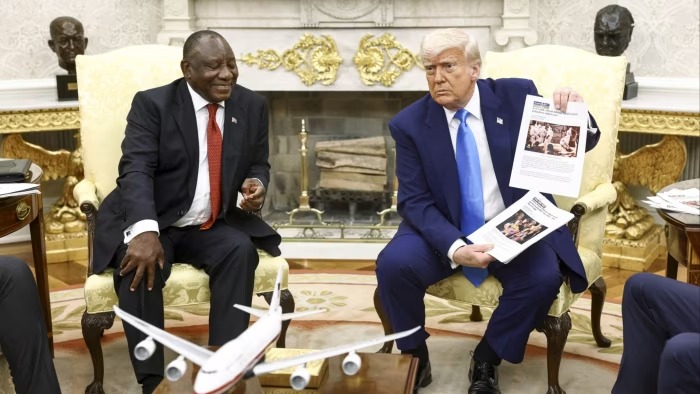
US President Donald Trump and South African President Cyril Ramaphosa
By: Silas Mwaudashen Nande
The assertion of a ‘white genocide’ in South Africa is a deeply contentious and emotionally charged claim that has garnered significant international attention, often amplified by political figures and media outlets. This narrative posits that white South Africans, particularly farmers, are being systematically targeted and murdered as part of a deliberate campaign to eradicate them. While the specific high-stakes diplomatic confrontation between a sitting US President Donald Trump and South African President Cyril Ramaphosa, has been avoided at all costs, the underlying contention – Trump’s repeated insistence on the persecution of white farmers and the South African government’s firm denial of any genocide – is a well-documented aspect of recent international discourse. This analysis will meticulously dissect the ‘white genocide’ narrative, juxtapose it against the empirical realities of crime in South Africa, illuminate the stark differences with historically recognized genocides on the African continent, and ultimately conclude on the veracity of the claim made by the White House.
The ‘White Genocide’ Narrative: Genesis and Global Dissemination
The concept of ‘white genocide’ in South Africa is not a new invention but rather an evolving narrative rooted in specific political and ideological movements. Its genesis can be traced back to certain right-wing and white supremacist groups, both within South Africa and internationally, who interpret crime statistics and land reform policies as evidence of a deliberate, racially motivated extermination. These groups often conflate generalized violent crime with targeted ethnic cleansing, asserting a specific intent to destroy the white population.
The narrative gained unprecedented global prominence and legitimacy when, during his presidency, Donald Trump publicly articulated concerns about ‘large scale killing of farmers’ and ‘land confiscation’ in South Africa, even directing his Secretary of State to investigate farm attacks and land expropriation. He stated, for instance, that white farmers were being ‘brutally killed and their land is being confiscated in South Africa,’ and that a ‘genocide’ was taking place. This endorsement from a head of state elevated the claim from the fringes of online forums to the forefront of international diplomatic discourse, putting South African officials on the defensive. Reports indicate that at a White House meeting with President Ramaphosa, Trump presented articles and videos, including footage falsely identified as ‘burial sites of thousands of white farmers,’ to support his claims, prompting Ramaphosa to condemn the misinformation.
The core tenets of the ‘white genocide’ narrative typically revolve around two main arguments:
Farm Murders as Targeted Killings: Proponents emphasize the horrific brutality of some farm attacks, asserting that these are not merely criminal acts but racially motivated murders designed to drive white farmers off their land and ultimately eliminate them. They often highlight the disproportionate violence used, claiming it signifies a deeper, genocidal intent beyond mere robbery.
Land Expropriation as a Tool of Dispossession and Elimination: The policy of land expropriation without compensation (EWC), aimed at addressing historical injustices from apartheid, is frequently misinterpreted or deliberately misrepresented as a means to dispossess white farmers and contribute to their alleged ‘genocide.’ The narrative frames this policy as a racially targeted attack on white economic well-being and a precursor to broader ethnic cleansing.
However, the international legal definition of genocide, as established by the 1948 Genocide Convention and the 1998 Rome Statute, requires ‘acts committed with intent to destroy, in whole or in part, a national, ethnic, racial or religious group.’ This element of specific intent is paramount. For a situation to be classified as genocide, it is not enough for a group to suffer widespread violence or even a high number of deaths; there must be demonstrable intent on the part of perpetrators to annihilate the group. Critics of the ‘white genocide’ narrative argue that this crucial element of intent is demonstrably absent in South Africa’s crime landscape and land reform policies.
Crime in South Africa: A Broader and More Nuanced Perspective
South Africa is indeed a country burdened by extremely high levels of violent crime. It consistently ranks among nations with alarmingly high murder rates, and this reality affects all citizens, regardless of their racial background. To isolate farm attacks, tragic as they are, and frame them as evidence of a ‘white genocide’ requires ignoring the broader context of crime in the nation.
Overall Crime Rates and Victim Demographics: The South African Police Service (SAPS) regularly releases crime statistics, which paint a grim picture of pervasive violence. While comprehensive racial breakdowns of all crime victims are not always publicly detailed, available data and analyses refute the claim that white people are uniquely or disproportionately targeted for murder in the context of a genocide. For instance, the Police Minister Senzo Mchunu, in response to the ‘genocide’ claims, explicitly stated that between January and March of a given year, five out of six people killed on farms were black, and only one was white. In the preceding quarter (October to December), 12 murders on farms were recorded, with only one white farm owner among the victims. This starkly contradicts the assertion that white people are the primary or exclusive targets.
Furthermore, given that black South Africans constitute over 80% of the population, they are, by sheer numbers, the most frequent victims of violent crime, including murder. Statistics often reveal that the majority of homicides in South Africa are intra-racial, meaning both victims and perpetrators belong to the same racial group. An older but still relevant study from 2004, for instance, highlighted that ‘the coloured population has the highest homicide rate in South Africa,’ followed by black South Africans, while ‘White and Indian homicide rates are lower than both the coloured and black rates.’ This pattern, experts note, has remained relatively consistent.
Farm Attacks: Criminality vs. Genocide: Farm attacks and murders are a deeply distressing issue in South Africa, causing immense fear and suffering within rural communities. The brutality often associated with these crimes is undeniable. However, extensive research and official investigations, including inquiries by the South African Human Rights Commission and police task forces, have consistently concluded that the primary motive behind these attacks is overwhelmingly criminal – robbery, theft, and sometimes labor disputes or domestic violence – rather than a racially motivated campaign of extermination. These crimes are often perpetrated by criminal gangs seeking valuables, equipment, or vehicles, and they target anyone perceived as vulnerable in isolated rural areas, irrespective of race.
The Institute for Security Studies (ISS Africa), an independent body tracking violence and crime in South Africa, explicitly states, ‘The lie of a ‘genocide’ against white farmers in South Africa took centre stage… The fact is that there is no ‘white genocide’ in South Africa… The motive for farm murders is almost always robbery – not the intent to ‘destroy, in whole or in part, an ethnic group.” They further highlight that farm murders represent a minuscule fraction (0.2%) of the total murders nationally (49 out of 27,621 in one financial year mentioned in a search result), and farm attacks constitute a small percentage (0.7%) of all robberies. While tragic, these numbers do not support a ‘genocide’ claim.
Systemic Issues in Law Enforcement: It is also critical to acknowledge the broader challenges faced by the South African criminal justice system. High crime rates are compounded by systemic issues such as low detection rates for murder (dropping by 65% since 2012 to 11% in a recent year) and low conviction rates for murder (just 13% nationally in the past five years). These shortcomings affect all victims of crime, irrespective of their race or location. Blaming these systemic failures on a ‘genocidal’ intent towards white people diverts attention from the necessary and complex reforms required to improve policing and justice for all South Africans.
Land Reform in South Africa: Context and Controversy, Not Genocide
Another pillar of the ‘white genocide’ narrative is the issue of land reform, particularly the policy of expropriation without compensation (EWC). To understand this, it is essential to appreciate South Africa’s historical context. The legacy of apartheid systematically dispossessed black South Africans of their land, concentrating ownership in the hands of the white minority. Land reform policies initiated after 1994 aim to address this historical injustice and promote equitable land distribution.
The policy of EWC has been a subject of intense debate within South Africa. Its proponents argue it is a necessary mechanism to accelerate land redistribution and address historical imbalances. Critically, the law is intended to allow the government to seize land for public purposes and public interest, with fair compensation generally outlined, but also allowing for nil compensation in specific instances where it is deemed just and equitable. It is not, as the ‘white genocide’ narrative suggests, a blanket seizure targeting white-owned land specifically to dispossess or harm white individuals as an ethnic group.
The South African government has consistently denied that the land reform policies are discriminatory or intended to target white farmers. President Ramaphosa has stated that it is ‘completely false’ to claim that ‘people of a certain race or culture are being targeted for persecution’ through land policies. Even some white Afrikaner groups and political parties within South Africa, while having concerns about the implementation and implications of EWC, have publicly stated that there is no government seizure of land that constitutes a ‘genocide.’ For instance, the Democratic Alliance (DA), the country’s second-largest party, while opposing ‘nil compensation,’ has agreed with the concept of ‘just-and-equitable’ compensation.
The debate around land reform is a complex socio-economic and political issue, reflecting the ongoing struggle to redress historical injustices and foster a more equitable society. To equate this policy with genocide is a fundamental misrepresentation that ignores its historical context, legal framework, and stated objectives, as well as ‘painting the wall black while it is supposed to be white.’
Historical and Contemporary Genocides in Africa: A Crucial Comparison
To appreciate the gravity and the specific meaning of the term ‘genocide,’ it is imperative to compare the claims made about South Africa with documented instances of genocide, particularly those that have scarred the African continent. These historical atrocities serve as a stark reminder of what constitutes a genuine attempt to destroy an ethnic, racial, or national group.
The Herero and Nama Genocide (German South West Africa, now Namibia 1904-1908): This is widely recognized as the first genocide of the 20th century. German colonial forces, under Lieutenant General Lothar von Trotha, launched a campaign of ethnic extermination against the Herero and Nama peoples in what is now Namibia. Following a rebellion, Herero survivors were driven into the Omaheke desert, where German forces prevented them from accessing water, leading to mass deaths by dehydration. Nama people faced a similar fate. Estimates suggest between 24,000 and 100,000 Herero (80% of their population) and 10,000 Nama (50% of their population) were killed. Methods included genocidal massacres, mass murder, starvation, concentration camps, forced labor, and human experimentation. The intent to destroy these groups was clear and orchestrated by the colonial state. Today, various Hereros are displaced and some are found in Botswana as a result.
Atrocities in the Belgian Congo (late 19th – early 20th Century): Under King Leopold II’s personal rule, the Congo Free State was subjected to a regime of extreme exploitation, particularly in rubber and ivory extraction. While not formally classified as a genocide under the 1948 convention, the systematic brutality, forced labor, mutilations, and mass killings led to the deaths of an estimated 10 million Congolese people. The scale of death and suffering was immense, resulting from a deliberate policy of terror and exploitation by the colonial administration.
The Rwandan Genocide (1994): This is perhaps the most well-known modern genocide. Within approximately 100 days, an estimated 800,000 Tutsi and moderate Hutu were systematically slaughtered by Hutu extremist forces (Interahamwe militia and elements of the Rwandan Army). The intent to destroy the Tutsi ethnic group was explicitly articulated through hate propaganda, organized killings, and systematic targeting. The scale, speed, and calculated nature of the killings, coupled with a clear ideological motive, unequivocally meet the definition of genocide.
The Genocide in Burundi (1972): In 1972, a wave of mass killings in Burundi targeted the Hutu ethnic group by the Tutsi-dominated army and government. Hundreds of thousands of Hutus were murdered, often intellectuals, civil servants, and those perceived as potential leaders. This was a deliberate attempt to eliminate the Hutu elite and consolidate Tutsi power, fulfilling the criteria of genocide.
The Darfur Genocide (Sudan, early 2000s onwards): In Darfur, the Sudanese government and its allied Janjaweed militia launched a campaign against non-Arab ethnic groups (primarily Fur, Masalit, and Zaghawa). This involved systematic killings, widespread rape, destruction of villages, and forced displacement into desolate areas, leading to hundreds of thousands of deaths and millions displaced. The International Criminal Court has issued arrest warrants for Sudanese officials, including former President Omar al-Bashir, on charges of genocide.
Why the ‘White Genocide’ Claim Fails in Comparison: When juxtaposed against these historical atrocities, the ‘white genocide’ narrative in South Africa collapses. The documented genocides in Africa share critical characteristics that are absent in South Africa’s current situation:
State-Sponsored, Organized Intent: In genuine genocides, there is clear evidence of state or powerful political group intent to destroy a specific group, often through systematic planning, organized militias, and explicit directives. This is entirely lacking in South Africa.
Targeting Based on Group Identity for Annihilation: The primary motive in historical genocides is the elimination of a group because of their identity, not simply criminal gain. In South Africa, while crimes may be racially motivated in individual instances, there is no evidence of a systematic, nationwide effort to annihilate white people.
Scale of Deaths and Suffering: The scale of death in documented genocides is in the hundreds of thousands or millions, often representing a significant portion of the targeted population. While farm murders are tragic, their numbers, even when aggregated, do not approach the scale of a genocidal campaign, and they are dwarfed by the overall murder rates affecting other racial groups.
Public Policy of Extermination: Genocidal regimes often implement public policies of extermination, forced displacement, and destruction of group identity. South Africa’s government explicitly condemns violent crime and implements land reform policies aimed at equity, not elimination.
Equating the crime problem in South Africa, however severe, with these historical instances of genocide is not only factually incorrect but also deeply offensive. It trivializes the immense suffering of genuine genocide victims and risks undermining the very concept of genocide, making it harder to identify and prevent future atrocities.
The Political and Ideological Underpinnings of the ‘White Genocide’ Narrative
The persistence and amplification of the ‘white genocide’ narrative, despite overwhelming evidence to the contrary, reveal its deep roots in specific political and ideological agendas.
Right-Wing and White Supremacist Agendas: The narrative is a cornerstone of white supremacist and far-right extremist movements globally. For these groups, it serves several purposes:
Racial Mobilization: It acts as a rallying cry, fostering a sense of victimhood and existential threat among white populations, both in South Africa and in the diaspora.
Discrediting Post-Apartheid South Africa: By portraying the country as a failed state where white people are under attack, it seeks to delegitimize the democratic, non-racial government that replaced apartheid.
Connecting to Broader ‘White Replacement’ Theories: The ‘white genocide’ narrative in South Africa is often linked to the broader, racist ‘Great Replacement’ or ‘white replacement’ conspiracy theories prevalent in the West, which falsely claim that white populations are being systematically replaced by non-white immigrants or groups. South Africa, with its unique history of racial segregation and transition, becomes a prime, albeit misleading, example for these global narratives.
Political Exploitation: As seen with Donald Trump’s statements, the narrative can be politically exploited to appeal to specific voter bases, often those feeling marginalized or anxious about demographic and social changes.
The Role of Misinformation and Social Media: The digital age has played a critical role in the dissemination of the ‘white genocide’ myth. Social media platforms, with their ability to spread information rapidly and without rigorous fact-checking, have been fertile ground for its propagation. Emotionally charged posts, often featuring decontextualized images or outdated statistics, can quickly go viral, bypassing traditional media gatekeepers. This creates echo chambers where the narrative is reinforced among believers, making it difficult for factual corrections to penetrate. The incident where President Donald Trump showed a video misidentified as ‘burial sites of thousands of white farmers’ during a diplomatic meeting illustrates the power and danger of such misinformation.
Conclusion: Final Assessment and International Responsibility
After a thorough critical analysis, the conclusion is clear and unequivocal: there is no credible evidence to support the claim of a ‘white genocide’ in South Africa.
The narrative is a distortion of reality, fundamentally misrepresenting the nature of crime in the country and misinterpreting legitimate socio-economic policies like land reform. While South Africa undeniably faces a severe challenge with high crime rates, which affects citizens of all races, these are primarily driven by criminal intent, not a systematic, state-sponsored, or ethnically targeted campaign of extermination against white people. The overwhelming majority of violent crime victims in South Africa are black, reflecting the country’s demographic reality.
Comparing the complex issue of crime in South Africa to historical genocides, such as those in Rwanda, Namibia, or Darfur, is not only factually incorrect but also deeply offensive. It trivializes the immense suffering and deliberate extermination experienced by victims of genuine genocidal campaigns, undermining the very concept of genocide and making it harder to recognize and prevent future atrocities.
The propagation of the ‘white genocide’ narrative serves a political and ideological agenda, often by white supremacist groups and those seeking to sow racial division and discredit the post-apartheid South African government. It relies heavily on misinformation and the amplification provided by social media.
For the world to engage constructively with South Africa, it is essential to focus on the real challenges the country faces: high crime rates, inequality, poverty, and the ongoing efforts to redress historical injustices. Spreading and believing in false narratives like ‘white genocide’ hinders genuine understanding, perpetuates racial animosity, and distracts from the collaborative efforts needed to build a more secure and equitable society for all South Africans. The international community has a responsibility to critically evaluate such claims, rely on credible sources, and reject narratives that are demonstrably false and harmful.
Similar Posts by The Mt Kenya Times:
- Mt Kenya Times ePAPER August 25, 2026
- Mt Kenya Times ePAPER August 24, 2026
- Diaspora Times Global Aug 22 – Aug 28, 2026
- Mt Kenya Times ePAPER August 21, 2026
- Ichung’wah dares ICC: Investigate the opposition too
About the Author