The Mt Kenya Times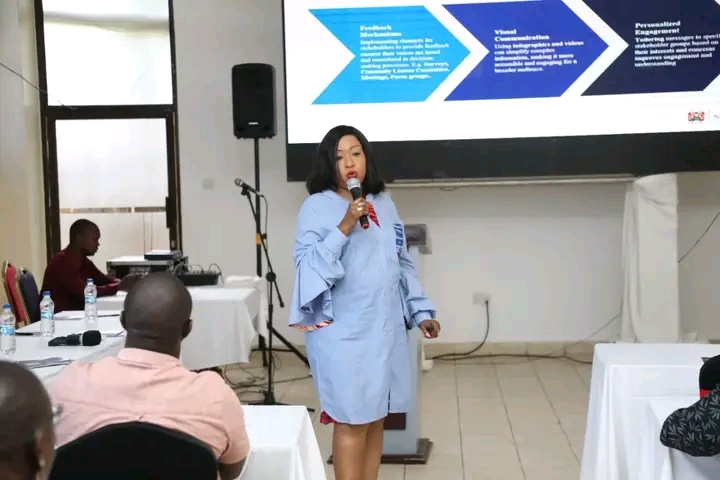
Ms Patricia Ndede director of communication NuPEA team during engagement with stakeholders.

Patricia Ndede is quietly doing one of the most demanding communication jobs in Kenya — explaining the unexplainable to communities whose land may never be the same.
By James Kilonzo Bwire
Patricia Ndede, director of information, advocacy and communication at the Nuclear Power and Energy Agency, yesterday emerged as a central figure in Kenya’s effort to bring credible public engagement to the country’s proposed nuclear power plant in Lenya Village, Bondo Constituency, Siaya County — a project that, if it proceeds, would represent one of the most consequential infrastructure decisions in the nation’s history.
Major national projects are typically announced through figures: megawatts of electricity, billions of shillings in investment, thousands of projected jobs. Behind those figures, however, are communities whose land, livelihoods and futures may be reshaped in ways no press release adequately captures. In Bondo Constituency, where Lenya Village has been identified as the preferred site for Kenya’s proposed nuclear facility, the quality of the public conversation is as consequential as the technical vision. Residents need clear information, honest answers and a genuine opportunity to participate in decisions that could redefine their community for generations. That is precisely where Ndede’s work begins.
Her role at the Nuclear Power and Energy Agency — known as NuPEA — connects the agency with communities, elected leaders, technical specialists and broader stakeholders navigating one of the most unfamiliar subjects ever placed before a Kenyan public forum. Communication in this context is not publicity. It is the bridge between complex national planning and the people who will live with its consequences. And it is a bridge that must be constructed carefully, maintained consistently and opened unconditionally to those who have the most to lose if the conversation fails.
Ndede brings more than 22 years of experience in media and communications to that bridge. Her professional journey spans journalism, public relations, government communication, public education campaigns and crisis management. She has worked with Nation Media Group and Capital Group, held communication responsibilities at Huduma Kenya and the Retirement Benefits Authority, and served in leadership roles within the public relations profession in Kenya. It is a combination that matters enormously in a subject where institutional credibility and public trust must be built simultaneously and largely from scratch.
Experience in journalism is particularly relevant when communicating issues that attract sustained public scrutiny. Journalists understand the importance of asking uncomfortable questions, verifying information independently, examining claims against evidence and presenting complex matters in ways that ordinary audiences can follow without feeling patronised. Public relations and institutional communication, meanwhile, demand the ability to explain an organisation’s mandate, maintain constructive stakeholder relationships and respond to legitimate concerns without retreating into defensive or bureaucratic language. Bringing those disciplines together helps NuPEA approach public engagement with a clearer sense of the questions communities are likely to raise — and the standard of answer those communities deserve and have every right to expect.
NuPEA has conducted a series of engagements with communities and stakeholders in the Bondo area on the proposed nuclear facility. Those sessions matter because a project of this magnitude cannot be understood through technical presentations alone. It requires direct, sustained interaction with the people who live in and around the proposed host site — people who did not ask to find themselves at the centre of a national energy debate but who now find their futures partly dependent on its outcome. Residents have raised substantive questions about safety, environmental protection, spent fuel management, land acquisition, employment opportunities, infrastructure development and the possible establishment of a Community Liaison Committee. These are not procedural concerns to be managed or deflected. They are the legitimate expectations of citizens with a direct and irreversible stake in what happens next.
Questions about safety require detailed, evidence-based explanations of applicable standards, regulatory responsibilities and proposed oversight arrangements. Questions about environmental protection require clear information about the assessments that must be completed — independently and transparently — before any final decision is made. Questions about spent fuel require technically accurate explanations of the management arrangements being considered and the international standards that would govern them. Questions about land require transparent, accessible information about the legal procedures that apply, the compensation frameworks available and the channels through which grievances can be raised and pursued. None of these can be adequately addressed through general assurances or institutional goodwill. They require specific, honest answers from the relevant institutions and specialists — and they require a communication function capable of ensuring those answers reach the people who need them in a language and format those people can actually use.
Nuclear energy is genuinely unfamiliar to most Kenyan communities, and the technical vocabulary that surrounds it — reactor technology, radiation protection, emergency preparedness, regulatory oversight, environmental impact assessments — can easily overwhelm a public forum and leave residents feeling excluded from a conversation that is directly about their lives. Yet the underlying issues connect precisely to what communities care about most deeply: the safety of their families, the protection of their land, water and natural resources, the future of their children and the long-term sustainability of their way of life. Effective communication of nuclear energy therefore demands the ability to explain technical matters accurately without burying the audience in specialist language, and the courage to acknowledge openly that some questions depend on assessments not yet completed and that some decisions have not yet been made and cannot honestly be pre-empted.
This distinction — between what is established, what is under assessment and what remains genuinely undecided — is one of the most important things Ndede’s communication function must convey with consistency and clarity. Public engagement loses its integrity and its value when residents cannot reliably distinguish confirmed facts from institutional proposals, or technical plans from regulatory approvals not yet secured. Where those lines are allowed to blur, trust deteriorates and the space for constructive dialogue contracts, sometimes irreversibly. Where they are maintained with discipline and transparency, public confidence can grow even around an unfamiliar and inherently contentious subject — and communities can engage with the process as informed participants rather than bewildered observers.
Trust is not something an institution can demand or declare. It is built through conduct — through communicating what is known honestly, explaining what remains uncertain without evasion and avoiding statements that outpace the evidence or suggest conclusions the regulatory process has not yet reached. For NuPEA, building trust means keeping relevant information accessible after meetings conclude, providing substantive answers to questions left unresolved during public forums and explaining in accessible terms how concerns raised by stakeholders are being incorporated into the agency’s thinking and planning. It means giving communities adequate time and genuine access to participate before important decisions are reached. And it means returning to communities with updated, accurate information as the project moves through its various stages — treating public engagement as an ongoing relationship rather than a one-time administrative obligation to be discharged and forgotten.
Ndede’s background in crisis communication is directly relevant to that challenge. Projects involving nuclear energy can generate intense public emotion because they engage simultaneously with safety, environmental responsibility, economic aspiration and the long-term character of local communities. When concerns arise and are not met with credible responses, silence creates an information vacuum that rumour and fear quickly fill. Overly technical responses can alienate audiences and deepen the perception that institutions are speaking past the community rather than to it. Vague reassurances, delivered without specificity, can intensify rather than reduce suspicion. Effective communication in this environment demands a careful and constantly recalibrated balance: accuracy without inaccessibility, institutional authority without condescension, empathy without the appearance of manipulation, and the organisational discipline to follow a difficult question through to a credible, verifiable answer rather than closing it with a deflection that satisfies no one.
That standard of sustained engagement cannot be delivered through a single public meeting or a carefully managed communication campaign with a fixed end date. It requires communities to be able to seek clarification long after forums close, to access updated information as the project develops and receives new regulatory attention, and to receive honest explanations when significant new developments occur. Local media, community meetings, printed materials, radio broadcasts and digital platforms all have a legitimate and useful role in that effort. But they must work in concert rather than as substitutes for one another. Digital communication provides reach and the ability to share detailed technical documents at low cost, but face-to-face engagement remains essential for residents with limited internet access, limited literacy in formal technical language or a well-founded preference for questioning officials and specialists directly, in a room where accountability is immediate and visible.
Inclusivity must remain a central discipline throughout the engagement process and not merely a rhetorical commitment made in mission statements. Women, young people, older residents, fishing communities along the shores of Lake Victoria, local traders, smallholder farmers, faith leaders, people with disabilities and households living closest to the proposed site may hold questions and priorities that differ significantly from those which surface in formal stakeholder meetings attended primarily by officials and community representatives. Their participation must not be treated as a procedural formality or a numerical target to be reported in agency documentation. Engagement arrangements must make it genuinely practical for different groups to contribute — and must do so with the recognition that access to information, transportation, technology and the time required to attend meetings is not evenly distributed across any community, particularly one in a rural constituency where many residents depend on daily economic activities they cannot easily suspend.
A Community Liaison Committee, if established through a transparent and participatory process with a clearly defined and publicly communicated mandate, could provide an additional and enduring channel between residents and the institutions involved in the proposed project. Its value would depend entirely on whether it functions as a genuinely trusted mechanism — one with credible and broadly representative membership, regular and publicly announced meetings, a reliable and independently verifiable process for recording community concerns and a practical means of communicating its findings and the responses it receives back to the wider community it is supposed to represent. A committee that exists on paper but operates primarily as a channel for institutional messaging, rather than as a vehicle for authentic community voice, would not strengthen the engagement process. It would undermine it, and the damage to public trust that would follow would be difficult to repair.
Communication cannot substitute for independent safety oversight, rigorous environmental assessment, transparent legal process or the technical work required to establish definitively whether a project of this nature can safely proceed in the proposed location. These processes must be conducted on their own terms, by the institutions and specialists constitutionally and legally responsible for them, and their findings must be made publicly available in accessible form. But effective public communication helps communities understand those processes, follow their progress, know which institutions are responsible for which decisions and hold those institutions accountable when explanations are inadequate or timelines are not met. It keeps the space for public participation genuinely open and functional — rather than allowing it to be reduced to a regulatory requirement visited briefly at the start of a project and then quietly set aside as decisions accumulate behind closed doors.
Ndede’s work at NuPEA, connecting the agency’s information and advocacy function to the practical needs of communities across Bondo and Siaya County, reflects a broader truth about complex public projects: that the people and processes responsible for communication are not peripheral to the enterprise. They are central to whether the enterprise retains democratic legitimacy as it moves forward. The engineering plans and investment projections that define a nuclear project on paper are visible and measurable. The communication work that determines whether communities understand, trust and meaningfully participate in the process that shapes those plans is less visible — but no less consequential.
The proposed nuclear facility in Lenya will ultimately be considered through technical, environmental, legal, economic and public participation processes that extend well beyond any communication programme and will take years to complete. Its future will be determined by evidence, independent regulatory findings and the decisions of accountable institutions operating within Kenya’s legal framework and within the standards of the International Atomic Energy Agency. But the quality of public understanding throughout that process — and the degree to which communities in Bondo and across Siaya County are able to participate meaningfully in it — will depend substantially on whether residents have access to clear, honest and consistently updated information, and on whether the professionals responsible for that information bring to it the experience, discipline and genuine respect for the public that the task unambiguously demands.
Ndede represents that standard of professionalism in a field where the temptation to manage public perception rather than serve public understanding is ever present and structurally reinforced. Her contribution is a reminder that national development is most credible, most durable and most just when the people closest to a proposed project are treated as participants in the process rather than as recipients of decisions already made elsewhere. The conversations she is helping to facilitate may be less visible in the public record than engineering specifications or financing agreements. But they are no less essential to whether what follows in Lenya and across Bondo Constituency is experienced by residents as development — or simply as disruption imposed from above.
The strongest and most meaningful measure of her contribution will not be found in any single public forum, any agency report or any media coverage of a stakeholder meeting. It will be found in whether the people of Bondo and the wider Siaya community, when this process reaches its most consequential and irreversible stages, can honestly say that they were genuinely informed throughout, that their questions received real answers, that their concerns were taken seriously by the people with the power to act on them — and that they had a meaningful voice in shaping the decisions that will determine the future of their land, their water and their community. That outcome, if it is achieved, will owe a great deal to the work being done now — consistently, professionally and without fanfare, by people like Patricia Ndede.
Similar Posts by The Mt Kenya Times:
- Mt Kenya Times ePAPER October 12, 2026
- Gachagua’s party storms Kikuyu from afar as 2027 countdown begins
- Counties caught: The KSh100B payroll scandal Kenya can no longer hide
- CS Ogamba: tree planting could generate carbon credit millions to fund education
- Farouk Kibet calls for unity and development as leaders rally behind Ruto’s 2027 re-election bid
About the Author