When equality stops asking questions: Why Kenya must recalibrate its gender agenda
 The Mt Kenya Times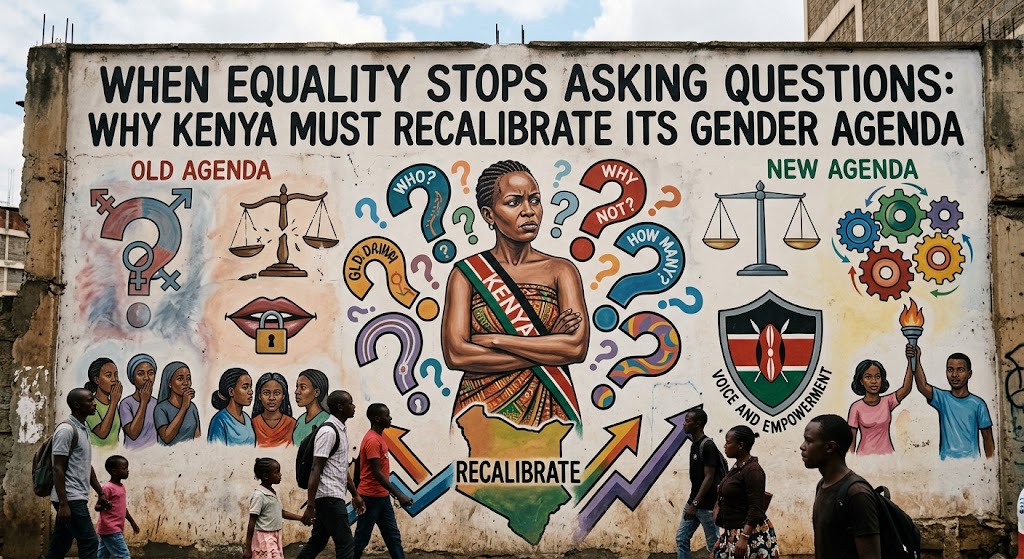
By Mr. Fredrick Kipchumba Chelimo PWD
Chairperson, Jiamini Disability network Community Based organization
Email: jiamini.network@gmail.com
A society demonstrates its moral maturity not by the slogans it proclaims but by its willingness to question whether its institutions still serve justice. There was a time when Kenya’s greatest constitutional challenge was to dismantle the deeply entrenched barriers that denied women equal opportunity. Women were systematically excluded from political leadership, formal employment, education, financial services and positions of influence. The Constitution of Kenya 2010 rightly responded by enshrining equality before the law, prohibiting discrimination, requiring affirmative measures to redress historical disadvantage and affirming that human dignity belongs equally to every Kenyan. Those reforms were not gifts bestowed upon women; they were a long-overdue recognition of rights that should never have been denied.
History will judge that constitutional moment kindly. It corrected profound injustices, expanded democratic participation and transformed the aspirations of millions of girls and women. Yet constitutions are living instruments, not frozen monuments. They are designed to respond to changing realities, and the legitimacy of any public policy depends not only on the justice of its origins but also on the justice of its continuing effects. No democratic society should fear examining whether programmes created to correct historical inequality remain proportionate, evidence-based and faithful to the constitutional promise of equal protection for every person.
The most dangerous assumption any nation can make is that yesterday’s solutions will always solve tomorrow’s problems. Justice is not a destination reached once and preserved forever; it is a continual process of measuring whether public institutions remain fair to all. If that process stops, equality itself risks becoming ideological rather than constitutional.
Across Kenya, a new social conversation is quietly unfolding. It is not driven by hostility towards women or by nostalgia for discrimination. It is driven by citizens asking whether some affirmative interventions have become so permanent that they are no longer periodically assessed against current evidence. Public policy should never become immune from review simply because its original purpose was noble.
This conversation is particularly evident in the allocation of public opportunities. Over the past decade, Kenya has created numerous empowerment initiatives, procurement preferences and targeted financial programmes intended to increase women’s participation in the economy. Many of these interventions have delivered important gains. However, questions are increasingly being asked about whether future programmes should be designed around measurable disadvantage rather than assuming disadvantage solely on the basis of gender. A young unemployed man from a poor rural household, a widower raising children alone, or a man living with a disability may face profound barriers that are not adequately recognised by programmes built around categorical assumptions. The Constitution protects every person from discrimination; its promise is not confined to one sex.
The same need for recalibration is emerging in education. For many years, Kenya’s education policies rightly focused on improving girls’ enrolment, retention and completion because girls faced significant structural barriers. Those interventions produced remarkable progress. Today, however, several counties report worrying levels of boys leaving school for casual labour, motorcycle transport, gambling, substance abuse and other forms of social disengagement. This does not diminish the continuing challenges faced by girls. It simply demonstrates that vulnerability evolves. Educational policy should evolve with it. Protecting girls and supporting boys are not competing objectives; they are complementary responsibilities.
The labour market presents another challenge. Public confidence in recruitment depends upon transparency, merit and fairness. Affirmative action remains constitutionally legitimate where clear underrepresentation exists, but citizens also expect appointments to reflect competence and integrity. Recruitment policies should therefore be subject to regular public review, supported by objective data showing where genuine disparities remain and where equal competition has become possible. Such transparency would strengthen affirmative action by ensuring it is demonstrably necessary rather than merely assumed.
Perhaps nowhere is the need for balance more delicate than within the family. Stable families remain the foundation of every prosperous society. Public institutions should therefore avoid reinforcing outdated stereotypes that caregiving belongs exclusively to mothers or financial responsibility exclusively to fathers. The constitutional principle of equality calls for shared parental responsibility wherever circumstances permit and for decisions guided by the best interests of the child rather than assumptions about gender. Strong families are built upon partnership, not institutional preference.
These questions should not be misunderstood as arguments for dismantling the legal protections that women continue to need. Gender-based violence remains an urgent national crisis. Women continue to bear disproportionate unpaid care responsibilities. Harmful cultural practices, unequal access to productive assets and barriers to leadership persist in many parts of the country. Those realities justify continued legal protection and effective enforcement. The challenge is not whether protection should continue, but whether every intervention should be periodically tested against evidence to ensure that it remains necessary, proportionate and constitutionally balanced.
The philosopher Aristotle taught that justice consists in giving each person what is due according to relevant circumstances. His insight remains profoundly relevant. Equality is not achieved by treating every situation identically, nor by permanently privileging one category of citizens regardless of changing realities. It is achieved by ensuring that public policy responds to actual disadvantage wherever it exists.
The political philosopher John Rawls advanced a similar principle through his concept of the “veil of ignorance.” He argued that just institutions are those we would design without knowing whether we would be born male or female, wealthy or poor, urban or rural, able-bodied or living with a disability. If Kenya’s equality framework were designed today from behind that veil, would it focus exclusively on one historical disadvantage, or would it seek to identify and respond to all forms of vulnerability? That question deserves thoughtful national reflection.
Our own African moral tradition reaches the same conclusion through Ubuntu: “I am because we are.” Ubuntu rejects the notion that one group’s flourishing must come at another’s expense. It reminds us that justice strengthens communities only when it deepens the dignity of everyone. Policies that unintentionally foster resentment, competition or perceptions of unequal treatment weaken the social trust upon which democracy depends.
Kenya now stands at a constitutional crossroads. One path treats existing policies as untouchable, beyond periodic review because their original purpose was just. The other path remains faithful to the Constitution by recognising that justice requires continuous evaluation, transparency and responsiveness to evidence. The second path does not abandon women’s rights; it safeguards them by ensuring that affirmative measures retain broad public legitimacy and continue to address genuine need.
The Constitution did not promise perpetual preference. It promised equal protection, equal dignity and equal benefit of the law. Those promises are strongest when they are understood to belong to every Kenyan. The future of equality in Kenya therefore lies not in preserving policies unchanged, nor in dismantling them, but in having the courage to refine them in the light of evidence, constitutional fidelity and the common good.
The American civil rights leader Dr. Martin Luther King Jr. reminded the world that, “The arc of the moral universe is long, but it bends toward justice.” That arc bends only when nations have the courage to ask difficult questions, measure their institutions honestly and ensure that justice remains recognisable as justice to all.
Similar Posts by The Mt Kenya Times:
- Mt Kenya Times ePAPER September 30, 2026
- Ruto mocks UNGA critics: “That requires someone with sense”
- Media warns: Information gaps fuel 2027 disinformation risk
- Gachagua’s DCP holds strategic NEC meeting ahead of 2027 polls
- Sifuna’s unending party ownership hurdles
About the Author