The invisible architecture of violence: Lessons from Kenya’s classrooms and courts
 The Mt Kenya Times
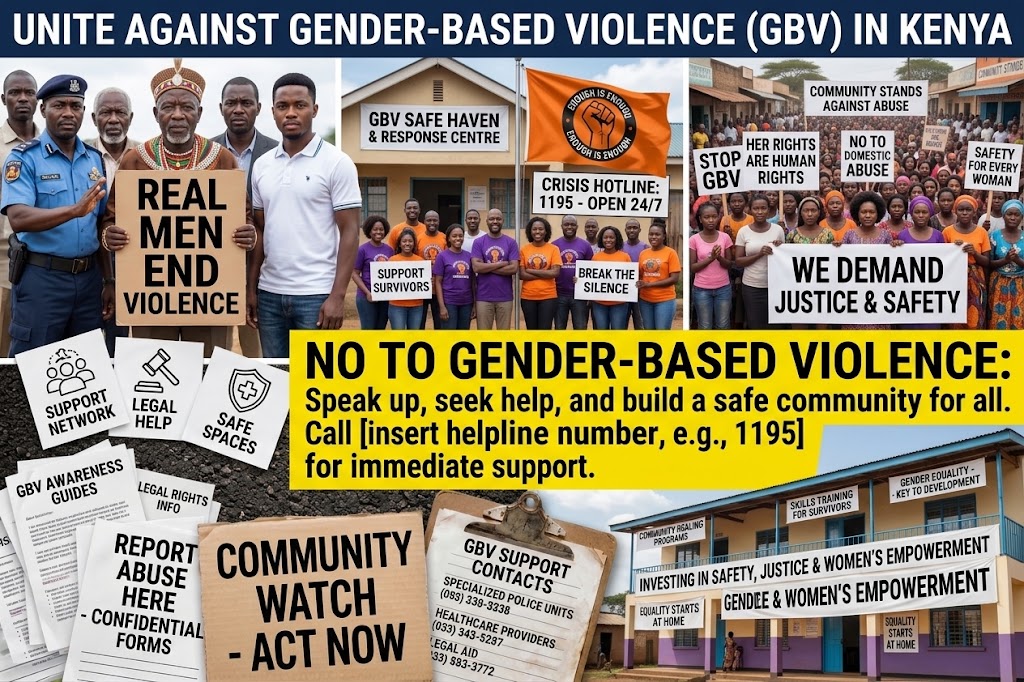
Kenya’s gender-based violence crisis is not a series of isolated incidents — it is the product of economic, legal and institutional structures built to fail women.
By Wanjohi P. Mugambi
For years, Kenya has counted gender-based violence after the blow has landed. We count the bruise, the defilement, the murder that makes the evening news. We treat it as a private tragedy between two individuals, a cultural problem in a distant village. But feminist movements across the country have long argued that this framing is itself part of the problem — because it hides the architecture that makes the blow possible in the first place.
What if we started counting before the blow? What if we examined the laws, the labour arrangements, the institutions and the policies that determine who is exposed to violence and who is denied justice? When we look closely, we find that gender-based violence in Kenya is sustained by invisible structures embedded in our economy, in state control over women’s bodies, and in the very institutions designed to protect them.
The first layer is economic. When governments adopt austerity policies, cut public health funding or remove subsidies on fuel and flour, the cost does not simply disappear. It is transferred — almost always to women — as unpaid care work. In Nyeri, Turkana and Nairobi’s Mukuru Kwa Njenga, women become the clinic, the school and the water supply. In Turkana, women walk up to 15 kilometres for water because rivers have dried. In Othaya, when tea bonuses fail, it is mothers who skip meals so their children can eat. In Mukuru Kwa Njenga, young mothers queue from 4am to buy water at KSh20 a jerrican, then carry it home through alleys where harassment is routine.
That unpaid labour creates deep economic dependency — and dependency traps women in violent situations. A woman in Baricho who has farmed her husband’s land for 20 years but holds no title deed cannot leave a violent marriage because she has nowhere to go and nothing to her name. Under customary law in many Nyeri communities, she cannot inherit land equally. The 2010 Constitution guarantees equal rights, but in Othaya and Tetu, elders still say land belongs to sons. When a widow in Karima is expelled from her farm by in-laws after her husband dies, that is not culture. That is economic violence, enforced by a system that refuses to implement its own laws. Her inability to leave is not a personal failure. It is a policy outcome.
In Nairobi, the same architecture wears a different face. A domestic worker in Mukuru Kwa Njenga, working 16-hour days, sleeping on a kitchen floor and earning KSh5,000 a month, cannot walk away from an abusive employer because her family depends on that wage. A girl working as a house help in Pipeline is told she must be available around the clock — no day off, no contract, no health insurance. Her labour is invisible. Her protection is zero. The economic system that permits unregulated domestic work in Nairobi’s residential estates is itself an architecture of violence.
Beyond the economy, the state sustains violence through its control of women’s bodies. Kenya’s Penal Code effectively criminalises abortion except where a health professional deems it necessary — yet post-abortion care is routinely denied in public hospitals across Nyeri and Nairobi. Girls who have been sexually assaulted fear reporting because they know they will be questioned about their prior sexual history or subjected to humiliating medical examinations. In schools across the country, we still measure the length of a girl’s skirt and expel her for falling pregnant, while the boy responsible remains in class. That is not discipline. That is state control over reproduction.
In spaces of displacement, this control intensifies. In Dadaab and Kakuma refugee camps, women report strip searches, denial of sanitary pads and sexual exploitation by those who control food distribution. In Eastleigh and Mukuru Kwa Njenga, Somali-Kenyan and Ethiopian migrant workers without documentation cannot report assault because they fear being arrested for being undocumented. In Mukuru, a survivor will not walk to the nearest police post at night because the path is unlit, there are no public toilets, and she needs boda boda fare she does not have. The slum’s physical design is itself a risk factor.
The third layer — and perhaps the most demoralising — is institutional. This is where many survivors are beaten twice. A girl in Karima is defiled on her way to school. She goes to Othaya Police Station and is told to bring KSh1,000 for fuel to arrest the suspect and KSh500 for a P3 form photocopy. A girl in Mukuru faces the same wall: sent from the police post to a distant station, told to buy her own gloves before a medical examination, assigned a court date at Makadara that is three years away. During that time, village elders convene an informal sitting and ask the family to forgive. Each institutional step is a second assault.
In schools, the violence is daily and structural. Girls in Nyeri and around Mukuru Kwa Njenga miss an average of four school days per month because of inadequate sanitary pads, no running water and toilets without lockable doors. That is 48 days a year — not because girls are weak, but because the school was designed without their bodies in mind. When those girls fail their exams, we say they lack ability. The system failed them.
Understanding this fully requires what scholars call an intersectional and decolonial lens. A woman is never only a woman. A disabled girl in Nyeri cannot reach the toilet without help, and that dependency becomes a site of abuse. A queer woman in Nairobi does not fit the recognised definition of a victim, and when she reports in Mukuru, officers laugh. A pastoralist woman in Garissa cannot report because the nearest police station is 30 kilometres away and she has no transport. Each additional layer — disability, sexuality, ethnicity, class, location — multiplies exposure to violence and shrinks access to justice.
The decolonial perspective asks a harder question: who defines violence? For decades, definitions have focused on individual acts and offered workshops in response. But Kenyan feminist organisations — the Centre for Rights Education and Awareness, the Federation of Women Lawyers — have consistently argued that you cannot end violence against women while ignoring the violence of economic adjustment, land dispossession and slum demolitions.
Treating gender-based violence as a political question in Kenya therefore means shifting what we demand. It means demanding economic justice alongside rescue centres. Land titles for women in Othaya and Garissa — implemented, not merely legislated. Secure tenure and housing for women in Mukuru Kwa Njenga instead of demolitions. Sanitary pads, clean water and lockable toilets in every school as rights, not charity. A re-entry policy for pregnant girls backed by real funding, not a memo. Institutions that protect every person regardless of disability, ethnicity or whom they love.
The violence that never appears in a police OB report is the violence that makes the OB report necessary. It is the inheritance law in Nyeri. The clinic closure in Mukuru. The school rule that expelled a girl in Nairobi. If we insist on treating gender-based violence as a private matter, we will keep offering private solutions to political problems. If we treat it as the political question it is, we can begin to dismantle the invisible architecture holding it up.
Wanjohi P. Mugambi is a researcher, writer and gender justice advocate.
Similar Posts by The Mt Kenya Times:
- Mt Kenya Times ePAPER November 4, 2026
- Kenya discharges first five Ebola patients as outbreak response gains ground
- Mt Kenya’s UDA exodus: How Ruto lost the region that made him president
- Autopsy finds stab wounds killed Regina Re’s 86-year-old mother
- Kenya’s Okowa wins full ICJ term in historic diplomatic victory
About the Author