
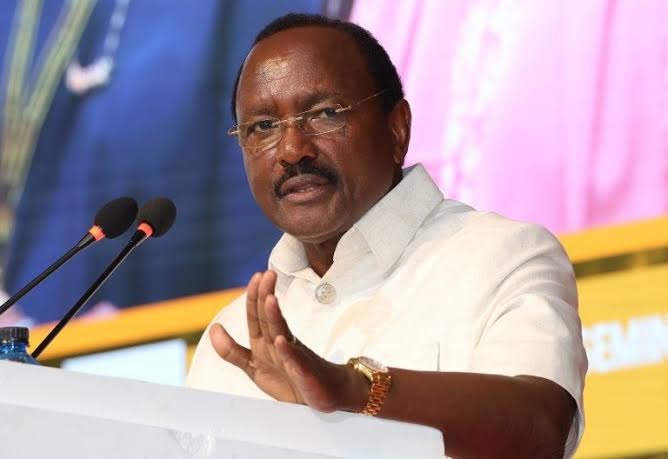

The Wiper leader used a church pulpit in Mwingi to launch his sharpest attack yet on the Ruto administration, connecting political corruption to deadly construction failures and an unconstitutional share sale.
By Daniel Karanja
Wiper Patriotic Front Party leader Kalonzo Musyoka yesterday accused President William Ruto’s administration of allowing politically connected individuals to profit from Kenya’s cement industry, linking what he described as systemic corruption to a string of deadly building collapses that have claimed lives across the country in recent weeks.
Kalonzo made the allegations during a worship service at Word of Faith Church in Mwingi Central on Sunday, delivering remarks that combined religious conviction with some of the most direct political accusations he has levelled against Ruto since the two emerged as adversaries ahead of the 2027 General Election. The choice of a church setting — before a congregation he described as “the salt of the earth” — was deliberate, casting his political challenge in moral as well as institutional terms.
“For every single bag of cement, there is a percentage going to Mr Ruto,” Kalonzo alleged, making a claim he did not substantiate with documentary evidence but that he framed as the logical explanation for the proliferation of substandard construction materials in the market. He argued that politically connected interests had penetrated the supply chains for essential building materials, compromising quality standards and leaving ordinary Kenyans to bear the lethal consequences.
His remarks came against the backdrop of renewed and urgent public concern about building safety in Nairobi and its surrounding areas, following multiple structural collapses that have drawn attention to the quality of construction materials, the enforcement of building codes and the capacity of regulatory authorities to hold contractors and developers to account. “Imagine how many people have died this month because one building collapses, then another collapses. Syokimau,” Kalonzo said, invoking a specific location as shorthand for a pattern of disaster that he argued was neither accidental nor inevitable.
“It is impunity and the presence of cement companies producing poor quality. When a building is constructed with this, it collapses,” he added, calling for the government to act decisively against manufacturers whose products he claimed were failing to meet basic safety standards. The government has not publicly responded to Kalonzo’s specific allegations about cement industry interests.
The building safety crisis, if it can be called that, is real regardless of its political framing. Construction-related fatalities in Kenya have been a recurring and tragic feature of urban growth, driven by a combination of rapidly expanding demand for affordable housing, inconsistent enforcement of building regulations, the widespread use of unverified construction materials and a culture of impunity among developers who cut corners on specifications. When a prominent political leader stands before a congregation and connects those deaths to corruption at the highest level of government, the accusation lands with emotional force that official denials struggle to match.
Kalonzo used the same platform to describe the Ruto administration as a “predator regime” — language that marked a significant escalation in his public characterisation of the government and signalled his intent to run a campaign built as much on moral condemnation as on policy contrast. “This is why I’m saying heavy lifting. Heavy lifting to get rid of this predator regime,” he declared, casting the 2027 election not as a routine democratic contest but as a civic emergency requiring extraordinary collective effort.
He positioned himself explicitly as a constitutional lawyer committed to the rule of law, pointing to his personal participation in court proceedings as evidence of that commitment. “I am a constitutional lawyer. And that is who I am. You can even see that I go to court myself to defend it,” he said, drawing a contrast with what he portrayed as an administration willing to override legal and institutional constraints for political and financial advantage.
That contrast found its sharpest expression in Kalonzo’s remarks about the KSh 204B Safaricom transaction, which he raised directly with the congregation. He was referring to the government’s sale of a 15 per cent stake in Safaricom to Vodacom, a transaction that generated approximately KSh 204.3B in proceeds, with a further KSh 40.2B paid upfront in exchange for future dividends on the government’s remaining stake — combined proceeds of KSh 244.5B that were channelled into the National Infrastructure Fund.
The High Court has since declared the divestiture unconstitutional, null and void, ruling that it was undertaken without adequate public participation and ordering the shares transferred to Vodacom to be restored to the government on behalf of Kenyans. The ruling has raised complex and unresolved questions about the fate of money already received, the mechanics of share restoration and the accountability of those who authorised the transaction. “He is supposed to have returned 204 billion shillings. That is a lot of money,” Kalonzo told the congregation, framing the sum not as an abstract financial figure but as a measure of what ordinary Kenyans had been denied.
The cumulative effect of Kalonzo’s Mwingi address was a portrait of an administration he characterises as predatory, corrupt and constitutionally reckless — one that profits from cement bags, presides over collapsing buildings and sells national assets without public consent. Whether those characterisations are legally sustainable or politically persuasive to a broad electorate is a question the coming months will test. What is beyond doubt is that Kalonzo is running, that he is running hard and that he has chosen to frame his campaign around accountability, constitutionalism and the daily economic suffering of ordinary Kenyans.
With August 2027 less than a year away, the congregation in Mwingi was not merely a church service. It was a campaign opening, delivered from a pulpit, aimed at a nation the Wiper leader believes is ready for what he called the heavy lifting of change.