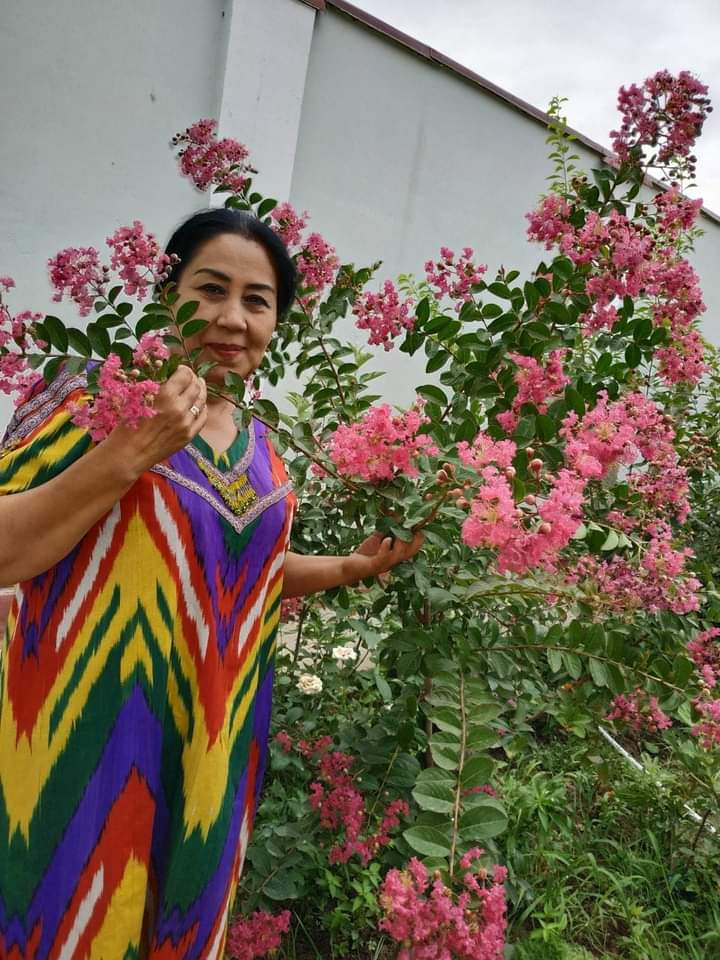
Munavvara USMONOVA

By: Munavvara USMONOVA
Worth Noting:
- My teenage brother would deliver food in a special container to a remote field shed. My brother couldn’t control the bike and would walk along the path of a snake if it was too heavy. Every day, I would look after my brother Nadir, and my heart was pounding, hoping that my brother would not fall down and his food would spill and hurt him.
- There were many holidays. We were especially looking forward to the holiday, where we would wear fancy clothes and receive Eid gifts from adults. At the beginning of the month of fasting, I asked my mother: “Mom, how many days are left until Eid?” I made her tired by counting with my fingers.
I will never forget those years. My father’s condition did not improve as he lay sick. He was bedridden. There was no door, no healer, no doctor that we went to find a cure. Every morning we tiptoed into the house where my father was sleeping and asked him how he was. My mother sat above his head day and night looking after him, who could not even greet with us or look at us. The condition of my sick father did not improve even in four or five years. The situation of the family was obvious to everyone after the breadwinner had gone to bed. As my mother said, it was impossible to fill the shortages of the housekeeping. My eldest brother was a student at the medical institute, and the next one was studying in Tashkent. The soul of my simple mother, who graduated from high school and got married, never walked a step away from my father, was divided into thousands. In early spring, my mother, who fed silkworms and then went to the field to hoe, had also time to take care of my sick father. Days passed like this.
At first, cows and calves were sold. Then, then… One of my brothers became an apprentice to a baker, and another to a carpenter. In one house in our neighborhood, food was used to be cooked for the children of the mothers who were working in the fields in a small pot.
My teenage brother would deliver food in a special container to a remote field shed. My brother couldn’t control the bike and would walk along the path of a snake if it was too heavy. Every day, I would look after my brother Nadir, and my heart was pounding, hoping that my brother would not fall down and his food would spill and hurt him.
One day my grandfather Abdujalil (my mother’s father) came with a cow. He said to my mother, “It’s going to give a birth today or tomorrow. Your children will have dairy then, and you won’t beg to anyone. Your patient also needs milk and yogurt, my daughter,” he said gently, wiping the skin on his forehead. After talking for a while, my grandfather returned home. We were all happy and shouted around the cow. But I saw worry on my mother’s face and tears in her eyes. Even though I did not dare to ask the reason, my mother, seeing that I did not go far, patted my head and said: “I have hope in God, my child. Dad will definitely stand up. The Lord who gave so many children will also provide for them. I was happy that my poor father came with a cow to help me live, thank you. But sooner or later, if your father gets back on his feet, if he finds out that we are dependent on the benevolence of old people, will he add pain to his pain…” she said.
THE RIGHT OF THE CHILD
We studied in the first grade. In those days, elementary school students were given a loaf of buttered bread and sweet tea. When we saw the cook aunt who came in with a plate, we all crowded around the teacher. One day, one of our classmates held his bread to the teacher and said: “Teacher, give me a bite of my bread.” When we saw him, we went to 3-4 children and said, “Eat my bread too.” Our desperate teacher seemed to bite the bread in our hands. Then he stroked our heads and said: “My children, even if you have a piece of bread, you are giving it to me. I have bit it for your heart, I committed a big sin! The child’s right is inviolable. I wish I could die without sharing a bite of your bread…” Seeing the tears in the teacher’s eyes, we all fell silent. My teacher, who was chewing the bite in his mouth with tears in his mouth, still does not leave my eyes. What teacher he was… Thank you, he is still there. There are many teachers who sacrifice their lives to teach, love their students like their own children, and plant seeds of goodness in their hearts.
But… but when my student gave flowers on the eve of the holiday, it didn’t make me tremble… It didn’t bother me as he could buy bread instead of those flowers with that money… SORRY… A THOUSAND SORRY…
THE GIFT FOR EID
There were many holidays. We were especially looking forward to the holiday, where we would wear fancy clothes and receive Eid gifts from adults. At the beginning of the month of fasting, I asked my mother: “Mom, how many days are left until Eid?” I made her tired by counting with my fingers. The most interesting thing was that on that auspicious day, we put on a new dress, an embroidered skullcap, “showed off” our braided hair to each other, and went out to play in the street early in the morning. Rejoicing that the long-awaited day has come, I put on the dress that my mother had made in the morning and went out. Before dawn, the streets and yards were swept and water was sprinkled, and a pleasant smell of earth came.
I joined the ranks of children who were running and playing with joy. My peer Komila, who lived five or six yards away from us, tied a red thread on her little finger. When I asked why she tied a thread on her finger: “My mother said that she couldn’t buy a new dress for me, at least she should tie a new thread on my finger,” she said sadly, picking at her fingers that were tied with a thread. I felt sorry for my friend, who was looking with envy at my shirt made of thread fabric with pictures of birds and fishes. I was embarrassed that I wore a beautiful dress that night.
Komila’s father was a teacher in our school.
When he was returning from work, he would hang something from the glue bag in his hand to the children playing on the street, and at least give them gum or worms from his pocket and stroke their heads. Komila’s father died prematurely due to illness. One day, my mother said, “It was difficult for a man who lost his life when he was young, and for a widow with one child. Satisfied with what her husband has earned, the young woman who did not go out into the field and did not plow the ground, now has to work even if she stumbles over a lump and sweeps the soil with her long hair. The people of the neighborhood should help them as much as they can and wait until their children join the people,” she said. I held the hand of Komila, who was looking sullenly at the footsteps of children rushing to the arms of their grandfather or father, who were returning from the Eid prayer. “Dad will be back now. They will give us both sweets and Eid gift,” I said with confidence. But my father was nowhere to be seen among the people who were leading home by the hand of their child. Everyone dispersed. Komila and I were sitting on the road. At that moment, my father’s body was seen from the beginning of the street. We both ran evenly. Dad patted our heads and held one of the bags in his arms to Komila. Then looked at it:
– My daughter, take these sweets into the house, open them and look, I bought you a dress. If it is not suitable, I will exchange it from the store, he said. Then he looked at me and said: “Darling, your mother made you a dress, I will bring you the same one on the next holiday.” “Thank you, Dad,” I whispered softly in Dad’s ear.
Munavvara
Translated by Maftuna DUNYO
Similar Posts by The Mt Kenya Times:
- Kalonzo becoming a movement: The quiet storm that is scaring Ruto
- Sifuna climbing the mountain: Kenya’s political map is being redrawn
- Counting regions, chasing power: Kenya’s road to 2027
- When the tax math changed, Kenyans found their voice
- Kipchoge completes the circle
About the Author