The Mt Kenya Times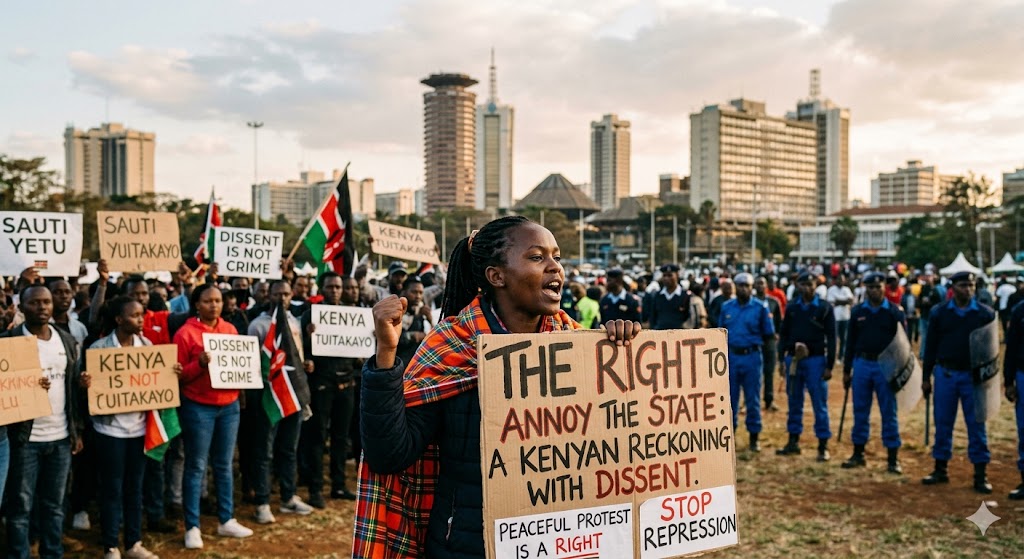
By Jerameel Kevins Owuor Odhiambo
In April 2017, Justice Mwita of the High Court did something quietly radical: he ruled that it is not a crime to annoy a Kenyan public officer. Section 132 of the Penal Code, which had criminalized “undermining the authority of a public officer,” was struck down as unconstitutional in the case brought by blogger Robert Alai, who had mocked President Uhuru Kenyatta’s remarks about Raila Odinga on Facebook. A year earlier, the same court had killed Section 29 of the Kenya Information and Communications Act, the notorious provision that punished anyone who used a “licensed communication system” to send a message that was merely “annoying” or “inconvenient” to another person. That case, brought by Geoffrey Andare, is the spine of this piece, because Andare’s lawyers won on a deceptively simple theory: annoyance is not a constitutional injury. A government that treats irritation as a prosecutable offence is not protecting public order; it is protecting its own comfort. These two judgments are the closest thing Kenya has to a founding myth for the modern free-speech jurisprudence, and they deserve to be read not as legal trivia but as a thesis statement.
The thesis is this: freedom of expression, properly understood, is substantially the freedom to be irritating. Not gratuitously, not maliciously, but structurally because the entire point of the right is to protect speech that someone in power would rather not hear. Nobody needs a constitutional shield to compliment the President’s road-building record or to praise a Cabinet Secretary’s spreadsheet discipline. That speech was never in danger. Article 33 of the Constitution of Kenya, 2010, exists for the inconvenient sentence, the inconvenient cartoon, the inconvenient hashtag. A right that only protects agreeable speech is not a right at all; it is a courtesy; revocable the moment courtesy becomes inconvenient to the one extending it. Kenya’s courts, to their credit, have understood this at the doctrinal level even as the executive has resisted it at the practical level and that gap, between what the judiciary has declared and what the security apparatus has done, is where this argument lives.
Consider the counter-argument, because it deserves a fair hearing before it is dismantled. Defenders of restriction and Kenya has had no shortage of them, from colonial administrators to the architects of the 2010s-era “hate speech” prosecutions argue that unrestrained expression is a luxury good, affordable only to societies with thick institutional buffers against incitement, ethnic mobilisation, and panic. Kenya, the argument goes, is not that society; it is a country whose post-election violence in 2007–2008 left over 1,100 people dead, substantially fuelled by inflammatory vernacular radio broadcasts and SMS chains. On this view, Section 132 and its cousins were not authoritarian overreach but social insurance. This is not a frivolous position. Article 33(2) of the Constitution itself carves out exceptions for propaganda for war, incitement to violence, hate speech, and advocacy of hatred constituting ethnic incitement; Kenya’s drafters were not absolutists either. The honest rebuttal is not that limits are illegitimate. It is that “undermining the authority of a public officer” and “annoying a person” are not limits at all; they are blank cheques, vague enough to swallow the exception and devour the rule. The Andare court grasped this precisely: a law that cannot tell a citizen, in advance, what speech is forbidden is not a limitation on rights it is the abolition of rights by administrative discretion.
Here the idiom earns its keep: in Kenya, the chicken that escapes the cooking pot is not free, merely temporarily uncaught. Section 132 is dead in the law reports, but its spirit migrated. What the statute book lost, the unmarked Land Cruiser gained. Between June and December 2024 alone, the Kenya National Commission on Human Rights documented 82 cases of abduction or enforced disappearance, the overwhelming majority of them young people connected to the Gen-Z-led protests against the 2024 Finance Bill. The Law Society of Kenya separately tracked 72 such cases by the end of August that year. Twenty-six people remained missing as of November 2024, according to the KNCHR’s own vice-chairperson, who noted with a bureaucrat’s understatement that the pattern was “taking the country back to its dark days.” When President Ruto was finally pressed on the matter at a joint press conference with Finland’s President in May 2025, he claimed all the missing had been “reunited with their families” an assertion offered without naming a single perpetrator, without a single prosecution, and without explaining who exactly had been doing the abducting if, as his own government had insisted for months, no abductions were occurring at all. This is not governance; it is gas lighting with a press pool.
It would be analytically lazy to treat 2024 as an aberration rather than a continuation. The legal architecture of suppression simply changed its instrument. Where Section 132 once supplied the charge sheet, today’s apparatus supplies the disappearance as a method that requires no charge sheet, no magistrate, no paper trail, and therefore, perversely, no court before which Andare-style reasoning can even be deployed. You cannot file a constitutional petition against a kidnapping that the state denies committing. This is the dissident’s bind, restated for the algorithmic age: the courts dismantled the law that criminalized your tweet, but they cannot dismantle a balaclava. Blogger and TikToker Albert Ojwang’s death in police custody in June 2025, after his arrest reportedly connected to his online commentary, is the grim coda to this argument proof that the state’s appetite for silencing critics did not shrink when its statutory tools did; it simply went informal, and informality is much harder to litigate.
There is a temptation, understandable but mistaken, to read this as uniquely Kenyan pathology. It is not. It is the oldest trick in the authoritarian playbook, merely localized: when the front door of legal suppression is welded shut by a vigilant judiciary, the back door of extralegal suppression swings opens, because the goal was never legal coherence — it was control. Achebe understood this instinct decades before Kenya’s courts caught up to it in doctrine. In “A Man of the People,” he sketched the post-independence African strongman not as an ideologue but as a manager of appearances, a figure who learns quickly that the optics of constitutionalism can coexist comfortably with the substance of repression, provided the repression is deniable. Achebe’s satire was never really about Nigeria alone; it was a diagnosis of a structural temptation available to any post-colonial elite that inherits both the rhetoric of liberation and the instruments of the colonial state it replaced the Special Branch files, the riot batons, the habit of treating the citizen as a subject on probation.
Synthesise the doctrine and the disappearance and a sharper proposition emerges: Kenya does not currently have a free-speech law problem so much as a free-speech enforcement problem, and the two are not interchangeable failures. A law problem is fixed by litigation, and Kenya’s public interest litigators Katiba Institute, the Law Society of Kenya, ARTICLE 19 Eastern Africa have been remarkably effective at it, racking up a string of victories from Andare through Alai to the more recent Katiba Institute petition that struck down further vague Penal Code provisions in 2023. An enforcement problem, by contrast, is fixed only by accountability investigations that actually conclude, prosecutions that actually proceed, an Independent Policing Oversight Authority that actually oversees. On this score the record is closer to barren than bare. The Human Rights Watch World Report covering 2025 noted that despite KNCHR’s own confirmation that police had abducted people still missing from the 2024 protests, IPOA’s reporting made no mention of investigating the disappearances at all. A right vindicated in the law reports and violated in the streets is not a right that has been secured; it is a right that has been relocated to a forum the state has learned to ignore.
It is worth being precise about what “annoying the state” actually buys a republic, because the framing in the title is not merely provocative it is functionally accurate, and Kenyan constitutional history supplies the proof. The 2010 Constitution itself exists because earlier generations of “annoying” Kenyans the Saba Saba agitators of 1990, the underground publishers of the Moi years’ samizdat pamphlets, the lawyers who kept filing hopeless-looking petitions against a one-party state that controlled every formal lever refused to let irritation be criminalized into silence. Mwai Kibaki’s government did not hand Kenyans Article 33; it was extracted, over decades, by people whose entire civic contribution was refusing to shut up. Annoyance, in this light, is not speech’s unfortunate side effect. It is frequently speech’s entire civic function the irritant that forces a complacent system to respond, to justify itself, to explain on the record why a particular silence is being demanded. A government immunized against annoyance is a government immunized against correction.
None of this licenses an unqualified celebration of unlimited expression, and intellectual honesty requires saying so plainly. The same digital openness that lets a blogger expose a procurement scandal also lets a propagandist organise an ethnic mobilisation campaign with the production values of a Nairobi ad agency. Kenya’s 2007 trauma is not a relic; its underlying conditions ethnically inflected political competition, a media landscape capable of both extraordinary courage and extraordinary recklessness remain live. The answer to this tension is not to romanticize speech as costless, but to insist that the line be drawn by courts applying Article 24’s proportionality test, in public, with reasons, rather than by an officer in plain clothes deciding at 2 a.m. that a particular X account has crossed an unwritten line only he can see. Predictability is the actual constitutional value at stake, not permissiveness. Andare’s lawyers did not argue that annoying speech should never have consequences; they argued that citizens are entitled to know, in advance, what those consequences are and on what authority they are imposed. That is a conservative, almost technocratic demand. It has simply proven radical in application, because the alternative discretion without disclosure is so much more convenient for everyone holding power.
 There is a second counter-argument that deserves engagement rather than dismissal: that focusing on abductions and statutory repeal obscures a subtler, more pervasive form of chilling effect self-censorship induced not by any single dramatic event but by the cumulative, ambient knowledge that visibility carries risk. Survey after survey of Kenyan civil society actors in 2024 and 2025 describes something closer to a low hum of anxiety than a series of discrete incidents Amnesty International’s own assessment, drawn from interviews with affected activists, journalists, and lawyers, captured this as a pervasive fear that does not require an actual knock on the door to function, only the credible possibility of one. This matters because it reframes the stakes beyond the dramatic register of kidnapping and toward something more insidious: a citizenry that polices its own speech not because the law demands it the law, post-Andare, largely does not but because the state has demonstrated, through pattern rather than statute, that it retains the capacity and the willingness to make examples of those who annoy it loudly enough.
So, if the government starts targeting dissidents it leads, historically and predictably, to one of two places, and Kenya is currently positioned at the fork. The first path is the one most authoritarian-adjacent states eventually walk: the chilling effect compounds, civic space contracts, the abductions normalize into background noise the way extrajudicial killings in Mathare and Kayole once did, and “annoying the state” becomes a young person’s idea of recklessness rather than a citizen’s idea of duty. The second path is the one Kenya’s own history Saba Saba, the 2010 Constitution, Andare, Alai, and a Gen-Z generation that returned to the streets in June 2025 exactly one year after the first wave of disappearances rather than being deterred by them suggests is equally plausible. Repression that operates by disappearing people rather than by passing laws is, paradoxically, a confession of institutional weakness: it is what a state resorts to once it has lost the argument in court and can no longer win it on the merits. Kenya’s courts have already delivered the verdict on whether annoyance is a crime. The remaining question, unresolved and genuinely open, is whether the rest of the state, the police, the DCI, the National Intelligence Service can be made to read the judgment, or whether it will take another generation of annoying, ungovernable, constitutionally literate citizens to make them.
The writer is a social commentator.
Similar Posts by The Mt Kenya Times:
- Ruto calls Kenyatta a conman as Kenya’s 2027 battle begins in earnest
- Electricity access must lead to local opportunity
- God had to break your marriage to save your mother’s house
- Meru commissioner urges residents to act before the rains claim more lives
- The hidden pressure of being a university student
About the Author