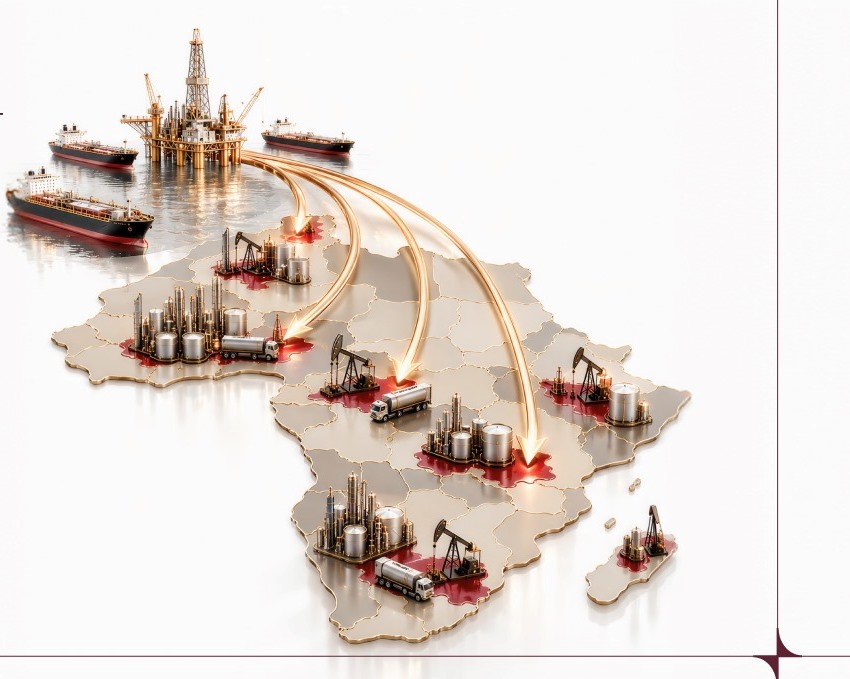
As Gulf crude recovers, refined fuel is leaking across African frontiers — and the continent’s best-supplied markets may be the most exposed
By Jacob Kimemia
Africa’s oil crisis has quietly changed character. What began as a shortage of Gulf crude following the closure of the Strait of Hormuz in late February has evolved into something more complex and, in many ways, more difficult to contain: a continent-wide competition for refined fuel that is pulling supply across borders, draining markets that appeared well-protected, and exposing the structural fragility at the heart of African energy security.
Middle East crude exports, excluding Iran, returned to pre-war levels in September, offering a degree of relief to global markets rattled by what the International Energy Agency described as “the largest disruption in history.” Yet the recovery in refined-product exports tells a different story. Those exports remain at roughly 58 per cent of their pre-war volumes, and Brent crude continues to trade near US$100 a barrel. The crude may be moving again, but the finished fuel — the petrol and diesel that powers African economies — remains stubbornly scarce.
Where scarcity exists, price differentials follow. And where price differentials exist across poorly regulated or porous borders, fuel moves. Not always through formal channels.
That dynamic is now reshaping supply across sub-Saharan Africa, most visibly in Nigeria, home to the Dangote refinery, the continent’s largest and most strategically significant refining asset. The refinery ran at 105.21 per cent of capacity in August, a figure that ought to signal strength. Crude deliveries to Nigerian refineries rose 16.75 per cent to 683,000 barrels a day, according to data from the Nigerian Midstream and Downstream Petroleum Regulatory Authority. On paper, Nigeria looks like the region’s most secure fuel market. In practice, that security is being tested from the outside.
Aliko Dangote, president of the Dangote Group, said on 15 September that petrol sells for between 30 and 50 per cent more in some neighbouring countries than it does in Nigeria. The price gap, he argued, is not merely an economic inconvenience — it is a standing incentive for diversion. Fuel intended for Nigerian consumers is crossing borders into Côte d’Ivoire, Cameroon, Ghana, Togo, and beyond, either through formal export arrangements or, as Dangote acknowledged directly, through smuggling. His assessment of the crisis was stark: it is “not even about price; it’s about availability.”
The warning carries weight. If refined fuel continues to leave Nigeria faster than the country’s refineries and import terminals can replace it, domestic buyers face the prospect of shortages or sharply higher pump prices — even with refinery utilisation running above full capacity. The Nigerian National Petroleum Company raised the Dangote refinery’s crude allocation to seven cargoes a month in May, up from approximately five. The refinery itself says it needs between 13 and 15 cargoes a month to operate optimally. The shortfall is filled by purchasing crude at international market prices, a cost that ultimately feeds back into the price of fuel at the pump.
Nigeria’s fuel security, in other words, depends on far more than the existence of a large refinery. It rests on the delicate interplay of crude allocation decisions, export volumes, and the price differentials between Nigerian pump prices and those of its neighbours. When those differentials widen during a regional supply crunch, the refinery’s output becomes, paradoxically, an asset for the entire neighbourhood — at the expense of the home market.
David Precious, Senior Market Analyst at EBC Financial Group, which has been tracking the regional dynamics closely, put the paradox plainly. “The common view is that more refining capacity in Africa means more protection from shocks such as Hormuz,” he said. “However, when fuel, the raw material itself, is scarce, a market that sells below its neighbours’ prices becomes their supplier too, as supply suddenly crosses boundaries. This is when shortages can appear at home.”
The reach of Nigeria’s refinery output illustrates precisely how far that pull now extends. Dangote fuel has reached buyers in Tanzania — a logistical and geographic stretch that would have seemed improbable just a few years ago. But Tanzania is not the only market feeling the strain at a distance. Africa’s landlocked economies, which sit at the end of long and vulnerable supply corridors, have been among the hardest hit.
Ethiopia, which depends heavily on the Djibouti corridor for its fuel imports, ordered conservation measures in March as supplies tightened. Zambia declared a fuel supply emergency in April after diesel scarcity began disrupting markets and transport networks. Both countries have since seen conditions ease, but the episodes serve as a reminder of how quickly an inland market can tip from adequacy to crisis when a shock hits the coast.
Currency movements, which are often blamed for fuel price pressures across Africa, appear to be a secondary factor this time. South Africa’s October fuel price breakdown, released by the Department of Mineral and Petroleum Resources, showed the rand contributing less than one cent per litre to the increase in pump prices. The dominant driver was international product prices, which the department attributed to “supply shortages caused by lower global inventories of products” — adding R3.29 a litre to petrol costs. The message is clear: this is a supply problem, not a currency problem.
Several markers in the coming days will indicate whether the pressure is easing. Kenya’s next pump-price review is scheduled for 14 October, the same day the reduced VAT rate on petrol and diesel is due to lapse — a double signal for East African consumers already absorbing higher costs. The IEA’s next Oil Market Report also falls on that date. Nigeria’s monthly NMDPRA supply figures, which track how much domestically refined fuel actually reaches the local market, will offer a further read on whether the border-leakage problem is worsening or stabilising.
Precious offered what amounts to the defining observation of the current crisis. “In a shortage, the cheapest fuel in a neighbourhood is the fuel most likely to leave it,” he said. “When a litre sells about 25 per cent more in Togo than in Nigeria and more than 50 per cent more in Ghana, that gap is a standing incentive to move fuel across the border, whatever a refinery produces. The pull may only ease when Gulf refined-product exports recover, the gaps between neighbouring pump prices narrow, or local refiners receive more of their own country’s crude — and until then, the markets that look best protected may be the ones most likely to run short.”
For a continent that spends an estimated US$30 billion a year importing refined fuel, according to the African Export-Import Bank, the lesson is a hard one. Refining capacity matters. But in a regional market where price signals travel faster than tankers, proximity to a refinery may offer less protection than it promises.
Similar Posts by The Mt Kenya Times:
- Six businesses campus students can start with almost no cash
- Bikeke school leads the way on competency-based learning
- Lucinda Hughes Afzal: Where compassion meets courage
- Uasin Gishu has the water: Why leaders must now turn the president’s irrigation call into food, wealth and opportunity
- From information to insight: Why AI in 2026 demands a rethink of education
About the Author