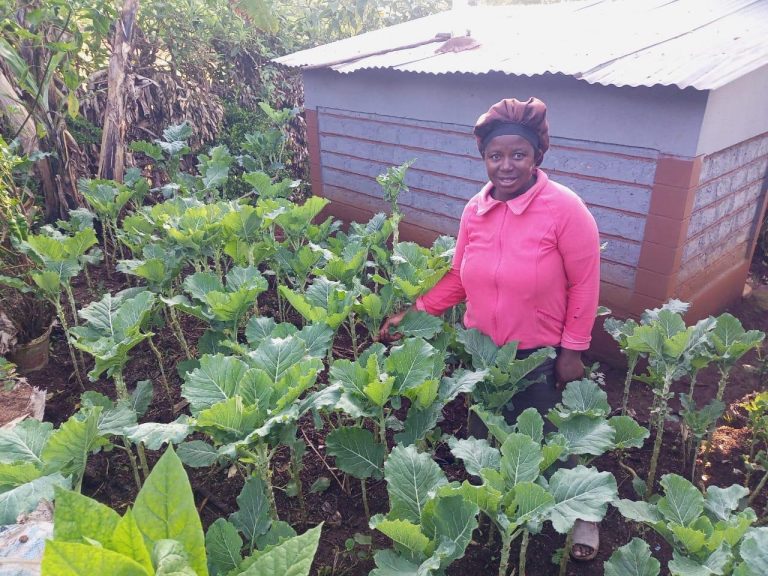
Agroecology Boom Lifts Coffee Yields In Nyeri As Farmers Reap Big Gains

By MKT Reporter
Coffee farmers in parts of Nyeri County are recording remarkable improvements in production after embracing agroecology practices championed by Resources Oriented Development Initiatives (RODI) Kenya.
What began as a gradual shift toward organic farming methods has, in just two years, transformed yields for hundreds of smallholder growers supplying the Kihuyo Coffee Cooperative Society in Nyeri Town constituency.
A recent survey shows that most farmers have more than tripled their production per tree; from an average of 1.5 kilograms of cherries to about 5 kilograms.
The surge, farmers say, is the direct result of intensive agroecology training offered by RODI experts. The programme equips growers with skills on soil fertility, organic pest and disease control, manure application, livestock integration and environmental conservation.
Agronomists regularly visit farmers’ groups in the villages of Nyarugumu, Kihuyo and Njeng’u, where significant improvements have been reported in both coffee and food crop production.
RODI Kenya Executive Director Esther Bett says uptake of the programme has been overwhelming across Nyeri, with measurable improvement in both yields and environmental restoration.
Through community-led conservation efforts, the organisation has also supported farmers with more than 78 biogas systems and encouraged the adoption of energy-saving cookstoves. Bett notes that these changes are helping protect local forests, including the once-degraded Nyeri Hill, which the community is now restoring.
RODI has also partnered with the Kenya Prisons Service to engage former inmates, who return to their communities to train farmers in organic practices.
“The inmates, upon completion of their jail term, continue to train communities on better farming practices,” Bett said.
One of the standout beneficiaries is Bernard Wambugu, a lead farmer from Kihuyo.
For years, he harvested no more than 320 kilograms annually from his 300 trees. But after adopting organic protocols, his output between October and November this year alone surged to 932.6 kilograms.
His per-tree yield has jumped from 1.2 kilograms to 3.5 kilograms, and he hopes to hit 5 kilograms within two years.
“My farming is on the right trajectory,” Wambugu says. “The changes in three years are tremendous, and I expect even better results ahead.”
Other farmers share similar success. Jane Mwaura says the guidance of agronomists has boosted not only coffee harvests but also household food production. “Residents are taken through environmental programmes that have protected both commercial and natural forests,” she says.
At the cooperative level, the transformation is equally visible.

Joseph Ndung’u, manager of Kihuyo Coffee Society, says average production per tree among their farmers has increased from 1.5 to 3.5 kilograms. Factory records show production rose from 120,000 kilograms in the 2023/24 season to 412,000 kilograms in 2024/25. Since October this year, the factory has already processed 105,000 kilograms and is projecting more than 600,000 kilograms in the 2025/26 season.
Coffee value-chain specialist Peter Chege, who trains farmers across six villages, says more than 300 growers have already completed the programme. Volunteer farmers now help train neighbours when experts are unavailable.
The benefits are spreading beyond Nyeri. During a visit, Mwea farmer Jeniffer Wambui said she became inspired to venture into beekeeping after interacting with agroecology farmers.
“I want to sell quality honey to my neighbours,” she said.
As more growers embrace organic, sustainable methods, Nyeri’s coffee belt is steadily reinventing itself; one tree, one household, and one village at a time.
Similar Posts by The Mt Kenya Times:
- Poisoned bottle: Are we drinking ourselves into early graves?
- How Kenya and South Africa constitutionalized concentration while preaching the gospel of the disadvantaged
- Discipline begins at home
- Onana escapes serious injury in three-car crash
- Kompany rushed to hospital after training collapse
About the Author