Anxiety, loneliness and Fear of Missing Out: The impact of social media on young people’s mental health
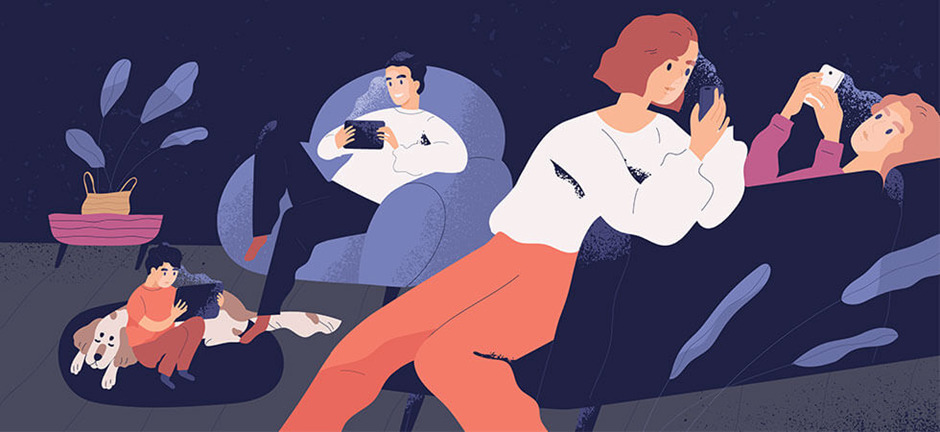
Anxiety, loneliness and Fear


By: Shivani Bhardwaj
Worth Noting:
- Sleeping patterns and sleep quality are negatively affected when using these platforms. Schools have noted that students who compulsively use social media may experience sleep issues, which in turn negatively impacts their performance. Young people who compulsively use social media at night struggle to unwind, which reduces their brain’s ability to prepare for sleep, according to the University of Glasgow. Sleep loss may lead to poor mental health, which consequently may lead to more intensive social media use at night and subsequent sleep deprivation.
- Keeping up with the happenings of your social circle on social media can increase users’ anxiety. The concept of Fear of Missing Out (FOMO) is defined as ‘the fear that others are having rewarding experiences from which one is excluded’ and ‘a desire to remain constantly connected with what others are doing.’
Human interaction has been revolutionized by the rapid development of social media over the last decade. These online platforms such as Facebook, Twitter, and Instagram have provided people around the world with 24/7 connection. By 2021, it is estimated that there will be 3 billion social media users. From the numbers alone, it is obvious that social media has become an inescapable (and in many cases an essential) aspect of our lives.
The rapid rise of social media has attracted a lot of attention in relation to young people’s mental health in recent years. In spite of its relative infancy, new research has revealed a comprehensive picture of the impacts of social media on mental health. Social media’s association with mental health has been established through substantial amounts of research, although still emerging. The popularity of social media as a method of communication with young people must be carefully evaluated, as it may have a much more detrimental effect than we previously thought.
From the statistics alone, it’s clear that social media has become an integral part of our lives
A wide range of studies and experiments have referred to ‘social media addiction.’ It is estimated that around 5% of young people are addicted to social media, and that it may be more addictive than alcohol and cigarettes. Its addictive nature is due to the level of compulsion with which it is used. When used compulsively, social media leads to both instant gratification (the desire for quick, immediate pleasure) and dopamine release (the chemical in the brain that stimulates pleasure and desire). Users may constantly refresh their social media feeds because they seek a dopamine ‘fix’ in addition to immediate gratification.
A compulsive user’s compulsion may cause internalization of beliefs that they are ‘unpopular’ or ‘unfunny,’ resulting in negative self-reflection, which leads to frequent page refreshes in the hope of seeing another individual ‘like’ a post. The lack of gratification may increase feelings of anxiety and loneliness, even if their image in the eyes of others isn’t actually reflected. A recent OECD report found that those who use social media more intensively in general have lower life satisfaction.
A person may continuously refill their social media feeds because of the desire for a dopamine ‘hit’, which demands instant gratification.
Sleeping patterns and sleep quality are negatively affected when using these platforms. Schools have noted that students who compulsively use social media may experience sleep issues, which in turn negatively impacts their performance. Young people who compulsively use social media at night struggle to unwind, which reduces their brain’s ability to prepare for sleep, according to the University of Glasgow. Sleep loss may lead to poor mental health, which consequently may lead to more intensive social media use at night and subsequent sleep deprivation.
Keeping up with the happenings of your social circle on social media can increase users’ anxiety. The concept of Fear of Missing Out (FOMO) is defined as ‘the fear that others are having rewarding experiences from which one is excluded’ and ‘a desire to remain constantly connected with what others are doing.’ FOMO has been associated with intensive social media use and lower mood and life satisfaction, but it has also been associated with reduced mood and life satisfaction. We see that we are missing out on things such as seeing what our friends are doing, for example.
People can feel anxious, lonely, and inadequate when they see photos of their friends having a good time without them, especially if they are continuously engaged with and informed of their activities through always on communication technology. Because humans are social creatures who desire group interaction, perceived exclusion can have adverse psychological consequences. In fact, research indicates a strong link between excessive social media usage, FOMO, and depression and anxiety in the USA.
Fear of Missing Out has been linked to intensive social media use and is associated with lower mood and life satisfaction
From another angle, online platforms may also have the potential to damage mental wellbeing through promoting unreasonable expectations. Social media has been linked to poor self-esteem and self-image through the advent of image manipulation on photo sharing platforms. In particular, the notion of the ‘idealised body image’ has arguably been detrimental to self-esteem and image, especially that of young women. The 24/7 circulation of easily viewable manipulated images promotes and entrenches unrealistic expectations of how young people should look and behave. When these expectations are inevitably not met, the impact on self-esteem can be damaging, to the disturbing extent that the Royal Society of Public Health recently found 9 in 10 young females say that they are unhappy with the way they look.
The rise of social media has been a fundamentally multifaceted phenomenon, the statistics suggesting that it will come to play an increasingly dominant role in our lives. The evidence suggests that social media use is strongly associated with anxiety, loneliness and depression. Whether it is causal or just a correlation will need to be further examined by researchers, mental health policy stakeholders and the social media industry. In the meantime, we must think very carefully about how we can manage its impact on mental health, for instance, through integrating social media ‘lessons’ into subjects in school, the use of behavioural economics and increased signposting efforts by social media firms.
Similar Posts by The Mt Kenya Times:
- Mt Kenya Times ePAPER October 22, 2026
- Ruto heads to Harare for COMESA summit on trade and regional security
- Mudavadi and Wetangula walk out as Sifuna speaks at Nabwera memorial
- Police accountability on trial as seven officers face probe over journalist’s arrest
- Learners, teachers graduate from thrive for good organic farming training
About the Author