Two-thirds rule protests

By: Dennis Wendo
Worth Noting:
- “In the event, that a political party presents a list including 47 candidates for county-based positions for Members of Senate, not more than 31 candidates can be of the same gender”
- The representation of women in Kenya’s parliament has been and remains minimal. Only 9.8% of the tenth parliament was women, and only 20.7% of the eleventh (sitting) parliament were women making it the lowest in East Africa.
- Under-representation of women in positions of power is indefensible; a country simply cannot progress economically, politically or socially without half its citizens participating meaningfully in political spheres and critical decision-making processes.
Ten years after the promulgation of the Constitution of Kenya 2010, there is yet to be enacted specific legislation to operationalize the constitutional provision on gender equality.
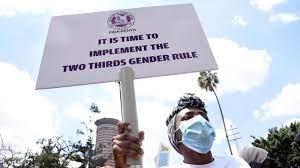
The implementation of the two-thirds gender principle should be understood in the context of the search for broader political inclusion for women. The principle is solidly entrenched in the Constitution of Kenya 2010. This makes its implementation a matter of constitutional compliance and not a choice, since the justification was already debated and settled in the constitution making processes.
The post 2010 experience of getting the relevant law enacted began with a debate on whether the principle should be implemented before or immediately after the first general elections under the new constitution. In this regard, the Constitution of Kenya Amendment Bill of 2011 was drafted to provide for post-election nomination of such a number of women necessary to meet the two-thirds gender principle. This bill lapsed without being debated.
Several legislative proposals requiring constitutional amendments such as the ;The Duale 1 Bill, The Sijeny Bill, The Mutambo Bill, The Chepkonga Bill ; The Duale II Bill,and civil societies approach through courts of law have been in pursuit of the realization of the two-thirds gender rule.
Political parties have concluded primaries and are expeditiously complying with IEBC timelines ahead of the August polls. The commission has indicated that it will reject party lists that do not meet the two-thirds gender rule;
“In the event a political party presents a list of 290 candidates for constituency-based elective positions, not more than 193 candidates can be of the same gender”
“In the event, that a political party presents a list including 47 candidates for county-based positions for Members of Senate, not more than 31 candidates can be of the same gender”
The representation of women in Kenya’s parliament has been and remains minimal. Only 9.8% of the tenth parliament was women, and only 20.7% of the eleventh (sitting) parliament were women making it the lowest in East Africa.
Under-representation of women in positions of power is indefensible; a country simply cannot progress economically, politically or socially without half its citizens participating meaningfully in political spheres and critical decision-making processes.
The Constitution of Kenya readily recognizes women by way of creation of special seats for women that resulted in the election of forty-seven (47) women into the National Assembly, nomination of sixteen women by political parties and one woman representing the youth and persons with disabilities into the Senate and County Governments and appointment of women into other decision-making bodies.
Despite these affirmative action measures, women participation in the 2013 general elections remained very low. There were 19 women candidates for senatorial gubernatorial positions out of 237 candidates. As a result, no women were elected as senators or governors.
Out of the 290 elected National Assembly members, only 16 women were elected, only 5 were nominated out of the 12 positions and 47 County women representatives bringing the total to 68 women out of the 349 seats (19.48%) falling short of 49 of the 117 required for full compliance with the two thirds gender rule.
In the Senate there are 18 women filling the 18 reserved seats under the Constitution (26.8%) which is 6.4% short of the constitutional requirement out of the total 67 seats. In the County assemblies there were not enough women who were elected as County representatives so a gender top up of 600 women were elected across the 1450 County Wards and now are fully compliant with two – thirds gender rule.
Kenya is a nation signatory to various international, regional and sub-regional instruments namely: the Universal Declaration of Human Rights, The Beijing Declaration and Platform for Action, The African Union Protocol to the African Charter on Human and Peoples Rights on the Rights of Women in Africa (Maputo Protocol) and the Solemn Declaration on Gender Equality in Africa, it therefore has no substitute but to uphold these principles and pull up its socks to attain equitable gender representation in the National, Senate and County assemblies.
The Constitution of Kenya 2010, domesticates these commitments to safeguard human rights and fundamental freedoms and entrenches the concept in article 81 (b): “Not more than two thirds of the members of elective or appointive bodies shall be of the same gender” however, the bone of contention since promulgation of the Constitution is the matrix, logistics and formula in ensuring that each House of Parliament is constituted properly .
Further, the Constitution in article 27(8) requires that the State shall take legislative and other measures to implement the principle that not more than two-thirds of the members of elective public bodies shall be of the same gender. To date this provision has not been implemented. The Attorney General on behalf of the Government of Kenya sought direction from the Supreme Court of Kenya through an Advisory Reference dated 8th October 2012. The issue presented before the Supreme Court for direction was whether the enforcement of the two thirds gender principle was realizable immediately or progressively based on articles 27 and 81(b) of the Constitution.
The Kenyan Parliament has witnessed high-level criticism and castigations for failure to enact the relevant legislation following the promulgation of the Constitution. It is salient to note; it is the State that is empowered to ensure that two-thirds of members of all elective and appointive positions are not of the same gender.
As a concept, the State is a form of political community and refers to a conglomeration of various organs. The State should be distinguished from the government which refers to a group of people who are usually in charge of state apparatus.
The various arms of government include the executive, parliament and the judiciary as well as independent constitutional commissions. It is therefore the State as a broad entity that is vested with the obligation to take measures towards ensuring gender parity.
An understanding of the entire law-making process indicates that it is not solely upon parliament to have a law enacted. Bills may originate from anywhere including from the public through petitions for presentation in Parliament, subsequently processed through the house and then finally presented to the President for assent.
The State also refers to the polity or the electorate or the sovereign who are the people. It is incumbent upon the people in exercise of their sovereign will through the ballot to give effect to the constitutional provisions on gender parity by ensuring they vote in their representatives to ensure compliance with respect to elective offices.
It then falls upon the Executive to ensure compliance with the gender parity dictates in appointive offices. A significant part of compliance required with respect to various elective and appointive positions does not necessarily require specific legislation enacted by Parliament. In any case, there is already a guiding theme and broad constitutional principle set out under the supreme law, the Constitution of Kenya 2010.
A good constitution, in and of itself, does not guarantee protection of fundamental rights and freedoms. Whereas the Constitution has altered the legal scene, and embedded gender-sensitive laws, the prescribed minimum threshold for women’s representation is yet to be achieved despite clear constitutional timelines and judicial orders on the same. This can be attributed to impunity, disobedience of court orders and lack of political will towards the goal.
It is important that parliament be fully co-opted into the inclusive philosophy of the constitution that has opened up space for women’s representation in elective and appointive positions.
The low proportional representation of women in political and governance structures across the globe has necessitated the introduction of gender quotas in different countries to remedy under representation.
Kenya has the largest economy and highest GDP per capita in East Africa, but it is the only country in the region yet to establish an affirmative action programme for gender representation in parliament. Political representation of Kenyan women now stands at 20.7%, Rwanda’s 58%, Tanzania’s 36% Uganda and Burundi both at 35%.
Women remain large victims of undemocratic nomination processes and challenges related to; patriarchal culture, electoral violence, gender-neutral laws, first-past-the-post contests, economic exclusions and Influence of international linkages that makes them more vulnerable and marginalized.
Dennis Wendo
Founder- Integrated Development Network
Email: dambehi@gmail.com
Similar Posts by The Mt Kenya Times:
- Mt Kenya Times ePAPER October 26, 2026
- Sakaja challenges Kamukunji police over Eastleigh suspect bail
- Muturi demands binding livestreaming rules for 2027 polls to prevent repeat of 2022 chaos
- NTSA calls for road safety to be declared a national disaster after 24 die in Mtito Andei crash
- Ruku turns on Waiguru over deputy president ambitions: ‘That seat is not being contested for’
About the Author