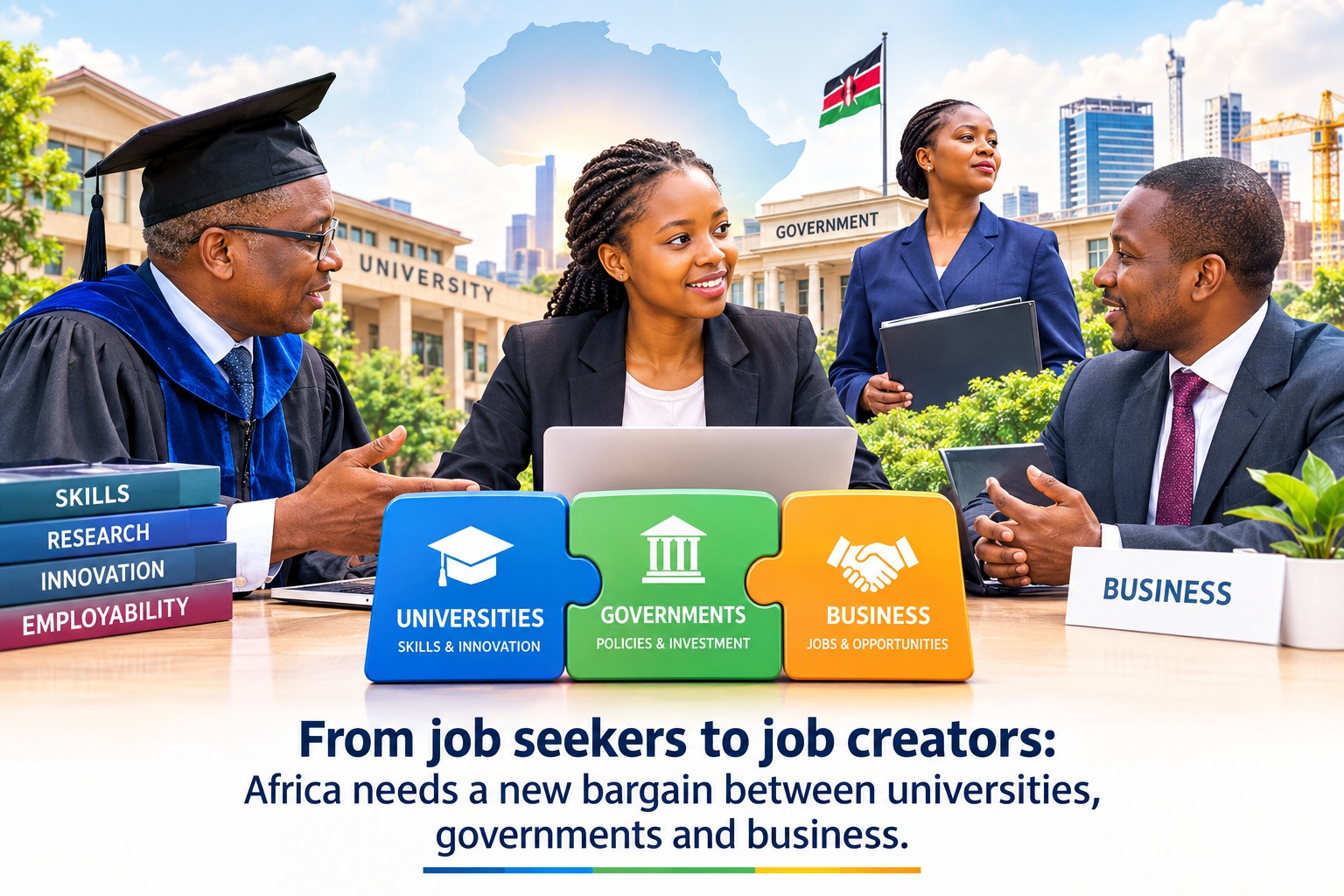
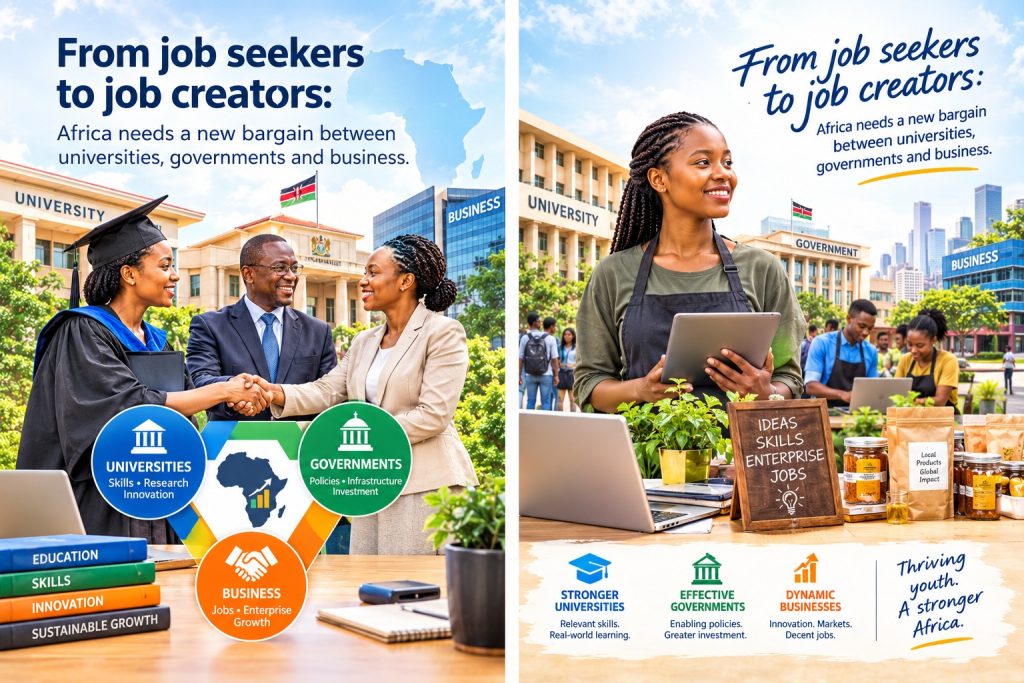
From job seekers to job creators: Africa needs a new bargain between universities, governments and business
 The Mt Kenya Times
Every graduation season, thousands of young Africans leave university with a certificate and one plan: to wait for a job. That waiting must end. Ending it requires universities that teach students to build enterprises, governments that clear the road for them, and a private sector that shares the load.
By Silas Mwaudasheni Nande
The long wait after the gown
Graduation day in Africa is a day of ululation, photographs and pride. Families who sold cattle or borrowed money to pay fees finally see a son or daughter in a gown. Yet for many graduates, the celebration ends at the gate. What follows is a long wait.
The routine is familiar across the continent. The graduate prints copies of a curriculum vitae. Applications go to ministries, regional councils, banks and mines. Weeks become months, and months become years. Meanwhile, the graduate sits at home, often in a village where few formal jobs exist or do not exist at all.
Over time, frustration turns into blame. The graduate blames the government that funded the studies through a loan or bursary, yet had no post to offer. Some ask what the point was of spending public money on training that leads nowhere. Governments, in turn, point to tight budgets and a public service already stretched beyond its means.
This article argues that both sides are asking an incomplete question. The question is not only who will give graduates jobs. It is also who will prepare graduates to create jobs, and who will make it possible for them to do so. The answer involves three actors: the university, the state and the private sector. Each has fallen short in part. Each can do far better.
The arithmetic of a youthful continent
The scale of the problem is not in dispute. In October 2025, World Bank Group President Ajay Banga addressed the Annual Meetings in Washington. He said that 1.2 billion young people will enter the global workforce within the next 10 to 15 years. Only about 400 million jobs, he estimated, will be available to them. He added that Africa will be home to one in four people on Earth by 2050.
The African Development Bank raised the same alarm a decade ago. It adopted its Jobs for Youth in Africa strategy in 2016. At the time, it noted that 10 to 12 million young Africans enter the workforce each year. Only about three million formal jobs were being created annually. That gap has not closed.
The International Labour Organization (ILO) adds an important detail. Its 2024 regional brief covered youth employment in sub-Saharan Africa. In 2023, 21.9 per cent of young people there were not in employment, education or training. In Southern Africa, the share was 34 per cent, the highest of any subregion. The ILO also found that about 72 per cent of young adult workers in the region held insecure jobs.
Southern Africa shows the crisis in its sharpest form. Statistics South Africa reported that the official unemployment rate reached 33.6 per cent in the second quarter of 2026. Among people aged 15 to 34, unemployment rose to 47.4 per cent. Graduates fared better, at 12.4 per cent, but their rate also increased during that quarter.
Namibia, my own country, faces a similar picture. The Namibia Statistics Agency released its 2023 census labour force report in January 2025. It placed national unemployment at 36.9 per cent and youth unemployment at about 44 per cent. In Ohangwena Region, unemployment rose from 33.3 per cent in 2018 to 47.2 per cent in 2023.
These numbers carry a clear message. No African government can employ its way out of this crisis. The public service cannot absorb more than a fraction of new entrants each year. Formal private employers are not growing fast enough either. If young people are to work, many will have to create work for themselves, and then for others.
The loan, the bursary and the blame
Public funding of higher education has opened university doors to millions of young Africans. That is a real achievement. It has also produced a quiet crisis of expectation and debt.
The Namibia Students Financial Assistance Fund (NSFAF) illustrates the problem. In October 2026, The Namibian reported on the latest audit of the Fund by the Auditor General. Former beneficiaries owe the Fund about N$11.7 billion. The Fund recovered N$21.5 million in the 2024/25 financial year, which is less than one per cent of the total owed. Expected credit losses on student loans were put at N$5.34 billion.
Part of this failure is administrative. The same audit found that repayments of N$20.3 million had not been credited to individual accounts. However, much of it reflects a simple reality. NSFAF rules allow repayment to be suspended while a graduate is unemployed or earns below the tax threshold. A graduate who never finds work never repays.
Student organisations have responded by calling for loans to be converted into grants. Their frustration is understandable. Yet the debate misses a deeper point. A loan system built on the assumption of formal employment will keep failing in an economy that does not produce enough formal jobs. A graduate who builds a viable business can repay. A graduate who waits cannot.
The blame placed on governments is therefore only partly fair. Governments did invest in training. What many did not do is ensure that the training prepared graduates for the economy that actually exists.
Universities built for a world of vacancies
Many African universities were shaped by the needs of the state after independence. New governments needed teachers, nurses, accountants, engineers and administrators. Universities supplied them, and the public service absorbed them. The unwritten contract was clear: study hard, graduate and receive a post.
That contract has quietly expired, but the curriculum has not fully adjusted. In many programmes, the assumed destination is still a salaried position. Students learn a discipline in depth. Far fewer learn how to identify a market need, test an idea, keep books, price a product, register a company, raise capital or manage staff.
ILO evidence confirms that the fit between education and work is poor. Its 2024 youth report examined low income and lower middle income countries. There, a tertiary qualification does not protect young adults from underutilisation as it does in richer economies. In those poorer economies, about two thirds of young adult workers hold qualifications that do not match their jobs well. Many are overqualified for the work they find.
Student attitudes reflect this conditioning. The Global University Entrepreneurial Spirit Students Survey (GUESSS) of 2023 gathered more than 226,000 responses from 1,300 universities in 57 countries. Globally, only 15.7 per cent of students intended to found a business immediately after graduation. Five years after graduation, the figure rose to 30 per cent. The survey also found that 58.8 per cent of students had never taken an entrepreneurship course.
The pattern is telling. Many students regard enterprise as something for later, after a spell of employment. In an economy without enough employment, that later moment may never arrive. Universities therefore have a duty to bring it forward.
Can a curriculum create entrepreneurs?
Sceptics will ask whether entrepreneurship can be taught at all. The evidence suggests that education makes a real difference, although it is no magic solution.
In 2022, Zhang and colleagues published a review in the International Journal of Environmental Research and Public Health. They combined the results of 36 earlier studies covering nearly 30,000 students. They found a clear positive link between entrepreneurship education and the intention to start a business. The strength of that link varied with national context.
The authors also noted an important limitation. Every study they reviewed measured students at a single point in time. Intention, moreover, is not the same as action. A student who wishes to start a business may never do so.
This caution matters for policy. It tells us that a single elective in business planning is not enough. What is needed is sustained, practical exposure across a programme of study, followed by real support after graduation. The curriculum must move from teaching about enterprise to teaching through enterprise.
African leaders are beginning to accept this. In February 2026, President Netumbo Nandi-Ndaitwah presented a review of the Namibian youth employment programme to the African Peer Review Forum in Addis Ababa. Among its recommendations was reform of the education system, with a strong emphasis on entrepreneurial development. The task now is to turn that recommendation into concrete curriculum change.
What a job creation curriculum should look like
Six practical shifts would transform the outlook of African graduates.
First, entrepreneurship should run as a compulsory thread through every degree, not sit as an elective in the business faculty. An agriculture student should graduate with a costed plan for a poultry, horticulture or processing enterprise. A nursing student should understand how a private clinic or home care service is financed. An education graduate should know how to run an early childhood centre or a tutoring service. A computing student should have built and tested a digital product with real users.
Second, final year projects should include a venture option. Alongside the traditional dissertation, a student could submit a working business with customers, accounts and a reflective report. Assessment would reward evidence of market testing, not theory alone.
Third, every university should host an incubator with real space, mentors and seed funding. Students should be able to register a company, open a business account and trade while still enrolled. Their ventures would then have two or three years of practice before graduation.
Fourth, work placements should include small businesses, not only ministries and large corporations. A student who spends six months beside a small business owner learns cash flow, customer care and resilience in a way no lecture can teach.
Fifth, lecturers need support. Many academics have never run an enterprise. Universities should bring practising entrepreneurs into the classroom as part time lecturers and mentors. They should also reward staff who build strong links with industry.
Sixth, the curriculum must speak to rural realities. The ILO found that agriculture accounted for about 60 per cent of youth employment in sub-Saharan Africa in 2021. A curriculum that prepares graduates only for city offices ignores where many opportunities in production, processing and services actually lie.
None of this means abandoning academic depth. A good engineer still needs mathematics, and a good teacher still needs pedagogy. The point is to add the capability to turn knowledge into enterprise. Graduates should leave able to seek a job, and able to create one when no job exists.
The other half of the problem: a blocked road
Changing the curriculum is necessary but not sufficient. Many young people already want to start businesses. Their complaint is that the road is blocked.
The barriers are well known. Banks demand collateral that young people do not have. Registration, licensing and tax compliance can be slow and costly. Municipal trading permits are hard to obtain. Public tenders often require years of experience and audited statements that a new firm cannot produce. Affordable workspace near markets is scarce.
International evidence supports these complaints. The World Bank launched its Business Ready (B-READY) report in 2024, covering 50 economies. It found that most economies, particularly developing ones, are not business ready. On average, the economies assessed were only about two thirds ready in the quality of their regulations. They were only half ready in the public services that firms rely on. Only half allowed electronic signatures or electronic identification for online company registration. On average, a business waited 25 days for a decision on a loan application. For a young founder with one customer order and no savings, such delays can be fatal.
Collateral deserves special mention. President Nandi-Ndaitwah reported on the Namibian youth fund in February 2026. She described its removal of the collateral requirement as the end of a longstanding barrier for young entrepreneurs. That statement is significant. It confirms that the old rules of credit kept many young people out of business.
South Africa offers a similar admission. The National Youth Development Agency responded to the latest labour data in August 2026. It listed barriers to entry for smaller firms among the deeper constraints on job creation. It also warned that youth programmes alone will not solve youth unemployment.
What governments must do
 Governments cannot create every job, but they write the rules under which jobs are created. Five reforms would make a large difference.
First, simplify business entry for young people. Company registration, tax numbers, social security registration and municipal permits should be completed online, in one place and within days. Young founders should pay reduced fees, or none, during their first years of trading.
Second, reform public procurement. Governments are among the largest buyers in most African economies. A fixed share of suitable contracts, such as school feeding, cleaning, maintenance and minor works, could be reserved for youth enterprises. Experience requirements for small contracts should be relaxed. Payment must be made on time, because late payment destroys small firms.
Third, finance must match the risk profile of young founders. Namibia has begun this journey. Its youth fund was launched in 2025 with N$257 million for its first financial year. The money flows through the Development Bank of Namibia, AgriBank, NamPost and the Environmental Investment Fund. A guarantee facility from the Namibia Special Risks Insurance Association supports lending without collateral. By February 2026, the President reported that N$62.3 million had reached 140 projects, creating about 722 jobs.
These early results are encouraging. They also reveal the scale of the challenge. Seven hundred jobs are welcome, yet Namibia counts its unemployed young people in the tens of thousands. Such funds must grow, disburse faster and track the survival of the businesses they support. Public reporting should show how many funded firms are still trading after two and five years. Without such data, no one can tell whether the money builds lasting enterprises or short projects. Mentorship must also continue after the loan is paid out, because most new firms fail in their first years.
Fourth, link student finance to enterprise. Loan rules could offer a defined grace period to graduates who register and operate a business. Part of a loan could even be converted into a grant when a graduate builds a firm that employs others. Such an approach would reward job creation rather than simply tolerate unemployment.
Fifth, invest in the foundations. No business can grow without electricity, roads, internet access and water. In his 2025 address, Banga stressed that governments must first build this physical and human infrastructure. Rural graduates in particular need connectivity and transport if they are to reach markets.
The private sector: partner, not spectator
Banga also told the 2025 Annual Meetings that nearly 90 per cent of jobs ultimately come from the private sector. If that is so, business cannot stand aside and complain about the quality of graduates. It must help to shape them, finance them and absorb them.
South Africa offers an instructive model. The Youth Employment Service (YES) was launched in 2018 as a joint initiative of business, government and organised labour. Companies create or sponsor twelve month work experiences for unemployed young people. By the end of 2025, YES reported more than 209,000 work experiences created, with over 1,930 corporate partners. It also reported that 15 per cent of its participants were engaged in entrepreneurial activity. About 45 per cent of its alumni were in employment. These figures come from the programme itself and deserve independent evaluation. Even so, they show what organised business can achieve when it treats youth unemployment as its own problem.
The model works because incentives are aligned. Participating firms gain recognition under the national empowerment framework against which they already report. Young people gain paid experience, skills and networks. Government provides the policy framework without carrying the full cost.
Namibia already has a legal foundation for deeper collaboration. The Public Private Partnership Act of 2017 established a dedicated committee and a directorate within the Ministry of Finance to manage such projects. The Act was designed mainly with infrastructure and public services in mind. Its discipline of shared risk, clear contracts and transparent approval could also serve youth enterprise.
In practice, four forms of cooperation stand out.
The first is supplier development. Large firms in mining, energy, retail and logistics can commit to buying a share of goods and services from youth enterprises. They can also mentor those suppliers on quality and delivery. This is a market relationship, not charity.
The second is jointly funded incubators. Government can provide land, buildings and tax incentives. Universities can provide students, research and staff. Companies can provide mentors, equipment and first contracts. Each partner contributes what it does best.
The third is blended finance. Public guarantees can reduce the risk to commercial banks that lend to young founders. Development finance can absorb the first loss, so that private capital follows. The Namibian guarantee facility is an early example of this approach.
The fourth is curriculum partnership. Industry councils should sit with university senates to review programmes regularly. Employers know which skills are scarce. Entrepreneurs know which markets are underserved. Their insight belongs inside the lecture hall.
The graduate also has a part to play
 A fair analysis must also speak to graduates themselves. Policy can open doors, but someone must walk through them. Many young people have more room to act than the culture of waiting suggests.
A graduate in agriculture can begin with a small vegetable garden, sell to the local school and clinic, and grow from there. A graduate in education can offer weekend lessons to learners preparing for examinations. A graduate in accounting can keep books for the many small shops and taverns in rural towns that have never had proper records. A graduate in information technology can repair phones, build simple websites for local businesses or train villagers in digital skills.
None of these ventures will make a graduate rich in the first year. Each, however, builds a record of trading, a set of customers and a reputation. Those are exactly the assets that lenders, partners and public funds look for. A graduate who has kept accounts for two years has something to show when the youth fund or the bank asks for evidence.
Graduates can also work together. A cooperative of five graduates with different skills can do what no single person can. One produces, another markets, a third keeps the accounts. Pooled savings and shared equipment reduce the risk that each would carry alone.
This is not a call to blame the young for structural failures. It is a call to combine structural reform with personal initiative. Waiting for a letter of appointment is a strategy that the numbers no longer support.
A necessary caution
Not every graduate will, or should, become an entrepreneur. Many new businesses fail. Some young people start enterprises only because they have no alternative. The ILO warns that insecure and informal work remains the norm for young Africans. Encouraging every graduate to sell airtime on a street corner is not a development strategy.
The goal, therefore, is not to replace employment with enterprise. It is to produce graduates who can do both. Some will build firms that employ dozens of people. Others will join those firms. Still others will serve in government and large companies. All of them will be stronger if they understand how value is created.
There is also a risk of shifting blame onto the young. A curriculum cannot fix weak growth, unreliable power or corruption. The South African youth agency made this point plainly: skills must be matched by demand. Universities, governments and businesses must therefore move together. Reform in one sector alone will disappoint.
Conclusion: from waiting to building
The image of the graduate waiting at home must not become the permanent face of African youth. It wastes talent, public money and hope. It also breeds a resentment that can turn into instability.
The way forward requires a new bargain. Universities must condition students, from their first year, to see themselves as creators of value and not only as applicants for vacancies. Governments must clear the road through simpler rules, fairer procurement and finance that does not demand what young people cannot provide. The private sector must become a full partner by opening its supply chains, sharing its expertise and investing alongside the state.
Addressing the African Peer Review Forum in February 2026, President Nandi-Ndaitwah urged fellow leaders not to fail the young people of the continent. That appeal deserves an answer from every lecture hall, every ministry and every boardroom. The next generation of African graduates should leave university not with a list of employers to visit, but with a plan to build.
Silas Mwaudasheni Nande is an educationist and analytical writer based in the Ohangwena Region of Namibia. He is a school principal and a doctoral candidate in Education at the International University of Management (IUM), Windhoek. He writes on African governance, education and public policy.
Similar Posts by The Mt Kenya Times:
- A girl’s dream is the future of society
- Education is the key to success
- BALLOTS, BULLETS AND THE PRICE OF A WARD
- Mt Kenya Times ePAPER October 24-25, 2026
- Muturi calls on IEBC to keep election technology tender clean and on schedule
About the Author