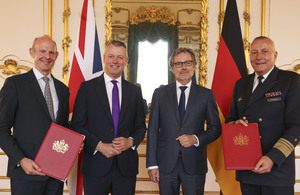
Left to right: National Armaments Director Rupert Pearce; Minister for Defence Readiness and Industry Luke Pollard; German State Secretary for Armament, Innovation and Cyber Jens Plötner; and German National Director for Armaments Vice Admiral Carsten Stawitzki.
By SHAMLAL PURI, Senior Editor & Associate Publisher, in London
The importance of building defence ties between European NATO allies was underscored last week when the UK’s Minister for Defence Readiness and Industry, Luke Pollard, and his German counterpart, State Secretary Jens Plötner joined industry leaders to discuss industrial priorities for collaboration.
The growing threat of never-ending conflict over Europe and the continued attempts of Russia over Ukraine and threats from Vladimir Putin to escalate the war to fit his and Donald Trump’s agenda are forcing many European leaders to think widely about taking steps to maintain their national and regional safety.
The United Kingdom and Germany held a crucial meeting in London last week to strengthen industrial collaboration and advance new technology.
The United Kingdom’s Minister for Defence Readiness and Industry, Luke Pollard, and his German counterpart, State Secretary for Armament and Innovation Jens Plötner, held critical talks at Lancaster House in London.
The latest UK-Germany Ministerial Group on Equipment and Capability Cooperation (MECC) meeting brought together senior officials and military leaders from both nations to review progress on joint defence capability programmes and to deepen the industrial partnership between the UK and Germany, two of NATO’s leading defence powers.
Minister for Defence Readiness and Industry Luke Pollard MP said last Friday: “Germany is one of our closest and most valued defence partners, and today’s talks demonstrate our determination to turn that ambition into real capability for our armed forces and real opportunity for our defence industries.
“As threats to our shared security evolve, the UK and Germany are standing together, strengthening our forces, our industrial bases and our resilience in lockstep.”
Discussions are built on the Trinity House Agreement, signed in October 2024, which sets out an ambitious programme of bilateral cooperation across the air, land, maritime, cyber and space domains.
The agreement sits under the wider Kensington Treaty, signed in July 2025, which provides the strategic framework for the UK-Germany relationship.
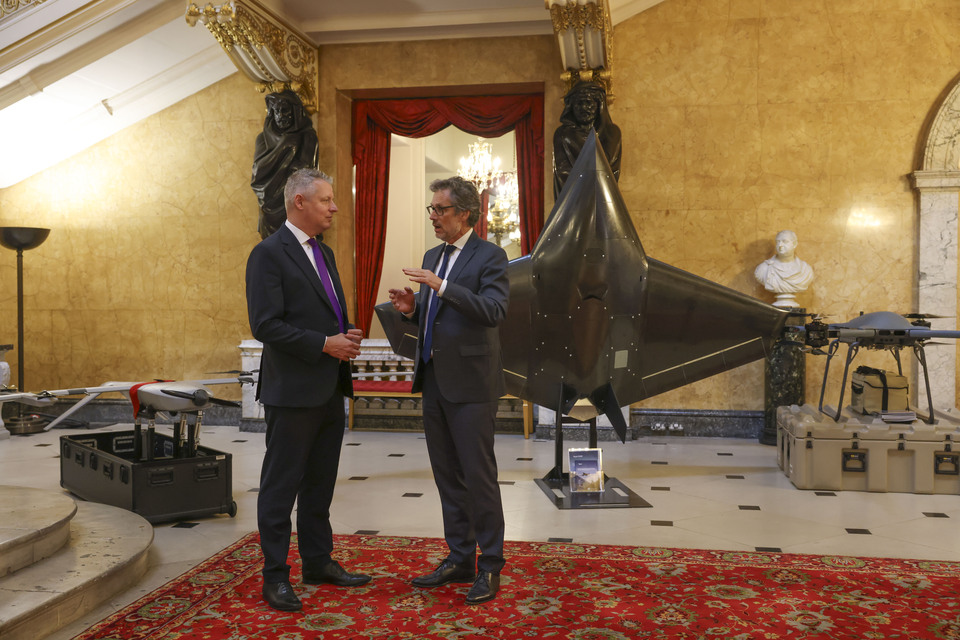
Among the flagship programmes on the agenda was Deep Precision Strike, a joint UK-Germany initiative to develop long-range strike capability, reflecting both nations’ shared ambition to address critical capability gaps and strengthen NATO’s deterrence.
The talks follow Prime Minister Andy Burnham’s visit to Berlin on 8 October, during which the UK and Germany agreed to deepen cooperation in space and establish a new UK-Germany Counter-Hybrid Partnership to strengthen joint resilience against grey-zone threats.
After the MECC meeting, Minister Pollard joined State Secretary Plötner at the German Embassy in London for a panel discussion in which senior policymakers and industry leaders reviewed defence-industrial progress and identified practical priorities for deepening cooperation.
Minister Pollard was joined on the panel by State Secretary Plötner, Dr Philipp Kerth, co-founder and chief executive of German defence technology company Hypersonica, and Alex Zino, Director Business Development & Future Programmes at Rolls-Royce.
The MECC is part of a wider programme of UK-German engagement ahead of the EU-UK summit.
The UK-Germany defence relationship continues to grow as both nations work towards a more resilient Euro-Atlantic security architecture, underpinned by a modern, innovative and competitive defence industrial base at the heart of NATO’s deterrence and readiness.
In another development, Scottish Secretary Douglas Alexander today welcomed the Scottish Government’s decision to match fund the UK Government’s £10 commitment to create two Defence Technical Excellence Colleges (DTECs) in Scotland, as part of a £50 million Scottish Defence Growth Deal.
The DTECs will help provide young people with new specialist pathways into high-skilled, well-paid careers in defence engineering, advanced manufacturing and maritime technology that are coming to Scotland.
The colleges will be located to support Scotland’s defence clusters in the East and West of the country. They will benefit from the engineering and innovation centres previously announced as part of the Scottish Defence Growth Deal.
Scottish Secretary Douglas Alexander said: “In March we announced a £10 million commitment to develop two Defence Technical Excellence Colleges in Scotland. I’m pleased the Scottish Government has now agreed to match-fund these colleges, giving our young people the skills they need to secure high-skilled, well-paid careers in Scotland’s defence sector in the years to come.
“Scotland is a defence industrial powerhouse and is already benefiting from increased UK Government investment as we deliver a defence dividend for Scotland, creating new skilled jobs, new training places and new opportunities for communities while keeping us and our allies secure. We must continue to develop the skilled workforce needed to support this growing sector.
Minister for Defence Readiness and Industry, Luke Pollard MP, said: “Finally matching DTEC funding is welcome news for Scottish careers. The colleges will provide routes into high-skilled, well-paid roles in the defence sector, which is crucial to keeping the UK safe around the clock.
This is an important part of our £50 million Defence Growth Deal – announced back in March – to boost growth opportunities for Scotland that supports our Armed Forces.”
Industry analysis suggests there could be demand for up to 50,000 additional defence jobs across the UK by 2034/35.
Scotland already benefits from over £2.5 billion a year in Ministry of Defence spending, which directly supports 12,200 jobs.
The Scottish Secretary launched the UK Government’s Defence Growth Deal on 12 March, committing £10 million towards the creation of two DTECs — one in the East and one in the West of Scotland — as part of a wider £50 million deal.
The offer remained conditional on the Scottish Government providing match funding.
Scottish Government Innovation Minister Alyn Smith on October 15 confirmed that Holyrood ministers would “partner with the UK Government” on the project.
Similar Posts by Shamlal Puri:
- Prime Minister slams brakes on rip-off charges and car scams
- BRITAIN PLEDGES ‘ROCK SOLID’ SUPPORT TO UKRAINE
- KENYAN HOCKEY LEGENDS HONOURED IN LONDON
- Tourism bonanza for the Middle East: FOUR DAYS WHEN THE WORLD CAME UNDER ONE ROOF IN DUBAI
- LONDON PACKAGING WEEK WITH TOP GLOBAL BRANDS ATTRACTS THOUSANDS OF VISITORS
About the Author