Germany Support For Farming Youth Working Wonders In Kisumu Slums
 The Mt Kenya Times
Daniel Owino Omunga, the Kisumu County Agri-nutrition Officer who has been working with KIYA, says 80,000 youths in the county are unemployed, representing 49.5 per cent of the population. Photo / Elizabeth Angira
By Elizabeth Angira

Amid the narrow backstreets of the bustling Nyalenda, one of the largest informal settlements in Kenya’s third-largest city of Kisumu, a group of innovative youth is rewriting the story of urban slums in Africa and their residents.
Faced with challenges such as unemployment and food insecurity, the youth have transformed unused spaces in the slum in the city on the shores of Lake Victoria into thriving farms through their initiative, the Kisumu Young Agripreneurs (KIYA), a community-organized youth group.
Mr. Roy Odawa, the Group’s team leader and co-founder, says they wanted to create a source of livelihood while addressing the shortage of food amidst rising food prices and environmental challenges affecting their community.
“Farming presented a viable solution, even in a slum like Nyalenda,” says Mr. Odawa.
Established three years ago by a group of 20 youths, the programme aims to combat joblessness and address the impact of rising food prices and environmental challenges posed by climate change.
Urban farming
Food and Agriculture Organization (FAO) says Africa has the world’s fastest growing population, with two-thirds of their inhabitants expected to live in urban areas in the next 30 years.
“And by the next century, Africa and Asia may be home to a total population of 9 billion of the projected 11 billion living on the planet,” says the United Nations agency charged with the task of combating hunger and improving nutrition and food security in the world.

FAO notes, the urban trends in Kenya mirror the global ones with urban dwellers accounting for 31 per cent of the total population, which is projected to rise to 50 percent by 2050.
The UN agency says three cities, Nairobi, Kisumu and Mombasa, accounts for the largest share of urban population in Kenya.
It warns that food insecurity and malnutrition levels are increasingly high especially among the vulnerable groups of the urban poor found in informal settlements.
“In Kenya, approximately 29 per cent of the urban population is considered food poor- meaning they cannot meet their daily calorific requirements based on their expenditure
Turning challenges into opportunities in Kisumu
The youth group, upon identifying suitable vacant plots within Nyalenda for their farming project, they started small but still initially faced challenges, including poor soil quality and limited water resources.
To overcome these, they collaborated with agricultural extension officers who trained them on urban farming techniques like vertical farming, container gardening, and composting.
“We started small, planting vegetables in sacks filled with soil,” says group member Ms. Elizabeth Ojwang’, “It was affordable and required minimal space.”
Yet, as a community, they had to grapple with tonnes of daily produced and mostly uncollected garbage, much of it made up organic waste, which is a constant eye sore in most urban centres across the country.
This is understandable given that the 2021 Food Waste Index Report, which the United Nations Environment Programme (UNEP) and the Waste and Resources Action Programme (WRAP) published, revealed that each Kenyan throw away around 99 kilograms of food per year, contributing to a total annual waste of 5.2 tones for the country.
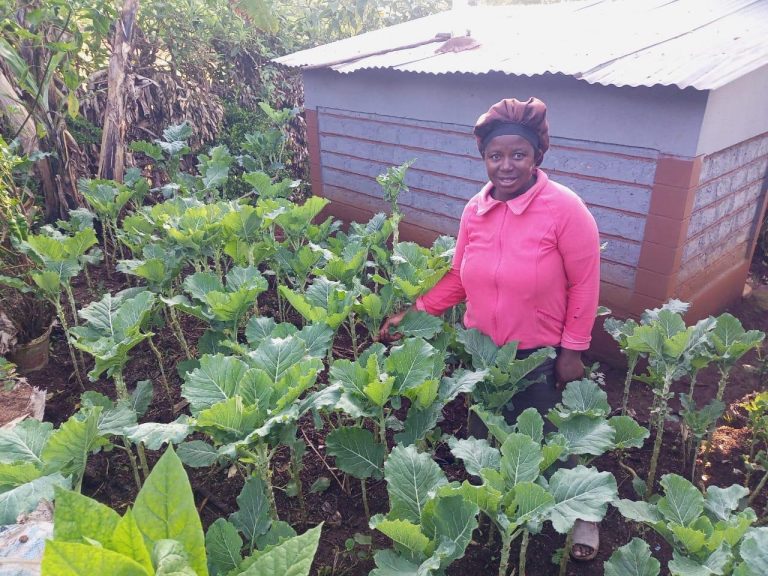
Determined to produce organically grown food, they applied the composting knowledge they learnt from the extension officers to transform organic waste into a good source of soil nutrients, which they have applied in growing African leafy vegetables such as kale, spider plant (saga), spinach, and tomatoes and tubers like cassava.
They have supplemented the growing of crops with raring of poultry, aquaculture, and black soldier fly farming for animal feeds production.
Mr. Odawa says that they have installed a drip irrigation system using recycled plastic bottles, ensuring water efficiency in an area with limited access to clean water.
A Green revolution in Nyalenda

Mr. Odawa says the once barren landscape of Nyalenda has been transformed into lush green spaces.
“We are happy that, as a group, we are supplying fresh, chemical-free produce to households within the slum and neighboring estates,” he says.
Ms. Ojwang, 24,’ says they are happy that they are contributing to better nutrition in the community and its environs.
“We are proud that our vegetables are organic and affordable,” says Ojwang.
The chair says that by engaging the youths in activities such as planting, weeding, and harvesting, the group has tackled unemployment while empowering the young people to embrace agriculture.
“We have trained over 3,000 young farmers, and more than 2,000 have ventured into agribusiness,” says Odawa.
According to the group, they have seen a 60 per cent increase in productivity, thanks to the skills they have gained from Germany government through its development agency, GIZ.
He says that the project has also become an economic lifeline for many in the slum.
“Our youth now see themselves as entrepreneurs,” Ms. Ojwang’ says with pride, “They are solving problems and making money, which keeps them away from destructive behaviors.”
This is a significant step since the World Bank notes that, although the unemployment rate in Kenya is relatively low, at 5.4 per cent, and youth unemployment stands at 8.4 per cent, many jobs are in the informal sector, where stability and pay are lacking.
“Youth unemployment in Kenya poses a significant challenge, with nearly 75per cent of the population under 35 facing limited job opportunities,” it says.
Breeding sustainability in the slum
One of the standout projects under the initiative is a black soldier fly breeding unit.
Ms. Ojwang’ says the organic waste collected from markets and households is fed to the larvae, which rapidly consume the waste and produce nutrient-rich compost
The harvested larvae are processed into animal feed for local poultry and fish farmers.
“With black soldier farming, we are managing waste and creating a sustainable way to grow food,” says Ms. Ojwang’.
The compost produced is applied to crops, ensuring purely organic farming practices.
The group also employs integrated pest management, using plants that naturally repel pests and, therefore, they do not apply any chemicals knowing that such chemicals pose health and environmental risks.
Community impact
Mr. Odawa says the transformation in Nyalenda has inspired other residents to start their own small-scale farms.
This is crucial in Kenya and Africa in general.
“Shockingly, over 20 per cent of the continent’s population, approximately 257 million individuals, are currently suffering from undernourishment,” the World Economic Forum noted in April 2024.
He says that with KIYA’s mentorship, many families have adopted sack gardening, reducing food insecurity in the slum.
“Farming has given us dignity and purpose,” says Mr. Odawa, “It is amazing to see how agriculture can bring hope and change.”
Plans
The group plans to expand into aquaponics and commercial poultry farming. They are also exploring partnerships with supermarkets and hotels in Kisumu to market their produce.
“We dream of making Nyalenda a model for urban farming,” says Mr. Odawa, “If we can succeed here, then it can be done in any urban slum in Kenya.”
They are extending their efforts to public schools.
“We realised that many children do not know where vegetables are produced; most of them think they simply come from the market,” he explains.
Hence, they have identified eight public schools where they plan to set up demonstration farms from January 2025.
These farms will serve as educational hubs, teaching both teachers and pupils the principles and practices of agroecological farming.
Heifer International, the development organization whose goal is to end hunger and poverty, says agriculture is the backbone of the economy in many places, accounting for 25 per cent or more of GDP in several developing countries.
“Engaging youth in agriculture — an available, opportune and essential sector for growth — is critical to strengthening local food systems, feeding communities and providing gainful employment opportunities for the world’s booming youth population,” it says.
Support from Kisumu County
Kisumu County Government has been instrumental in supporting the youth initiative.
Daniel Owino Omunga, the Kisumu County Agri-nutrition Officer who has been working with KIYA, says 80,000 youths in the county are unemployed, representing 49.5 per cent of the population.
“We are proud of this group for training and empowering over 2,000 youths,” says Mr. Omunga.
He says the County has set aside Ksh 50 million as a County Enterprise Fund to support youth agribusiness ventures.
Collaboration with Germany Government through GIZ has also played a crucial role, providing the skills that turned the group into agripreneurs.
Mr. Omunga says the County has significantly reduced its reliance on supplies of African leafy vegetables from other counties, with local production now meeting 50 per cent of the demand.
He says they are part of the team reviewing National Youth Agribusiness Strategy, which will enable the youth to define what they want from both the national and county governments.
“We will support such initiatives through multisector nutrition coordination platform that focuses on nutrition for the children,” he says.
Mr. Omunga hailed the GIZ for coming up with capacity building project of which 30 per cent of its beneficiaries being the youth.
He says KIYA is a good example of resilience and innovation, proving that even in the most challenging environments, young people can create thriving, sustainable livelihoods while addressing pressing social and environmental issues.
Support and partnerships
Mr. Odawa notes that, with the GIZ support, the youth have acquired valuable skills through training.
“They have learned how to produce effectively, maintain proper records, communicate with clients, lease land, and manage various challenges,” he explains.
Similar Posts by The Mt Kenya Times:
- Diaspora Times Global Oct 17 – Oct 23, 2026
- Is social media a blessing or a curse for university students?
- Light at last: How electricity is reshaping Nandi and Uasin Gishu
- The triple squeeze: how EPRA’s fuel price hike is reshaping the survival equation for the common mwananchi
- Zelenskyy accuses Trump of rewarding Putin as Pope pleads for peace from a hospital bed
About the Author