Harambee Stars slump to bottom of AFCON qualifying group after Guinea defeat
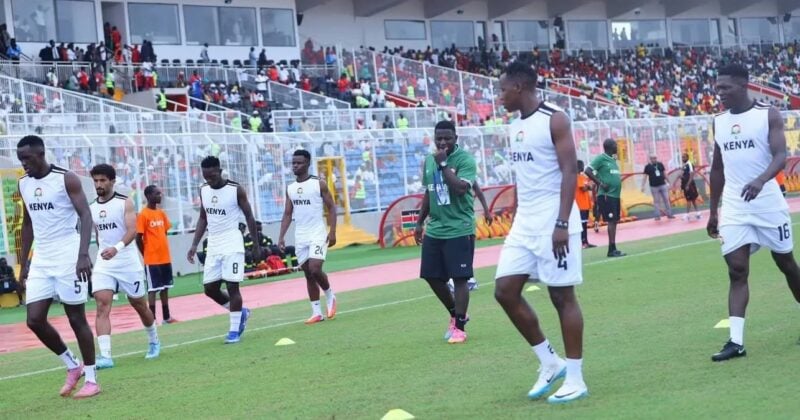
Harambee Stars. Photo/COURTESY
Kenya’s co-host status offers a safety net, but a 1-0 loss in Conakry exposes real problems that will need answers before 2027
By Martin Weche
Harambee Stars sit bottom of Group D in the 2027 Africa Cup of Nations qualifiers after falling 1-0 to Guinea in Conakry on Thursday night, with Serhou Guirassy’s 32nd-minute strike — slotted through goalkeeper Bryne Omondi’s legs — proving the decisive and only difference between the two sides.
It was a painful night for a team that has been building quietly towards what should be a landmark moment in Kenyan football history. Kenya, alongside Tanzania and Uganda, will co-host the 2027 AFCON — a tournament that will bring the continent’s biggest football spectacle to East Africa for the first time. Qualification is therefore already secured by virtue of host nation status, which spares Harambee Stars the existential anxiety that would otherwise accompany a result like this. But safety nets have a way of obscuring real problems, and Thursday’s defeat raised several that coach and fans alike cannot simply wave away.
Guinea’s winning goal came from one of the most recognisable strikers on the continent. Guirassy, who has built a formidable reputation at club level in Europe, needed only half an hour to find his moment — and when it came, the finish was clinical. Omondi, stationed between the posts, was beaten at the near post as the ball rolled beneath him, a goal that will be uncomfortable viewing on the team’s return to Nairobi. The manner of the concession matters as much as the concession itself. Allowing a striker of Guirassy’s quality a clean opportunity from that range reflects defensive organisation that will need urgent attention.
The result sees Guinea move to four points and into second place in the group, behind South Africa who lead the standings. Eritrea sit third on a single point, level with Kenya, who occupy the foot of the table. For a team preparing to welcome the entire African continent as hosts, the optics are uncomfortable — even if the competitive stakes, strictly speaking, are not.
That distinction is worth examining carefully. Kenya’s automatic berth in the tournament removes the pressure of results but does nothing to remove the responsibility of performance. The players who will represent the nation on home soil in 2027 are, by and large, the same players who took to the field in Conakry on Thursday. The tournament is less than a year away. Every competitive minute between now and the opening fixture matters, not for qualification, but for readiness — for the sharpness of organisation, the confidence of individuals, and the cohesion of a team that will need to perform in front of its own people.
There is also a broader point about the value of the qualifying process for a host nation. The temptation, when results go against you and qualification is already in the bag, is to treat remaining fixtures as low-stakes. That temptation should be resisted firmly. Matches against Guinea and, next, South Africa offer precisely the quality of opposition that a team needs to prepare for tournament football. The Bafana Bafana, who lead Group D and represent one of the stronger sides in African football, will provide Kenya’s next examination — an away fixture on 11 November that will be a genuine test of where this squad actually stands.
South Africa, with their technical quality and physicality, are exactly the kind of opponent Harambee Stars need to face before 2027. A competitive, high-intensity qualifier in Johannesburg or Pretoria will tell the coaching staff more about their squad’s readiness than any friendly ever could. The question is whether the lessons from Thursday — particularly in defensive shape and the ability to contain a clinical striker — will be absorbed quickly enough.
Kenyan football has waited a long time for a moment as significant as co-hosting AFCON. The infrastructure investment, the national excitement, and the expectation building around the tournament all demand a team capable of doing the occasion justice. Qualifying results will not determine whether Kenya plays — that is settled. They will, however, shape the form, confidence, and competitive edge of a team that has everything to prove to a home crowd.
Thursday in Conakry was a setback. November in South Africa is the next chance to respond.
Similar Posts by The Mt Kenya Times:
- Garang’s ghost: What South Sudan does with its liberation ideals
- When the teacher breaks: TSC’s quiet battle for mental health in the classroom
- Patel makes history with third African crown
- From menstrual health to AI: Kenya keynote tour puts youth voices at the centre
- The Kenyan paradox: How political elitism and social stratification are mortgaging the ambitions of future generations
About the Author