How Social Media Uses Dark Humour To Criticize The Kenya Kwanza Government


Kenyans in trouble will always react either by speaking or keeping silent. If they do any of the above, Kenyans from other dimensions or regions will also either speak for them or also keep quiet. In their doing of these, they will definitely use humour to spark the discussions surrounding a particular issue. In a letter dated 28th May 2024, “An Open Letter to President William Ruto,” Ngugi wa Thiong’o takes the pain of crafting a sort of a reminder to the president of Kenya, after his visit to the U.S.A. He uses the sitting arrangement symbol where the president of Kenya was sitting on a chair and Biden was standing behind him, his face beaming with satisfaction. This is a pictorial symbolism. Ngugi uses this symbol to lecture president Ruto on historical lessons of Kenya and the black nations across the world, teaching him about the previous massacres such as that of Muammar Gaddafi and reminding him what awaits Kenya. This symbol is a burlesque, a high-end humour.
In Kenya, humour is ubiquitous on social media. We consume this humour from memes on WhatsApp status to posts on Face book and twitter (X) timelines and all those other social media platforms. Humorous content is indicative of independent thinking and creativity, causing contemplation, confronting hegemonic power of the oppressor and challenges fear and apathy. As such, it is a protest action that brings laughter, order and truth closer to the hearts of the people in their real world. This enables humour to reach wider audience even those disinterested in a particular topic.
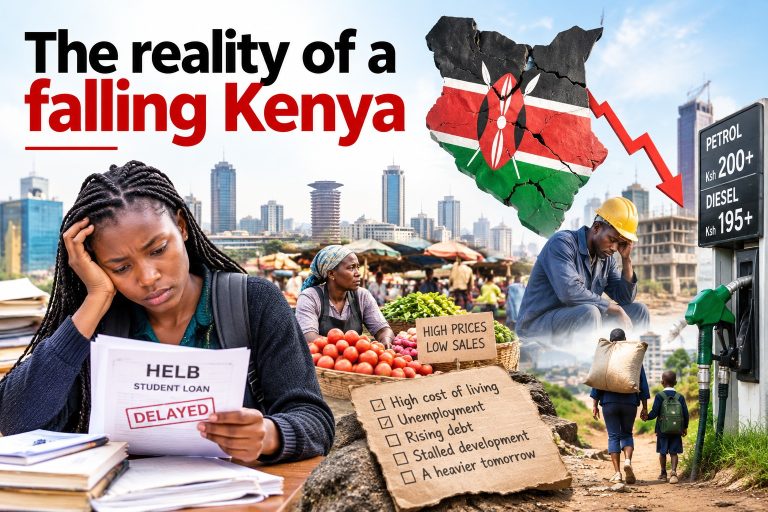
This is a wake- up call that artists, activists and social media influencers are trying to send to Kenyans and especially, the Kenyan government. Many social media influencers have resorted to using dark humour as a way of keeping the government on toes. In the recent times, there have been statements that have been made on social media to criticize the government.
For instance, a statement such as, “I don’t regret selling my grandmother’s wheelchair to buy bundles” is a sarcastic statement. The statement is a critic on the social and economic paradigms of the day today. A wheelchair is supposed to help the needy lame people in their movements but because of the hard economy, it is assumed that it is better to sell such stuffs for one to go to online and see some drama that will make them happy. This hard economy comes amidst what Kenyans believe it is as an aftermath of heavy taxing. In a comic mimic interview of Kafengo posted on face book by the account Mr. KK Mwenyewe on 21st May 2024, the taxes are nonsensical. In the interview, it is asked, “why are you taxing the bread mheshimiwa?” and the answer is, “we are not taxing the bread but we are taxing the paper to discourage importation.” This is dark sarcastic.
In the same interview, the interviewee comments, “we are working very fast and you might not see. You see when we are working very fast things move very fast hwa… hwa… hwa… and that is why the sun is rising in the morning as usual. In the past governments the sun did not rise normally.” Again, this is satirizing the government’s shift of blames.
Many other people have settled on using dark humour in various activities to criticize the government and check on the awareness of the people. This humour is used in skits, plays, drama, videos, posts and comments that are done on social media platforms. Taking the example of Gabriel Oguda on the X app, he is known for his humorous statements while critizing the government. A statement such as “in politics as in science, the arrow points to the eater,” posted on his X on 29th May, 2024, he is alluding to corruption and the predatory nature of politics as it was seen in the alleged fallout between the president and the deputy president.
Yet in another skit, Aineah Nabwera and Victor Namani (Ujinga za Victor) role played P.K Salasya and Atwoli respectively in a visit to a mock Ruto immediately after coming from the United States. In the drama, the two are only given biscuits to take home and for Salasya to take to Parliament. This is symbolic of the ruling government. The skit can be looked at from two different angles. One, Atwoli being the representative of workers, and Salasya being a representative of citizens as a member of Parliament, this could mean that the trip to the U.S had nothing for the workers nor the citizens. Equally, looking at it from the political spectrum, one could analyze it as political theatrics of the different leaders. In the skit, a lady who acts as the first lady firmly says that she only came with prayers from abroad. Here, many Kenyans have referred to the first lady as the praying mantis, a statement that Gabriel Oguda comments, “si hapa umekuja sana.” Which can contextually mean your oversight is welcomed.
When someone does a good job, the humour we use in Kenya is, “they are doing the Lord’s work.” This too is attributed to Oguda. Kenyans have mastered the art of using comedy and activism to help create awareness, a force for change and to remind leaders of the oath of office they took to serve Kenyans.
Through this angle, I argue that the present Kenyan government is the quintessential theatre of absurd. We are led by the obsequious incongruities that need to be checked frequently, not in a very serious manner for fear of severe repercussions but in a manner that is so sentimentally lucrative to their ears. Let Kenyans from all walks of life be encouraged to talk!
By Enos Odero.
Literature analyst and critic
M.A Literature student.
Similar Posts by The Mt Kenya Times:
- Mt Kenya Times ePAPER October 24-25, 2026
- Muturi calls on IEBC to keep election technology tender clean and on schedule
- Ruto meets UAE minister in push to deepen trade ties
- Gideon Moi breaks silence on Ruto fallout, cites broken promises
- The doctor who refused to abandon a sick Uganda
About the Author