The Mt Kenya Times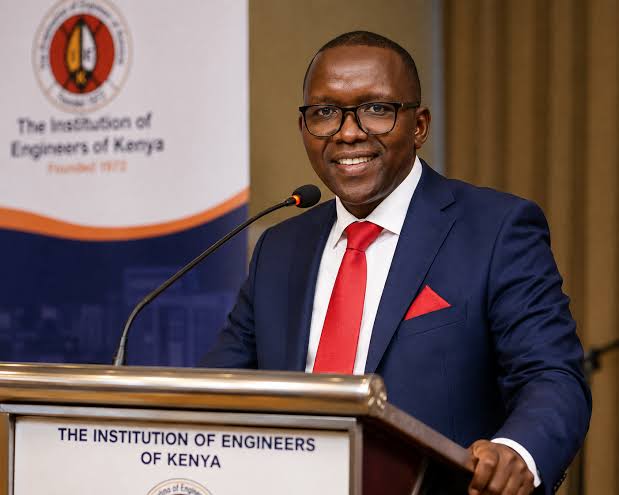
Eng. Harrison Keter
Harrison Keter’s election as Institution of Engineers of Kenya president — on a record 75% turnout and the body’s first electronic ballot — sets the stage for a term that will test whether engineering ambition can be turned into national policy.
By David Nyaga
Eng. Harrison Keter was announced as the president-elect of the Institution of Engineers of Kenya (IEK) on August 4, 2026, following electronic elections held on August 3, 2026 taking over from Shammah Kiteme in what the institution described as the most participatory election in its history.
The vote, conducted electronically for the first time, recorded a turnout exceeding 75%, with more than 2,180 engineers casting ballots. That figure is not merely a statistical milestone. For those who watch the intersection of professional governance and national development, it signals something more substantive: a fraternity that is increasingly restless for reform, keener on accountability, and more determined to have its voice heard in the corridors where economic policy is made.
Keter arrives at the presidency with credentials that are well matched to the moment. He holds a Bachelor of Science in Mechanical Engineering from the University of Nairobi and a Postgraduate Diploma in Geothermal Technology and Utilisation from the United Nations University Geothermal Training Programme. His professional career has been built largely at the Kenya Electricity Generating Company, KenGen, where he serves as Assistant Operations Manager for Geothermal — a role that has placed him at the centre of mega-project design, development, and maintenance in one of Kenya’s most strategically important energy sectors.
In a country where energy transition and renewable technology are central to any credible industrialisation agenda, that specialisation matters. The IEK, under Keter’s leadership, is positioned to shape national energy policy from a place of genuine technical authority rather than institutional proximity alone.
The road to the August 2026 elections was not straightforward. The IEK navigated court-ordered delays arising from disputes over constitutional amendments and graduate voting rights, a period during which Keter served as first vice president and effectively steered the institution through administrative uncertainty. That he managed the caretaker period without fracturing the membership, and delivered a clean, digitally driven election at the end of it, speaks to an administrative steadiness that his supporters argued was the defining reason to back him for the top role.
In his acceptance speech, Keter was direct about what comes first. His pledge to “restore unity and strengthen engagement across our membership” was less a ceremonial flourish than a recognition that the institution emerges from a contested period and needs consolidation before it can project influence outward.
Three priorities have emerged clearly from his campaign manifesto and early policy declarations. The first is workforce development. The bottleneck between graduating as an engineer and becoming a registered professional has frustrated young practitioners for years. Keter has outlined plans to strengthen practical training, expand internship pathways, and deepen collaboration between universities and industry. Central to this will be accelerating the full constitution and operational efficiency of the Engineers Board of Kenya.
The second priority is commercial empowerment. For decades, the capital flowing into Kenya’s infrastructure projects has not flowed proportionately into local engineering firms. Keter’s administration intends to push hard for systemic frameworks that guarantee Kenyan engineers a primary stake in national development work — moving beyond the rhetoric of local content into structural guarantees for local consultants and contractors.
The third is digital transformation. The new council is committed to moving the profession away from traditional methodologies toward Building Information Modelling, digital twins, and automation. The ambition is to position the Kenyan engineer as globally competitive, supported by innovation hubs and applied research rather than left to adapt in isolation.
Keter is joined on the new council by Howard M’mayi as first vice president and Grace Kagondu as honorary secretary — a team whose composition reflects both technical depth and a deliberate focus on institutional renewal.
The record turnout that brought this council to office is, in itself, a form of pressure. Engineers voted in unusually large numbers because they want something to change. Whether it is faster professional registration, fairer access to public contracts, or a stronger institutional voice on matters of national policy, the expectation is real and the mandate is clear.
The true measure of Keter’s presidency will not be found in the manifesto. It will be found in whether the everyday Kenyan engineer — the graduate waiting for registration, the consultant competing against foreign firms, the practitioner trying to keep pace with a rapidly changing industry — feels the difference by 2028.
Similar Posts by The Mt Kenya Times:
- Kingdom Bank charts new path for MSME growth through chamber partnership
- Mt Kenya Times ePAPER September 25, 2026
- Babu Owino’s party predates Linda Mwananchi, clarification shows
- Anglican church tells Kenyans: The country is getting worse and silence is complicity
- Sifuna set for UDP presidential unveiling as Western Kenya bids to field its own candidate
About the Author