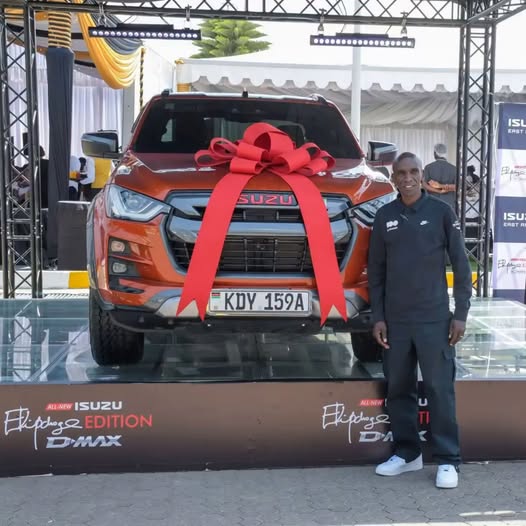
Eliud Kipchoge received the 159th and final Isuzu D-Max Kipchoge
Six years after Vienna, the 159th and final Isuzu D-Max Limited Edition has found its way home — to the man who inspired every single one
By John Irungu Maina
There is a particular kind of elegance in things that come full circle. A story that begins with one man running through the streets of Vienna in the early hours of a October morning and ends with a pickup truck parked in his hands — the last of 159, returned to the person who made all 159 possible.
Eliud Kipchoge received the 159th and final Isuzu D-Max Kipchoge 1:59 Limited Edition, bringing to a close one of the more quietly remarkable chapters in the relationship between sport and commerce in Kenya. It was not a product launch or a press event. It was a conclusion — and a deeply fitting one.
The number 159 has never been arbitrary. It is a direct echo of 1:59:40.2, the time Kipchoge recorded in Vienna on 12 October 2019 when he became the first human being to complete a marathon in under two hours. The achievement was made under controlled conditions — pacemakers, a closed circuit, optimal weather — but nothing about what Kipchoge’s body did that morning was artificial. He ran 42.195 kilometres in one hour, 59 minutes and 40.2 seconds. The world stopped and took note.
Isuzu took note too. In the months that followed, the automaker commissioned a limited production run of 159 specially branded D-Max pickups — each one a tribute to that historic time, each one carrying the 1:59 identity across its badging, its details, and the story attached to it. For three years, those vehicles made their way to customers across Kenya, each purchase a small act of participation in something larger than a car transaction.
The D-Max was a thoughtful choice of canvas for the collaboration. It is a vehicle built around endurance — tough enough for rough terrain, dependable across long distances, and designed to perform in conditions that would expose any weakness. Those are not random qualities. They are the same qualities that define Kipchoge’s career, and the same values he has spoken about publicly for years: discipline, consistency, the refusal to stop when conditions become difficult.
There is a reason Kipchoge has become one of the most quoted athletes on the planet, and it has little to do with marathon times. It is the philosophy behind those times. His training blocks in Kaptagat, his commitment to the group over the individual, his insistence that no human is limited — these ideas have resonated far beyond the running world. They have made him not merely a great athlete but a figure whose story people want to own a piece of. The 1:59 D-Max gave them a way to do exactly that.
The first 158 belonged to those customers. They bought a vehicle, certainly, but they also bought proximity to a moment that mattered. A number on a badge that meant something specific — not a marketing invention, but a real figure from a real morning when a real man did something no one had done before.
The 159th is different. It belongs to Kipchoge himself.
There is something quietly powerful about that arrangement. The man who created the story did not receive the first vehicle off the line. He received the last. The project ran its course, reached its natural conclusion, and the final piece was returned to its origin. It is the kind of symmetry that does not need to be explained — it simply lands.
Kipchoge’s marathon career has been defined by completions. World records set and then broken by himself. Olympic titles defended. The sub-two-hour barrier approached in Berlin in 2018 and then breached in Vienna a year later. Each chapter has built on the one before, and each has added another layer to a legacy that is already extraordinary by any measure.
Receiving the 159th D-Max adds nothing to that athletic record. It does not change his times or his titles. But it closes a loop that began the moment he crossed the finish line in Vienna and Isuzu’s creative team began imagining what a tribute might look like.
A historic time inspired 159 vehicles. Three years of production put 158 of them in the hands of Kenyans who wanted to be part of the story. And now the 159th has come home.
From the streets of Vienna to the roads of Kenya, the number 1:59 has travelled further than any marketing plan could have mapped. It became a moment, then a badge, then a limited-edition vehicle, and finally a symbol sitting in the possession of the man who made it mean something in the first place.
Eliud Kipchoge has completed many circles in his life — on tracks, on roads, in the minds of people who believe that limits are negotiable. This one, modest by comparison but satisfying in its own right, is now complete.
The 159th vehicle has returned to its inspiration.
Kipchoge has completed the circle.
Similar Posts by The Mt Kenya Times:
- My Mother Tongue — The Most Sacred Voice Of My Heart
- General conditions for the development of preschool-age children
- The Poet’s Silence, The World’s Noise: Who Needs Literature Today?
- Polycystic Ovary Syndrome: Diagnostic Challenges And Its Impact On Reproductive Health
- Understanding parentification and its impact on learning
About the Author

 Shamlal Puri