National Assembly Fiancé Committee Meets Lawmakers Over Legislative Proposals
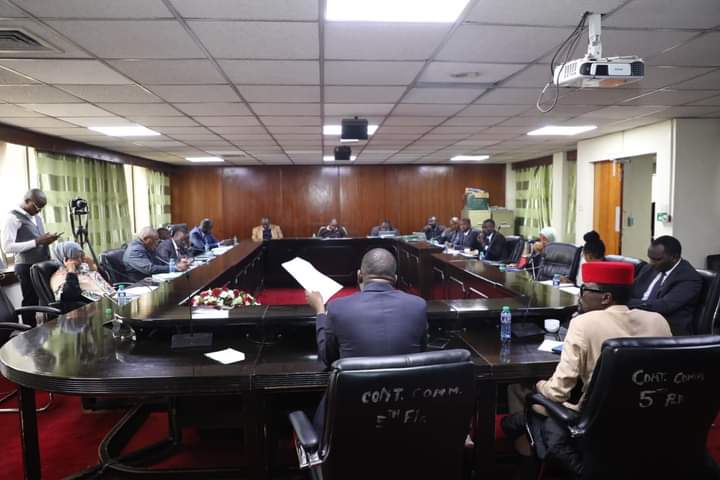
The team during yesterday's session

By PSCU
Worth Noting:
- “Hon. Chairman, Muslims have a right to access credit just like other Kenyans. However, the current banking regulations are not Sharia Compliant. The Islamic faith does not permit faithfuls to access credit where interest is payable,” Farah noted.
- Committee members led by the Chairperson, Kuria Kimani however told the legislator that enacting such a law could potentially open a Pandora ’s Box whereby sections of the society and people of various faiths may seek to also institute provisions that favour their beliefs.
- The members further raised concerns that the only two banks regulated under Sharia Law had remained non-performing with one struggling financially, and the other already put under receivership.
The Departmental Committee on Finance and National Planning yesterday held a sitting to consider legislative proposals under the Committee’s purview. The committee met two lawmakers; sponsors of two of the nine legislative proposals currently before the committee.
First to appear before the committee was Wajir West MP, Yusuf Farah who is rooting for the amendment of the Banking Act to empower the Central Bank of Kenya to make a regulatory framework for Islamic Banking.
The lawmaker argued that there was need for a regulatory framework has become necessary based on the fact that international banks offering Islamic products are keen on breaking into the financial market in Kenya in order to exploit the full potential of Islamic Banking.
Appearing before the Departmental Committee on Finance and National Planning this morning, the lawmaker presented a strong case on the need to stop discrimination on Muslims with regard to access to credit because of their faith.
He told the Committee that the current conventional bank regulations are not Sharia compliant and thus have shut off Muslims from accessing credit alongside other Kenyans.
“Hon. Chairman, Muslims have a right to access credit just like other Kenyans. However, the current banking regulations are not Sharia Compliant. The Islamic faith does not permit faithfuls to access credit where interest is payable,” Farah noted.
Committee members led by the Chairperson, Kuria Kimani however told the legislator that enacting such a law could potentially open a Pandora ’s Box whereby sections of the society and people of various faiths may seek to also institute provisions that favour their beliefs.
The members further raised concerns that the only two banks regulated under Sharia Law had remained non-performing with one struggling financially, and the other already put under receivership.
Members of Parliament John Ariko (Turkana South), Umulkheri Kassim (Mandera County) and Paul Biego (Chesumei) argued that it would be unfair to allow the adoption of such a provision that only favours one religion.
They wondered how the law would ensure that only Islamic faithfuls access this privilege without making discriminatory.
Didmus Barasa (Kimilili) also appeared to defend his proposed amendment to the Commission on Revenue Allocation (Amendment) Bill, 2023.
The lawmaker is proposing to amend the Commission on Revenue Allocation Act, 2021 to provide that the Chairperson and Members of the Commission shall serve on a part-time basis.
The Bill also proposes that the Commission be hosted at the Controller of Budget Offices and that the maximum number of meetings that the Commission can hold in a year be capped at fifteen.
Barasa told the committee that in the wake of run away wage bill, public funds would be saved if the Commissioners were engaged on part-time basis. This is in consideration that the Commission’s mandate as per the Constitution is to make recommendations on the revenue share formula to the Senate.
“The Commissioners do not need to sit from Monday to Friday, January to December while they only make recommendations to the Senate once a year. Faced with high cost of living and with the government employing austerity measures, we need to have the Commission operating part time,” he held.
Members however observed that the proposal to have one Constitutional Commission operate on part-time basis while the others are serving on full-time basis was discriminatory.
They told the member that there is need for him to justify why he has elected to have only two Commissions committed to part-time engagement. Hon. Barasa has also proposed that the Salaries and Renumeration Commission (SRC) also operates on a part time basis.
Having received the legislators’ views,
the committee is now set to engage various stakeholders before presenting its report to the House for consideration.
Similar Posts by The Mt Kenya Times:
- Mt Kenya Times ePAPER August 21, 2026
- Ichung’wah dares ICC: Investigate the opposition too
- Embu elders reject Kindiki endorsement as illegitimate
- Gachagua dares NCIC: Come to Wamunyoro
- Kenya’s electoral clock starts ticking: Inside the 12-month countdown to the 2027 general election
About the Author