Ruto heads to Moscow seeking trade deals and investment as Kenya eyes Russia partnership
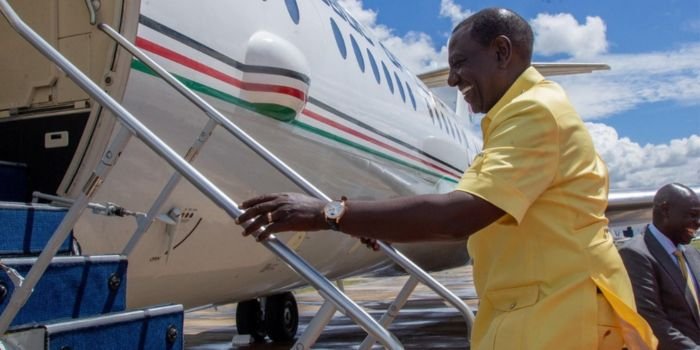
President William Ruto
The President’s visit to the Third Russia-Africa Economic and Humanitarian Forum signals Nairobi’s pursuit of new export markets, technology transfers and strategic alliances beyond traditional Western partners
By David Kimani
President William Ruto departed for Moscow yesterday to attend the Third Russia-Africa Economic and Humanitarian Forum, where he will seek new export markets for Kenyan goods, attract foreign investment and pursue technology partnerships as part of a broader push to diversify Kenya’s international economic relationships.
The visit, confirmed by State House Spokesperson Hussein Mohamed, places Ruto at the centre of a geopolitical moment that carries significance well beyond bilateral trade figures. Kenya’s decision to engage Moscow at this level reflects a calculated foreign policy position — one shared by a growing number of African states — that economic sovereignty requires maintaining relationships across competing global power blocs rather than anchoring exclusively to any single one.
Ruto travels to Moscow wearing two hats. As President of Kenya, he will push for market access for Kenyan tea, coffee, cut flowers, fresh produce and value-added goods. As the African Union champion for the African Continental Free Trade Area, he will advocate for broader African market integration, pressing for commercial frameworks that treat the continent not as a supplier of raw materials but as a producer of finished goods capable of competing on global terms.
The commercial agenda is ambitious. Kenya’s export basket, while diverse by regional standards, remains heavily dependent on a narrow set of markets and commodities. Expanding into Russia and through Russia into Central Asian and Eastern European supply chains would reduce that dependence and provide Kenyan farmers, processors and manufacturers with the price stability that comes from market diversification. Ruto is expected to seek investments in agro-processing, manufacturing, energy and infrastructure — sectors where Kenya has productive capacity but requires capital, technology and reliable off-take agreements to scale.
The technology dimension of the visit is equally significant. Planned engagements around artificial intelligence, digital innovation and technology transfer reflect Kenya’s ambition to position itself as a continental leader in the digital economy. Nairobi’s tech sector, anchored by the Konza Technopolis project and a thriving start-up ecosystem that has attracted significant venture capital in recent years, needs partnerships that provide access to emerging technologies and skills training at scale. Ruto is expected to explore agreements that could accelerate digital infrastructure development and equip Kenya’s young population — the majority of whom are under 35 — with skills relevant to a rapidly changing global labour market.
Food security will also feature prominently. Kenya has faced persistent pressure on agricultural input costs, particularly fertiliser prices, which spiked sharply following the disruption of global supply chains. Securing affordable and reliable agricultural inputs through direct government-to-government agreements would provide Kenyan farmers with greater cost certainty, improve yields and strengthen the country’s broader food security position. Russia, as one of the world’s largest producers of fertilisers and agricultural chemicals, represents a potentially significant supply partner for a country determined to expand domestic food production.
The Africa-Russia Business Roundtable will give Ruto a platform to market Kenya as an investment destination and as a gateway to African markets — a pitch he has made consistently in Washington, London, Beijing and Riyadh. The consistency of the message reflects an understanding that Kenya’s greatest competitive advantage is not simply its own domestic market of 55 million people, but its position as a logistics, financial and commercial hub for a region of several hundred million. Investors who establish in Nairobi gain access not only to Kenya but to East Africa, and through AfCFTA, to an increasingly integrated continental market.
The political dimension of the forum cannot be separated from the economic one. African leaders gathering in Moscow will engage Russia on global peace, regional security challenges and the reform of international governance structures. The African Union’s long-standing call for greater representation in multilateral institutions — from the United Nations Security Council to the International Monetary Fund — will find a sympathetic audience in Moscow, which has its own grievances with the existing architecture of global governance. Ruto and other African heads of state are expected to advocate for equitable partnerships based on mutual respect and sovereign equality, a formulation that signals discomfort with conditionality-laden engagements and a preference for relationships that do not carry political strings.
This diplomatic positioning carries domestic resonance. In a pre-election year — Kenya goes to the polls in August 2027 — Ruto’s foreign policy activism serves a political as well as an economic purpose. Each overseas engagement that yields tangible commitments around jobs, investment or trade reinforces the government’s narrative of economic transformation and international relevance. The Moscow visit, coming after engagements across Europe, North America, the Gulf and Asia, reinforces the image of a president pursuing Kenya’s interests across every available frontier.
Critics will note that the gap between forum commitments and ground-level economic outcomes in Kenya remains wide. Previous high-profile investment pledges have not always translated into operational projects within promised timelines. The government will face scrutiny over whether the partnerships announced in Moscow produce measurable results — jobs created, factories built, export volumes increased — within a timeframe that matters to voters.
On the sidelines of the forum, Ruto is scheduled to meet other heads of state, international organisations, financial institutions and major corporations. These bilateral engagements are often where the most consequential agreements are struck, away from the formal forum proceedings and their diplomatic choreography.
Kenya’s foreign policy has, under Ruto, been defined by an assertive pursuit of economic opportunity wherever it can be found. Moscow is the latest stop on that journey — a journey that will ultimately be judged not by the distances travelled, but by the returns delivered.
Similar Posts by The Mt Kenya Times:
- Mt Kenya Times ePAPER October 28, 2026
- Ruto breaks ground on KSh70B cement plant that will create 3,000 jobs in Kitui
- Ruto orders Magadi soda ash monopoly broken as new investors set to enter
- Waititu begs for mercy as Sh588M corruption sentencing looms
- Roads and electricity bring inclusive growth to Masinga as Ruto launches Ukambani development drive
About the Author